
“Ambulance Life: A Paramedic Simulator” plunges players into the relentless, high-stakes world of emergency medical services, offering an incredibly detailed and often harrowing glimpse into the daily responsibilities of a frontline paramedic. Far from a casual arcade experience, this simulation game, available for Windows and various console platforms, meticulously recreates the urgency of emergency response and the intricate complexities of medical care, challenging players to balance speed, precision, and profound ethical decision-making. Set against the backdrop of the fictional city of San Pelícano, the game distinguishes itself by its commitment to realism, aiming to provide an authentic, albeit intense, portrayal of saving lives under extreme pressure.
From the moment players don their virtual scrubs, they are thrust into a dynamic environment where every second counts. San Pelícano is not just a static map; it’s a living, breathing city divided into three distinct districts: the historic quarters, bustling business areas, and sprawling industrial zones. Each area presents its own unique challenges and a varied array of potential incidents, ranging from commonplace accidents to large-scale catastrophic events. Players must navigate this intricate cityscape, responding to dispatch calls with a critical balance of speed and precision, all while adhering to the highest standards of medical professionalism. This constant tension between rapid response and meticulous care forms the core of the game’s immersive experience, demanding players to think on their feet and adapt to rapidly changing scenarios.

A Deep Dive into Emergency Medical Services
“Ambulance Life: A Paramedic Simulator” is more than just a driving game; it’s an intricate medical simulation that requires players to genuinely engage with the principles of emergency medicine. The initial dispatch call sets the scene, often providing only a brief, frantic overview of the situation. It’s up to the player to interpret this information, plan the quickest and safest route to the scene, and prepare mentally for what awaits them. The journey itself is a mini-game of sorts, demanding players to skillfully maneuver their ambulance through traffic, obeying traffic laws where possible but overriding them when necessary, all while maintaining control of the vehicle under duress. The cityscape is designed with enough realism to make navigation a genuine challenge, complete with unexpected obstacles, diverse road conditions, and the ever-present threat of accidents that could delay critical response times.
Upon arrival at an incident site, the true depth of the simulation unfolds. Players are immediately faced with a scene that can range from a minor fender bender with a single injured person to a multi-vehicle pile-up or an industrial accident involving numerous victims. The first critical step is often scene assessment and securing the area, ensuring both patient and paramedic safety before any medical intervention can begin. This often involves interacting with environmental elements, identifying hazards, and prioritizing initial actions. The visual fidelity of the game, particularly in its depiction of accident scenes, contributes significantly to the immersion, making each incident feel genuinely impactful.
Once the scene is deemed safe, the focus shifts entirely to patient care. “Ambulance Life: A Paramedic Simulator” features an impressive array of medical instruments, each with its specific function and application. Players will utilize stethoscopes to check vitals, oxygen masks to assist with breathing, defibrillators for cardiac emergencies, and a host of other tools that mirror those found in a real paramedic’s kit. The game doesn’t simply automate these actions; it requires players to perform them with a degree of procedural accuracy. For instance, diagnosing a patient might involve a sequence of checks, questions, and instrument readings, building a complete picture of their condition before appropriate treatment can be administered.
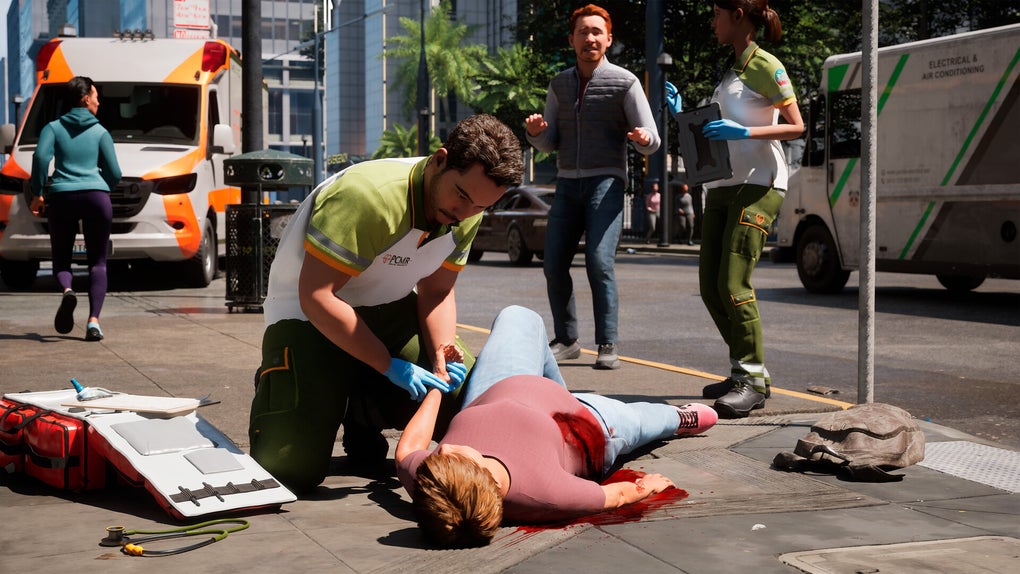
The scenarios presented are far from simplistic. Players must contend with realistic medical complexities, such as managing patient allergies, addressing pre-existing conditions that might complicate treatment, and understanding the nuances of different types of injuries and illnesses. This depth of medical detail elevates the game beyond typical simulators, transforming it into an educational, albeit challenging, experience. Every treatment decision carries weight, directly influencing the patient’s prognosis and the overall success of the mission. For instance, misidentifying an allergic reaction or failing to account for a patient’s heart condition could have dire consequences, reinforcing the game’s strong commitment to authentic medical simulation.
The Art of Patient Care: Tools, Triage, and Tough Decisions
A significant portion of “Ambulance Life: A Paramedic Simulator” is dedicated to mastering the art of patient care, an endeavor that goes far beyond simply applying bandages. The game excels in presenting players with situations that test not only their medical knowledge but also their ability to make swift, sound judgments under immense pressure. Whether it’s a lone victim in a quiet residential street or a chaotic mass casualty event in the heart of the industrial zone, the core principles remain the same: assess, prioritize, and treat.

During routine accidents, players have the luxury of focusing intensely on a single patient. This allows for a more methodical approach, where every symptom can be carefully evaluated, every instrument deployed with precision, and every treatment step deliberated. This phase is crucial for new players to learn the ropes, familiarizing themselves with the game’s detailed medical system, understanding the functions of various instruments, and internalizing the protocols for different medical emergencies. The game provides subtle cues and feedback, allowing players to refine their diagnostic and treatment skills over time.
However, the game truly ratchets up the intensity during catastrophic events. These scenarios are designed to push players to their absolute limits, presenting a cacophony of injuries, multiple victims, and a desperate race against the clock. In such situations, the skill of triage becomes paramount. Players must quickly evaluate the severity of each victim’s condition, allocating resources and attention to those who need it most and have the highest chance of survival. This often involves gut-wrenching moral dilemmas, where difficult decisions must be made about who receives immediate, life-saving intervention and whose treatment might have to wait. The emotional weight of these choices is palpable, as the game makes it clear that every decision directly influences patient survival and overall mission success. This adds a layer of psychological realism that is rare in the simulation genre, forcing players to confront the harsh realities faced by real paramedics.
Classic vs. Simulation: Tailoring the Challenge
“Ambulance Life: A Paramedic Simulator” wisely caters to a broad spectrum of players by offering two distinct gameplay modes: Classic and Simulation. This thoughtful design choice ensures that both newcomers and seasoned simulation enthusiasts can find a challenge tailored to their expertise and preferences.
The Classic Mode serves as an ideal entry point for those new to paramedic simulators or even to the game itself. It provides a more structured and guided introduction, easing players into the complex mechanics of emergency medical services. In Classic Mode, the game might offer more explicit prompts, clearer objectives, and a slightly more forgiving environment for learning. Medical procedures might be streamlined, and the consequences of minor errors less severe, allowing players to build confidence and understanding without being overwhelmed by the full weight of realism. This mode is perfect for practicing fundamental skills, familiarizing oneself with the city layout, and getting a grasp on basic patient assessment and treatment protocols. It allows players to enjoy the core experience of emergency response without the punishing difficulty of its more realistic counterpart.
In stark contrast, the Simulation Mode is designed for experienced players seeking the ultimate challenge. This mode pushes the boundaries of realism, presenting highly detailed medical procedures, complex diagnostic scenarios, and unforgiving consequences for mistakes. In Simulation Mode, players are expected to possess a deep understanding of medical terminology, treatment protocols, and the nuances of human physiology. The game offers minimal hand-holding, forcing players to rely on their accumulated knowledge and keen observational skills. Scenarios are often multifaceted, requiring players to manage multiple complications simultaneously, prioritize efficiently, and execute flawless medical interventions. The pressure is significantly heightened, mirroring the intense, critical nature of real-world emergency medical response. Success in Simulation Mode is not just about completing the mission; it’s about executing it with the precision and expertise expected of a seasoned paramedic, where every choice, every delay, and every misstep can mean the difference between life and death. Both modes, however, share the game’s strong commitment to realism, emphasizing the intense and critical nature of emergency medical response while accommodating different levels of player expertise.
Evolving Realism: Post-Launch Enhancements and Future Horizons
The development team behind “Ambulance Life: A Paramedic Simulator” has demonstrated a commendable commitment to improving and expanding the game since its initial launch. Far from resting on their laurels, they have continuously released multiple updates, patches, and content additions, signaling a long-term vision for the title. These post-launch efforts have been crucial in refining the gameplay experience, addressing player feedback, and enhancing the overall technical and experiential quality of the simulation.
One of the primary focuses of these updates has been bug fixes. In a game as complex and intricate as a medical simulator, unforeseen glitches and technical issues are almost inevitable. The developers have diligently tackled issues reported by players, ranging from minor graphical anomalies to more significant gameplay-impacting bugs, ensuring a smoother and more reliable experience. Alongside bug squashing, numerous quality-of-life changes have been implemented. These improvements, while sometimes subtle, significantly enhance the overall gameplay flow and user experience. This might include tweaks to the user interface for better readability, improved control responsiveness, or more intuitive interaction mechanics.
Visually, the game has also seen significant enhancements. The developers have actively worked on improving the game’s graphics, taking full advantage of modern image enhancement and upscaling technologies. This commitment to visual fidelity means that “Ambulance Life: A Paramedic Simulator” can now achieve enhanced visuals without drastically compromising performance, a crucial balance in demanding simulation titles. Players can expect sharper textures, more realistic lighting, and more immersive environmental details, all contributing to a more believable and engaging San Pelícano.
Beyond technical refinements, the developers have also been continuously working on adding more substantive content to the gameplay, recognizing the technical scope and depth of their subject matter. Recent updates have introduced new types of random events, diversifying the callouts and keeping the experience fresh. A notable addition, for instance, has been gunshot callouts, which introduce new injury types, different patient management protocols, and heightened levels of danger, pushing players to adapt to increasingly violent and complex situations.
The medical system itself, the heart of the simulation, has also undergone continuous refinement. The developers have made specific changes based on medical accuracy and gameplay balance. For example, a recent update replaced Epinephrine with Saline during shock treatment, reflecting a more accurate real-world medical approach in certain scenarios and deepening the medical realism. Furthermore, the game now introduces penalties for untreated patients, adding another layer of consequence and reinforcing the importance of thorough and timely care. Improvements to diagnosis progression mean that the process of identifying a patient’s ailments feels more logical and challenging, requiring players to piece together clues more effectively.
Other notable improvements include better collision physics, making vehicle interactions and environmental damage more realistic and impactful. Tweaked UI scaling for easier readability has made the on-screen information more accessible, particularly for players with different screen sizes or visual preferences. Visual enhancements for lighting and water effects have further contributed to the game’s atmospheric quality, making the city feel more alive and dynamic, whether responding during a sunny day or a torrential downpour.
However, despite these laudable efforts, some aspects of the game still require more attention or are yet to be fully addressed. While performance has seen improvements, there can still be instances of lag during intensive gameplay, particularly in graphically demanding scenarios or during mass casualty events. Optimizing performance further remains a key area for potential future updates to ensure a consistently smooth experience. Another recurring point of criticism has been the low-quality dialogue and voiceovers. In a game that aims for high immersion, generic or poorly delivered voice acting can detract significantly from the realism and emotional impact of critical moments. Improving the quality of spoken lines and character interactions would greatly enhance the narrative and immersive qualities of the simulation, making the patients and dispatchers feel more real and urgent. Addressing these remaining points will be crucial for “Ambulance Life: A Paramedic Simulator” to reach its full potential and truly solidify its position as a leading title in the simulation genre.
The Unvarnished Truth: Addressing Mature Content and Audience Appeal
One of the most distinctive, and perhaps divisive, aspects of “Ambulance Life: A Paramedic Simulator” is its unflinching commitment to depicting the harsh realities of emergency medicine, which includes a significant amount of mature content. This creative decision, while contributing immensely to the game’s realism, also fundamentally shapes its audience appeal and necessitates a clear warning for potential players. The game’s developers have chosen to portray graphic injuries and gore with a level of detail that can be profoundly unsettling for some individuals. This isn’t just about superficial cuts or bruises; it extends to realistically depicted open wounds, severe trauma, and the visceral consequences of accidents and violence.
The inclusion of such graphic content is not gratuitous; it serves a deliberate purpose within the simulation. Paramedics in the real world routinely encounter scenes of extreme injury and bodily harm. By presenting these visually intense scenarios, the game aims to replicate the psychological and emotional pressure that real emergency responders face. It forces players to confront the immediate, often gruesome, aftermath of disasters and accidents, emphasizing the gravity of their mission. This realism makes the challenge of diagnosing and treating patients feel more impactful and the stakes incredibly high. The sight of blood, disfigurement, and the visceral signs of severe trauma contribute to the authentic, high-pressure environment the game strives to create. For players seeking an unvarnished, true-to-life simulation, this level of detail is a key selling point.
Adding another layer to the mature content, the game occasionally features nudity. While not as pervasive as the depiction of injuries, its presence contributes to the overall intense and adult nature of the simulation. This could appear in various contexts, such as patients who have had their clothing damaged in an accident or during medical examinations where privacy is secondary to immediate life-saving care. Like the gore, this element is likely included to enhance the perceived realism of emergency situations, where dignity can sometimes be compromised in the face of medical necessity.
However, it is precisely this commitment to realism that limits the game’s broad appeal. “Ambulance Life: A Paramedic Simulator” is unequivocally not suitable for all audiences. Players who prefer less graphic content, more family-friendly experiences, or simply find realistic gore and nudity disturbing will likely be put off by what the game presents. It’s a game designed for a specific niche: those who are prepared for, and perhaps even seek, the darker, more challenging aspects of emergency response. Parents should exercise extreme caution, and younger players should definitely steer clear. This mature content warning is not merely a formality but a critical piece of information for anyone considering diving into the intense world of “Ambulance Life.” Understanding this aspect beforehand is crucial to ensure that players are emotionally prepared for the immersive, yet potentially distressing, journey that awaits them.
Final Verdict: A Demanding Yet Rewarding Journey
“Ambulance Life: A Paramedic Simulator” stands as a remarkably detailed and immersive experience, offering a compelling journey into the heart of emergency medical services. It meticulously balances realistic medical care with high-pressure, time-sensitive scenarios, creating a simulation that is both challenging and deeply engaging. The game’s comprehensive approach to patient diagnosis, treatment procedures, and the utilization of a wide array of medical instruments ensures that players gain a genuine appreciation for the complexities involved in saving lives. From managing allergies and pre-existing conditions to triaging multiple victims during catastrophic events, every decision carries weight, making for an impactful and intense gameplay loop.
The thoughtful inclusion of two distinct modes — Classic and Simulation — is a significant strength. This design choice effectively caters to players of varying skill levels, ensuring that both newcomers and seasoned simulation enthusiasts can find a tailored challenge. Classic Mode provides a gentle, guided introduction, allowing players to grasp the fundamentals without overwhelming difficulty. In contrast, Simulation Mode offers an uncompromised, highly realistic experience for those seeking to test their medical expertise and decision-making under extreme duress. This flexibility broadens the game’s accessibility, even while its core content remains niche.
Furthermore, the continuous post-launch support from the developers, as documented on resources like PhanMemFree, highlights a dedication to refinement and expansion. Updates introducing bug fixes, quality-of-life improvements, visual enhancements, and new content — such as gunshot callouts and tweaks to the medical system — demonstrate a commitment to evolving the game and addressing player feedback. These ongoing efforts ensure that “Ambulance Life” remains a dynamic and increasingly polished simulation.
However, it is crucial to acknowledge the game’s most significant drawback: its mature content. The depiction of graphic injuries, gore, and occasional nudity, while contributing to the game’s pursuit of realism, can be profoundly unsettling for some players. This intensity limits its appeal to a more specific, adult audience prepared to confront the unvarnished realities of emergency medical response. For players who prefer a less graphic or more family-friendly experience, this aspect will undoubtedly be a deterrent. Additionally, despite ongoing performance improvements, some players may still encounter occasional lag, and the low-quality dialogue and voiceovers detract slightly from the otherwise strong immersion, as noted in various reviews on platforms like Phanmemfree.org.
In conclusion, “Ambulance Life: A Paramedic Simulator” offers a gripping, demanding, and ultimately rewarding simulation experience. It excels in delivering realistic scenarios, detailed medical procedures, and a profound sense of purpose. While its mature content and some lingering technical rough edges mean it’s not a game for everyone, those who are prepared for its unflinching portrayal of emergency medicine will find it to be a deeply immersive and uniquely challenging journey. It serves as a potent reminder of the critical importance and immense pressure faced by paramedics, making every saved life feel like a hard-earned victory.
Pros:
- Highly realistic scenarios and challenging gameplay.
- In-depth medical system and treatment procedures.
- Two distinct game modes (Classic and Simulation) cater to varied player skill levels.
- Continuous post-launch support and content updates.
- Immersive portrayal of a high-pressure profession.
Cons:
- Graphic injuries, gore, and occasional nudity may be off-putting for some.
- Low-quality dialogue and voiceovers detract from immersion.
- Potential for performance dips, despite improvements.
- Not suitable for all audiences due to mature content.
File Information
- License: “Full”
- Version: “varies-with-devices”
- Latest update: “February 12, 2025”
- Platform: “Windows”
- OS: “Windows 11”
- Language: “English”
- Downloads: “1.3K”


