
In the vast and ever-evolving landscape of digital entertainment, some games carve out a niche by offering a distilled, unadulterated dose of arcade action. “Armada Tanks” is precisely one such title, a charmingly straightforward shoot-em-up for Windows that harks back to an earlier era of gaming. Developed by Enkord, this trial version game, available through platforms like PhanMemFree, offers players a chance to step into the treads of an armored vehicle, defending a military base against an endless onslaught of enemy tanks across 60 levels of increasing intensity. While it may appear simple on the surface, “Armada Tanks” delivers a challenging, fast-paced experience that, for better or worse, becomes fiercely demanding as players progress.
“Armada Tanks” occupies a curious space, often likened to a tank-themed reimagining of the classic “Bomberman” formula. This comparison isn’t without merit; like its explosive predecessor, “Armada Tanks” places emphasis on navigating confined maps, strategic positioning, and timed attacks to eliminate all threats. However, instead of setting bombs, players are at the helm of a powerful tank, firing shells to destroy enemy vehicles and various destructible environmental elements. The core objective remains consistent throughout its 60 levels: annihilate every opposing tank that appears on the screen, secure your base, and survive.
Upon first launching “Armada Tanks,” players are greeted with an immediate sense of familiarity, especially if they have any fondness for vintage arcade titles. The game wastes no time with elaborate narratives or complex tutorials; it throws you directly into the fray. This directness is a core part of its appeal, catering to players who appreciate instant action over sprawling epics. The game’s premise is refreshingly simple: you are a lone tank tasked with defending your military headquarters from relentless enemy forces. Each level presents a new tactical challenge, with varying enemy compositions, maze layouts, and environmental hazards that demand quick reflexes and smart decision-making.
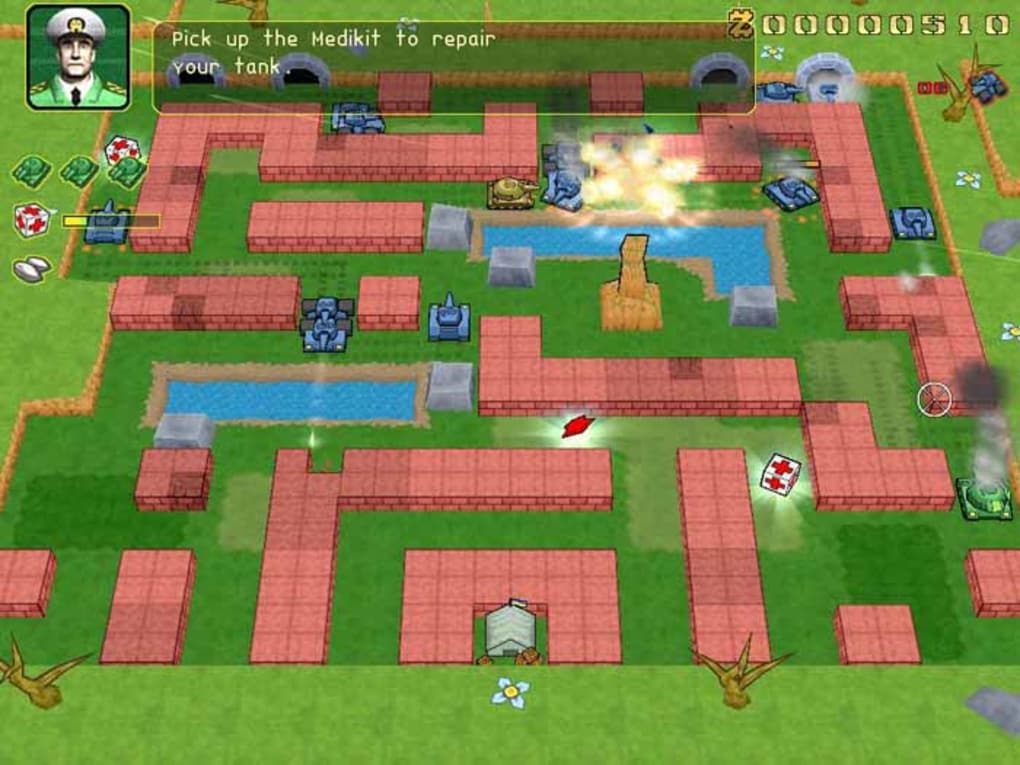
The interface is minimalist, displaying only what’s necessary: your tank, the enemies, the level map, and perhaps a small indicator of your health or score. This uncluttered approach ensures that players can focus entirely on the action unfolding before them. The learning curve for the basic mechanics is almost non-existent, making it highly accessible for newcomers to the genre. However, mastering the nuances of tank movement, shell trajectory, and enemy patterns requires considerable dedication, particularly as the game rapidly ramps up its difficulty. The initial levels serve as a gentle introduction, allowing players to familiarize themselves with the controls and objectives, but this honeymoon phase is notoriously short-lived.
Gameplay at a Glance: Simple Controls, Explosive Action
At the heart of “Armada Tanks” lies its straightforward yet engaging gameplay loop, built upon intuitive controls and a clear objective. Players primarily interact with the game using a keyboard, leveraging the cursor keys for movement. This traditional setup provides a tactile and responsive feel, crucial for navigating the often-tight corridors and dodging incoming fire. Movement is fluid, allowing for precise adjustments to your tank’s position, whether you’re strafing to avoid a projectile or quickly repositioning for a flanking maneuver. The tank’s ability to turn on a dime is a key asset, enabling players to react swiftly to threats emerging from any direction.
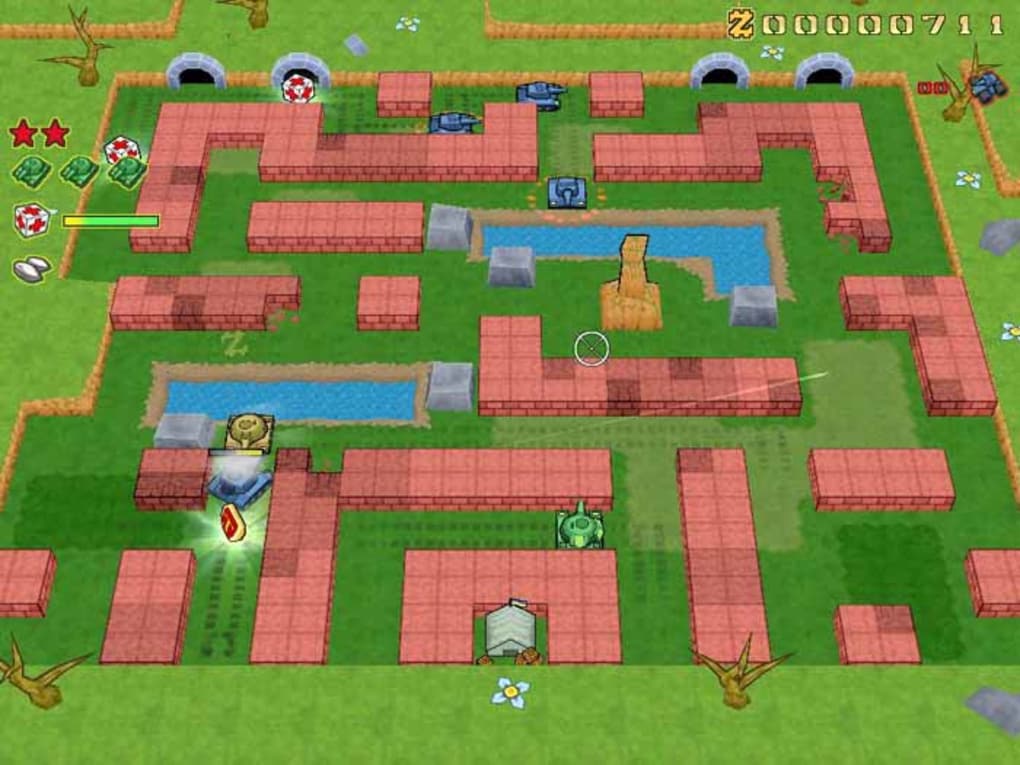
Shooting is equally simplistic, requiring either a press of the “Enter” key or a click of the left mouse button. This dual-input option offers flexibility, allowing players to choose their preferred method for unleashing destruction. The simplicity of the firing mechanism means there’s no complex aiming system or ballistic physics to master; shots travel in a straight line from your tank’s cannon. While this might seem basic, it contributes to the arcade feel, emphasizing quick target acquisition and strategic timing over intricate targeting. The rate of fire, while not excessively rapid initially, is sufficient to engage multiple targets and clear paths efficiently.
The primary objective across all 60 levels is unequivocally to “eliminate and destroy enemies at all costs.” Each map is a contained battle arena, often filled with destructible barriers and obstacles that can be used to your advantage or disadvantage. Players must systematically hunt down and destroy every enemy vehicle that appears on the small, top-down map displayed on screen. These enemy tanks come in various forms, differing in their speed, armor, and firing patterns, providing a dynamic threat that constantly demands adaptation. Some might be slow but heavily armored, requiring multiple hits, while others are nimble but fragile, necessitating quick reflexes to intercept.
What makes the combat engaging, despite its simplicity, is the constant need for tactical decision-making. Should you charge head-on, risking a direct hit? Or should you strategically use cover, peek-and-shoot, and lure enemies into choke points? The maze-like level designs often create natural ambush opportunities or force players into precarious situations, where being surrounded means almost certain destruction. The feedback loop is immediate and satisfying: a well-placed shot results in an explosive visual effect and the satisfying disappearance of an enemy tank. This direct causality between player action and in-game reaction is a hallmark of good arcade design.
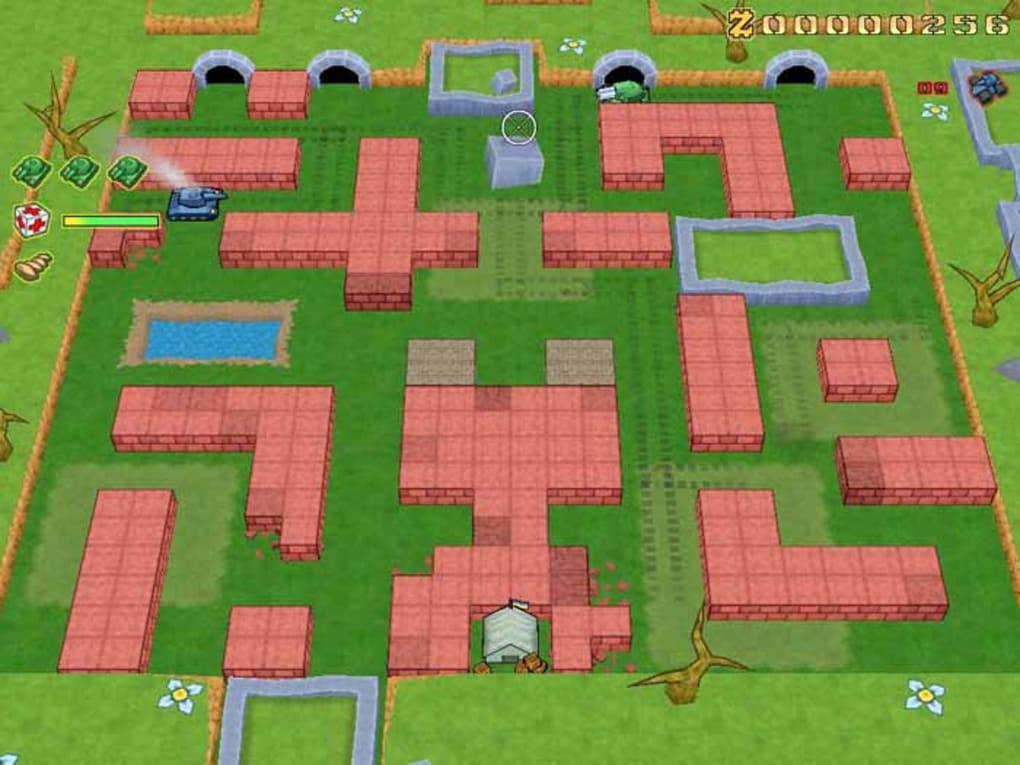
Beyond simply destroying enemies, “Armada Tanks” introduces a layer of resource management through its mission completion rewards. As players successfully clear levels, they earn “money” or credits. This in-game currency is vital for progression, allowing players to purchase upgrades for their tank or acquire new, more potent weapons. This adds a strategic element beyond just raw combat skill, as players must decide whether to invest in improved armor, increased firepower, faster movement, or other enhancements that could turn the tide in later, more challenging levels. The allure of a more powerful tank fuels the drive to keep playing, even when the difficulty spikes dramatically.
The Battlefield: Levels, Upgrades, and Power-Ups
The world of “Armada Tanks” unfolds across 60 distinct levels, each presenting a unique battlefield layout and enemy configuration. These levels are the core challenge, demanding players adapt their tactics to varied environments. Early levels might feature open spaces with minimal cover, emphasizing direct confrontation, while later stages introduce intricate mazes, destructible blocks, and environmental hazards that require more nuanced movement and strategic shot placement. The variety in level design helps to keep the experience from becoming monotonous, constantly forcing players to think on their treads.
As players navigate these battlefields, they’ll discover that completing missions isn’t just about survival and destruction; it’s also about building a stronger, more resilient war machine. The in-game economy, while simple, is crucial. Earning money from completed missions allows players to purchase various upgrades and new weapons. These enhancements are designed to bolster your tank’s capabilities, making it more effective against the increasingly formidable enemy forces. Typical upgrades might include:
- Increased Armor: To withstand more hits before being destroyed.
- Enhanced Firepower: To deal more damage with each shot, or potentially increase the rate of fire.
- Improved Mobility: To increase your tank’s speed, making it easier to dodge enemy projectiles and outmaneuver opponents.
- Special Weapons: Unlocking alternative firing modes or projectile types that could offer tactical advantages in specific situations.
However, a recurring criticism highlighted in the original description is that these “extensions you can buy are not exactly spectacular.” This suggests that while upgrades do exist, their impact might feel incremental rather than transformative. Players might find themselves pouring credits into minor statistical boosts that don’t significantly alter the gameplay experience or provide a decisive edge against the burgeoning difficulty. This can lead to a sense of grinding, where the effort of earning money for upgrades doesn’t always translate into a proportionally easier experience, especially in the later stages. The incremental nature of the upgrades can make the struggle against increasingly tough enemies feel like an uphill battle where your tank is only marginally better equipped.
Adding another dynamic layer to the gameplay are the various power-ups scattered across the battlefield. These temporary boosts appear periodically and can be rolled over by your tank to activate their effects. They offer crucial, albeit transient, advantages that can turn the tide of a challenging encounter. Common power-ups in arcade games of this type often include:
- Invincibility: A temporary shield that makes your tank impervious to all damage, allowing for aggressive pushes or safe retreats. This is particularly valuable when surrounded or facing overwhelming firepower.
- Base Repairs: If your military base is taking damage (a common mechanic in base-defense games), a repair power-up can restore its structural integrity, buying you precious time.
- Increased Fire Rate: Temporarily allows your tank to shoot much faster, unleashing a barrage of projectiles.
- Double Shot/Triple Shot: Equips your tank with the ability to fire multiple projectiles simultaneously, significantly increasing offensive capabilities.
- Speed Boost: A temporary increase in movement speed, useful for dodging or quickly covering ground.
These power-ups introduce an element of risk and reward. Players must often decide whether to divert from their current objective to collect a power-up, potentially exposing themselves to enemy fire, or if the benefit outweighs the danger. Their appearance is often randomized, meaning strategic improvisation is key. A well-timed invincibility pickup can save a mission, while a speed boost can help you flank a stubborn enemy. The fleeting nature of these power-ups means players must make the most of them, maximizing their impact within their limited duration.
Visuals & Sound: A Blast from the Past?
“Armada Tanks” embraces a visual aesthetic that is undeniably retro, leading to the description of its “graphics are very basic.” For some, this simplicity is a nostalgic trip, evoking memories of 8-bit and 16-bit arcade classics. For others accustomed to modern gaming’s photorealism and elaborate special effects, it might appear dated. However, it’s important to understand that “basic” doesn’t necessarily mean “bad”; often, it implies functional design chosen for clarity and performance rather than graphical fidelity.
The game’s visuals are characterized by clean, easily discernible sprites for tanks, projectiles, and environmental elements. The color palette is vibrant but not overly complex, ensuring that enemy tanks stand out against the backdrop. Explosions, while simple, are effective, providing clear visual feedback when an enemy is destroyed. The maze-like levels are constructed from repeating tile sets, which can sometimes lead to a slightly repetitive look, but this also ensures that the player always understands the layout and available pathways. There’s an absence of intricate textures, dynamic lighting, or complex particle effects, all hallmarks of a game designed for broad compatibility and quick, unencumbered gameplay.
This minimalist approach means that “Armada Tanks” is unlikely to strain modern hardware, making it accessible to a wide range of Windows users, even those with older systems. The focus is squarely on gameplay mechanics rather than graphical prowess. For fans of classic arcade titles, this visual style often enhances the experience, contributing to the overall retro charm. It requires players to engage their imagination slightly more, filling in the blanks that hyper-realistic graphics would otherwise provide.
Complementing the visuals is the game’s sound design, which also leans into the arcade tradition. Expect punchy, distinct sound effects for tank movement, projectile firing, and, most importantly, explosions. These auditory cues are crucial for immediate feedback, informing players of successful hits or incoming threats. The background music, if present, is likely to be a high-energy, looping track designed to keep the adrenaline flowing without being overly distracting. While not groundbreaking, the soundscape is functional and effectively supports the fast-paced action. The overall presentation, both visual and auditory, forms a cohesive package that deliberately harks back to the golden age of arcade gaming, prioritizing immediate playability and nostalgic appeal over cutting-edge technology.
The Challenge Ahead: Difficulty and Longevity
One of the most frequently cited aspects of “Armada Tanks” is its steep difficulty curve, particularly “after you’ve done the first five levels.” This isn’t just a minor increase in challenge; it’s often described as a significant spike that can quickly overwhelm unprepared players. The initial levels serve as a deceptive warm-up, allowing players to become comfortable with the controls and basic enemy types. However, this comfort is short-lived.
As players progress, the game introduces a combination of factors that contribute to the escalating difficulty:
- Increased Enemy Numbers: More enemy tanks appear on the map simultaneously, making it harder to manage threats from multiple directions.
- Tougher Enemy Types: New enemy variants with heavier armor, faster movement, or more aggressive firing patterns emerge, requiring more hits to destroy and presenting greater danger.
- More Complex Level Layouts: Maps become more intricate, with tighter corridors, more destructible obstacles that can block your path or vision, and fewer safe zones.
- Faster Projectile Speed: Enemy shots might travel faster, demanding quicker reflexes for dodging.
- Base Vulnerability: The player’s base might become more directly targeted or suffer damage more quickly, adding another objective to defend while engaging enemies.
This rapid escalation in difficulty, coupled with the “unexciting” nature of the purchasable upgrades, can create a frustrating dynamic. Players might feel that their efforts to earn money for enhancements aren’t adequately matched by a corresponding increase in their tank’s power, leading to a sense of being perpetually outmatched. The upgrades, being incremental, might not provide the significant tactical advantage needed to counter the exponential rise in enemy strength and complexity. This means success relies almost entirely on player skill – precision movement, accurate shooting, and strategic enemy prioritization become paramount.
The longevity of “Armada Tanks” is directly tied to a player’s tolerance for this high level of challenge and their enjoyment of pure, unadulterated arcade grind. For those who thrive on overcoming seemingly insurmountable odds, the 60 levels offer a substantial amount of content. Each victory, hard-won as it might be, provides a sense of accomplishment. The simple “destroy all enemies” loop, while repetitive for some, can be deeply engaging for others who appreciate the core mechanics. Replayability comes from the pursuit of higher scores, faster completion times, or simply the satisfaction of perfecting one’s tank combat skills. The randomization of power-up drops also adds a slight variation to each playthrough, forcing on-the-fly adaptations.
However, for players who prefer a more balanced difficulty curve, meaningful progression systems, or a diverse array of gameplay mechanics, the intense challenge and incremental upgrades of “Armada Tanks” might lead to early burnout. The game demands dedication and patience, rewarding persistence with the satisfaction of mastering its unforgiving nature. Its “trial version” status might also influence how players perceive its longevity; after experiencing the first few levels and the subsequent difficulty spike, some might decide whether to invest further time based on their appetite for this kind of intense, skill-based challenge.
Verdict: Is Armada Tanks Worth Your Time?
“Armada Tanks” stands as a testament to the enduring appeal of classic arcade action. It’s a game that doesn’t aim to reinvent the wheel but rather to perfect a specific type of experience: a fast-paced, challenging top-down tank shoot-em-up. Its core mechanics are simple to grasp, making it immediately accessible, but the journey through its 60 levels quickly transforms into a test of skill, patience, and strategic thinking.
Pros:
- Easy to Play, Hard to Master: The straightforward controls ensure that anyone can pick it up, but the escalating difficulty provides a substantial challenge for those seeking mastery.
- Addictive Arcade Loop: The “destroy all enemies” objective, combined with mission rewards and temporary power-ups, creates a compelling, albeit repetitive, gameplay cycle.
- Nostalgic Appeal: For fans of retro arcade games and the “Bomberman” style of tactical destruction, “Armada Tanks” offers a delightful blast from the past.
- Clear Objectives: There’s no ambiguity about what you need to do, allowing players to focus entirely on the action.
- Accessible Trial Version: The ability to try the game via PhanMemFree allows players to experience the core mechanics and initial challenge before committing.
Cons:
- Graphics are Very Basic: While charmingly retro for some, the visual fidelity is undeniably simple and may not appeal to players accustomed to modern aesthetics.
- Upgrades to Tank Not Particularly Exciting: The incremental nature of the upgrades can feel unrewarding, with significant grinding often yielding only minor improvements that don’t dramatically alter gameplay or significantly mitigate the intense difficulty.
- Difficulty Becomes Rather Too High After the Initial Levels: This is the most significant hurdle. The sudden and steep increase in challenge can be off-putting for many players, making progression feel like a chore rather than an enjoyable evolution.
- Repetitive Gameplay: While characteristic of the genre, the core loop can become monotonous for players seeking more varied objectives or deeper narrative engagement.
Ultimately, “Armada Tanks” is a fun shoot-em-up for a specific audience. If you cherish the golden age of arcade gaming, appreciate a stiff challenge that demands skill over flashy graphics, and don’t mind a grind for incremental upgrades, then this game, available through PhanMemFree, might just be the explosive diversion you’re looking for. It offers a pure, distilled tank warfare experience that, despite its limitations, delivers on its promise of relentless action. However, those expecting a modern, visually stunning, or narratively rich experience with a balanced progression system might find its retro charm and unforgiving difficulty a bit too much to bear. It’s a game that celebrates the past, warts and all, inviting players to conquer its challenging battlefields one tank at a time.
File Information
- License: “Trial version”
- Latest update: “July 15, 2022”
- Platform: “Windows”
- OS: “Windows 98 SE”
- Language: “English”
- Downloads: “19.9K”
- Size: “9.83 MB”


