
In an era defined by constant connectivity, our mobile phones have become indispensable tools for communication, work, and entertainment. Yet, for many users, the full potential of these devices remains tethered by carrier restrictions, primarily the infamous “network lock.” This often means that a phone purchased from one service provider cannot be used with a SIM card from another, limiting user choice, impacting travel flexibility, and diminishing a device’s resale value. It’s a common frustration that has spurred a vibrant market for unlocking solutions, and among them, the CIUX Mobile IMEI Unlocker has emerged as a contender, promising to liberate users from these constraints from the comfort of their homes.
This article delves into the intricacies of the CIUX Mobile IMEI Unlocker, exploring its purported functionality, its business model, the user experience it offers, and critically, the mixed reception it has garnered from its user base. We will also contextualize its place within the broader landscape of mobile utilities, security considerations, and the economic advantages it seeks to provide, both for individual users and potentially for businesses.
Understanding IMEI and Carrier Locks
Before dissecting the CIUX Mobile IMEI Unlocker, it’s crucial to understand the fundamental concept it addresses: the IMEI and the carrier lock. IMEI stands for International Mobile Equipment Identity, a unique 15-digit serial number assigned to every GSM, WCDMA, and iDEN mobile phone. Think of it as your phone’s fingerprint – it’s used to identify a specific device on a mobile network, to track stolen phones, and crucially, to enforce network locks.
Mobile network carriers often sell phones at subsidized prices, offering them as part of a contract package. To recoup the cost of the subsidy and ensure customer loyalty, these carriers “lock” the phone to their network. This means that even if a user’s contract obligations are met, the phone might still only function with a SIM card from that specific carrier. This practice is widespread globally, though legal frameworks surrounding it vary. For consumers, this presents several challenges:
- Limited Choice: Users are prevented from switching to a more affordable or better-performing network even after their contract ends.
- International Travel: Roaming charges can be exorbitant. An unlocked phone allows travelers to use local SIM cards, drastically reducing communication costs.
- Resale Value: A locked phone is less attractive to potential buyers, especially those using different carriers, thereby reducing its market value.
- Device Flexibility: Users cannot easily transfer their phone to a family member who uses a different network or repurpose it as a backup device.
The promise of the CIUX Mobile IMEI Unlocker is to circumvent these restrictions, offering a “factory unlock” that theoretically allows a device to be used with any compatible network worldwide.
CIUX Mobile IMEI Unlocker: A Closer Look at the Software
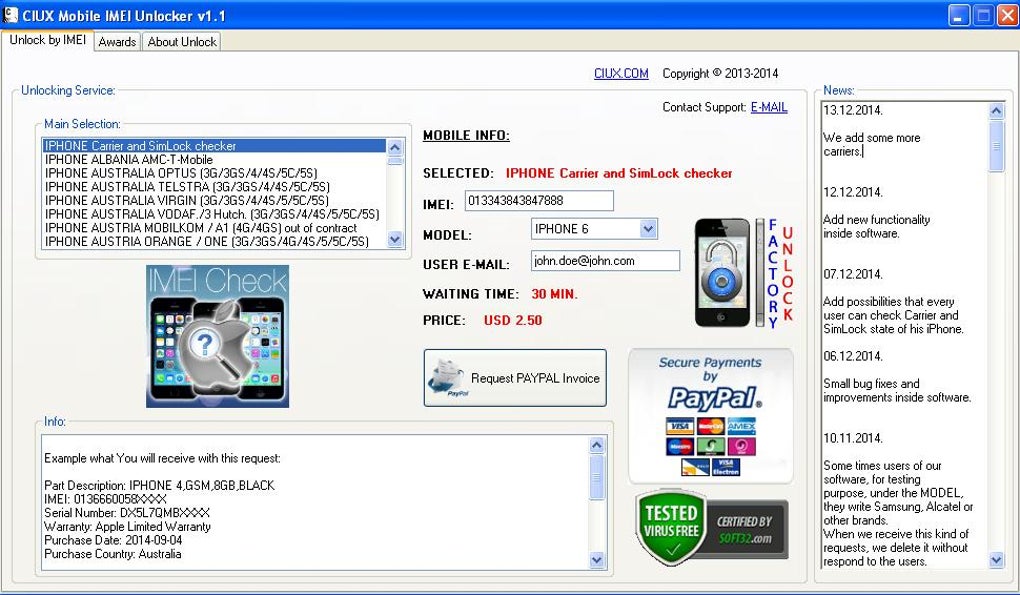
The CIUX Mobile IMEI Unlocker, developed by CIUX Computer Shop and Service, presents itself as a straightforward solution for individuals seeking to unlock their mobile phones without the need for specialized shops or technicians. Available for Windows platforms (specifically Windows XP and later, including Windows 7 for related tools), the software is presented as a free download, with version 6.0.7 being the latest noted update as of October 30, 2024. Its file size is relatively modest at 76.05 MB.
The core functionality, as described by its developers and promotional material, revolves around deactivating the security protocols and mechanisms embedded within a phone that bind it to a single carrier. Users are instructed to download and install the program, open it, and select the “factory unlock” option. Upon successful execution, the software supposedly neutralizes these carrier-imposed restrictions, enabling the phone to accept SIM cards from any network provider.
However, a critical distinction in its business model must be highlighted: while the download and installation of the CIUX Mobile IMEI Unlocker are free, the actual unlocking service itself is not. A fee is calculated and presented to the user after they initiate an unlocking request through the program. The service is only rendered if the user agrees to pay this fee. This “freemium” model is common in software, offering a low barrier to entry while monetizing the core service.
The user interface is described as “not complicated,” though there’s an admission that “it takes a while to understand what options you are selecting.” This suggests a balance between simplicity and potential for user confusion, especially for those less technically inclined.
Stated Pros of CIUX Mobile IMEI Unlocker:
- Convenience: Eliminates the need to visit a physical shop or specialist.
- Accessibility: The software itself is free to download and install.
- Ease of Use (Claimed): Described as “very easy and not very technical” to operate.
Stated Cons of CIUX Mobile IMEI Unlocker:
- Cost: Despite the free download, a fee is required for the actual unlocking service.
- Reliability Issues: It “doesn’t work every time,” implying a degree of inconsistency.
- Compatibility Limitations: The software “doesn’t seem to work for newer phones,” indicating potential struggles with evolving mobile security.
Utilities & Tools: The Core of Mobile Freedom
The CIUX Mobile IMEI Unlocker squarely fits into the broader category of “Utilities & Tools” software. This category on platforms like PhanMemFree typically encompasses applications designed to enhance system performance, manage files, recover data, or perform specialized functions that optimize or extend the capabilities of a device. Within this framework, an IMEI unlocker serves a very specific, yet highly impactful, utility purpose: granting users control over their mobile hardware.
Compared to other utilities like file managers, data recovery tools, or system cleaners, an unlocker addresses a fundamental hardware-software interaction problem. Its utility isn’t about speeding up a phone or organizing files; it’s about altering its core operational freedom. The “do-it-yourself” appeal is strong for users who prefer to handle such tasks independently, avoiding the potential costs, time, or perceived lack of transparency associated with third-party unlocking services or official carrier processes.
Related sub-topics under “Utilities & Tools” that highlight its context include “Phone Utilities,” “Mobile Phone Tool,” and “Unlocker.” These classifications underscore the software’s direct relevance to mobile device management and customization. The appeal of such a tool lies in its promise of empowerment – turning a carrier-locked device into a truly personal and versatile mobile companion. For many, the ability to switch carriers is a significant liberation, making the phone a more adaptable and economically viable asset.
Security & Privacy: Navigating Carrier Restrictions
The act of unlocking a phone inherently involves interacting with its “security protocols and mechanisms” – the very systems designed to enforce carrier locks. This raises significant questions regarding security and privacy. When an application like CIUX Mobile IMEI Unlocker claims to “deactivate” these protocols, it suggests a deep interaction with the phone’s firmware or operating system.
From a user’s perspective, employing such software comes with potential risks:
- Data Security: Any software that interacts deeply with a phone’s core systems could theoretically expose user data or create vulnerabilities if not developed with robust security practices.
- Malware/Adware: The internet is rife with malicious software disguised as legitimate tools. User reviews for CIUX Mobile IMEI Unlocker, as seen on PhanMemFree, contain serious allegations of “VIRUS! DO NOT DOWNLOAD” and the installation of “adware and bloatware.” While some reviews vehemently defend the software as “1000% free of viruses and ads,” these conflicting reports highlight a significant area of concern for potential users. PhanMemFree, as a software repository, plays a crucial role in vetting and ensuring the safety of listed applications, making these user claims particularly important.
- Phone Integrity: Incorrectly or incompletely unlocking a device can potentially “brick” it (render it inoperable) or cause instability.
On the other hand, the security protocols enforced by carriers are primarily for their business interests, not necessarily the user’s data privacy. An unlock doesn’t inherently compromise user data; rather, it bypasses the network restriction. However, the method of bypassing is what dictates the security implications. If the unlocking tool itself is compromised, then the user’s privacy is at risk.
The developer, CIUX Computer Shop and Service, has a responsibility to ensure their software is secure and transparent. The conflicting user reviews on PhanMemFree regarding viruses and adware point to either inconsistent past versions, regional download variations, or simply misinformation. For users, verifying the integrity of any download, especially one that interacts with core phone functions, is paramount. This often involves downloading from reputable sources (like PhanMemFree after its security checks), checking user reviews, and running antivirus scans.
Internet & Network: Enhanced Connectivity and Choice
The primary and most compelling benefit of an unlocked phone, achieved through tools like CIUX Mobile IMEI Unlocker, lies in the realm of “Internet & Network.” By freeing a device from its original carrier’s tether, users gain unparalleled flexibility and choice in how they access mobile networks and the internet.
This enhanced connectivity manifests in several critical ways:
- Freedom to Switch Carriers: The most immediate advantage is the ability to choose any mobile network that offers better plans, superior coverage, or more competitive pricing. This competition among carriers ultimately benefits the consumer, driving down costs and improving service quality. For instance, a user might find a prepaid plan from a different provider that offers more data or cheaper calls, or their current carrier’s service might deteriorate in their area, necessitating a switch. An unlocked phone facilitates this transition seamlessly.
- Global Mobility: For frequent international travelers, an unlocked phone is a game-changer. Instead of incurring exorbitant international roaming charges from their home carrier, travelers can purchase local SIM cards in their destination countries. These local SIMs often provide much cheaper rates for calls, texts, and mobile data, leading to substantial cost savings and a more convenient travel experience. This is especially beneficial for business travelers or expatriates who spend significant time abroad.
- Improved Resale Value: An unlocked phone is a more desirable asset in the secondary market. Buyers are willing to pay a premium for a device that isn’t restricted to a single network, significantly increasing the phone’s resale value compared to its locked counterpart. This economic advantage benefits both the original owner and potentially the new owner, who gains greater flexibility.
- Access to Latest Technologies: In some cases, certain network features or technologies might be exclusive to specific carriers or only work optimally on unlocked devices. While less common, an unlocked phone generally offers a broader scope of compatibility with evolving network standards.
The ability to choose one’s network provider isn’t just a matter of convenience; it’s an economic and practical liberation that enhances the overall value and utility of a mobile device. CIUX Mobile IMEI Unlocker, in its ideal functioning, promises to deliver this crucial freedom to its users.
FOR BUSINESS: Unlocking Potential for Enterprises
The benefits of unlocked phones extend beyond individual consumers, offering significant advantages for businesses, particularly those with a mobile workforce or international operations. The category “FOR BUSINESS” in the reference content underscores the strategic importance of such tools and the flexibility they afford.
For enterprises, managing a fleet of mobile devices can be a complex and costly endeavor. Integrating a solution like CIUX Mobile IMEI Unlocker, or simply adopting unlocked devices, can offer several strategic benefits:
- Cost Efficiency in Mobile Fleets: Businesses often provide employees with company phones. If these phones are locked to a single carrier, the business is beholden to that carrier’s plans and pricing, even if more cost-effective options emerge elsewhere. Unlocked phones allow businesses to procure devices separately from service plans, enabling them to shop for the best corporate mobile plans across various carriers, potentially leading to substantial savings on monthly bills.
- Enhanced International Travel for Employees: For companies with employees who travel frequently for international business, unlocked phones are invaluable. Instead of relying on expensive international roaming packages, employees can use local SIM cards, drastically cutting down on communication expenses while ensuring they remain connected. This not only reduces costs but also improves employee productivity and morale by eliminating communication hurdles.
- Device Lifecycle Management and Flexibility: Unlocked devices offer greater flexibility in device deployment and lifecycle management. When an employee leaves, or a device needs to be reassigned, it can be easily repurposed for another employee, even if they use a different carrier. This streamlines the process of device provisioning and reduces waste, as devices don’t become obsolete simply because of a carrier lock.
- Resale and Asset Recovery: Businesses periodically upgrade their device fleets. Unlocked phones command a higher resale value in the secondary market, allowing companies to recover a greater portion of their initial investment when selling or trading in old devices. This contributes to a more efficient IT budget and better asset management.
- Disaster Recovery and Redundancy: In situations where a primary carrier’s network experiences an outage, an unlocked business phone can quickly be switched to an alternative network using a different SIM card, ensuring business continuity. This provides a valuable layer of redundancy for critical communications.
However, businesses considering such tools must also weigh the potential risks. Reliability, security of the unlocking software, and adherence to legal guidelines regarding unlocking are paramount. IT departments would need to ensure that any third-party unlocking solution used aligns with corporate security policies and provides consistent results across their device fleet.
Analyzing User Experiences: The Reality of CIUX Mobile IMEI Unlocker
The practical efficacy of any software often boils down to real-world user experiences, and the CIUX Mobile IMEI Unlocker is no exception. User reviews on platforms like PhanMemFree offer a mosaic of opinions, ranging from enthusiastic endorsements to scathing denunciations, highlighting the complex reality of such a tool.
Positive Experiences: Several users reported successful unlocks, particularly for older iPhone models. An anonymous user on March 23, 2015, stated, “Working. CIUX IMEI Mobile Unlocker working. True, was stopped for two months, because author primary job, but now working again. And, application is 1000% free of viruses and ads, opposite some unreliable people here saying.” Another user on December 15, 2014, proudly declared, “I unlock my Iphone 4S using this software. Thanks. … Really great that I find this software which factory unlock my device!” Pros mentioned include “easy to use, fast response, big carriers database,” and “fast service, easy use, virus freereliable.” These positive reviews suggest that for some users, under specific conditions (possibly older iPhone models and earlier software versions), the CIUX Mobile IMEI Unlocker delivered on its promise. The mention of it being “stopped for two months” and then “working again full speed” implies periods of development or maintenance challenges for the CIUX team.
Negative Experiences and Concerns: Conversely, a significant portion of the user feedback expressed severe disappointment and warnings. An anonymous user on November 20, 2014, bluntly stated, “It doesnt work!!!. The software doesnt work!!!…be careful…PhanMemFree should review this software and remove it.” More alarming were the reports of malware and unwanted software. On September 30, 2014, a user warned, “VIRUS! DO NOT DOWNLOAD. DO NOT DOWNLOAD IT! BEWARE! AS SOON AS I DTRIED TO DOWNLOAD ADS ADS AND ENDLESS ADS!” Another user on March 3, 2014, described a particularly frustrating experience: “Dont bother, software doesn’t exist, but added adware abd bloatware does… The software doesn’t exist I tried twice to download once the domain was un-available next time it was could not find server, Funny thing,however the attached toolbar, PC optimizer and the default search engine were installed on my PC.Don’t waste your time trying to download this is a rip off of all rip offs.”
Reconciling the Contradictions: The stark contrast in reviews can be attributed to several factors:
- Time and Version Dependence: Software evolves. Early versions might have been more effective or less problematic. The “stopped for two months” comment suggests periods of instability or changes in the software’s functionality or availability.
- Phone Model and OS Version: The software explicitly states it “doesn’t seem to work for newer phones.” As mobile operating systems and security features advance, older unlocking methods become obsolete. The success for iPhone 4S users suggests a compatibility sweet spot for older devices.
- Source of Download: While PhanMemFree aims to provide safe downloads, the internet is vast. Users might have downloaded compromised versions from unofficial sources, leading to adware or virus infections.
- Developer’s Business Practices: The claims of bundled adware/bloatware, if true, point to aggressive monetization tactics that can severely detract from user experience and trustworthiness. The developer’s reputation plays a crucial role here.
- User Expectations and Technical Skill: The interface being “not complicated but it takes a while to understand what options you are selecting” could lead to user error and perceived failure if options are misunderstood.
Ultimately, the user reviews paint a picture of a tool with a checkered past and inconsistent performance. While it might have provided a valuable service to some users with older devices, the serious allegations of non-functionality, viruses, and bloatware cannot be ignored by prospective users.
Beyond CIUX: Exploring Alternatives and Best Practices
Given the mixed reviews and inherent risks associated with third-party unlocking software, it’s prudent to consider alternatives and best practices when seeking to unlock a mobile phone:
- Official Carrier Unlock: This is universally considered the safest and most reliable method. Most carriers offer unlocking services once contract obligations are fulfilled or a device is fully paid off. The process is typically straightforward, often initiated through a customer service request, and results in a permanent, legitimate unlock that doesn’t void warranties or compromise device security.
- Reputable Third-Party Unlocking Services: Several legitimate third-party services specialize in providing unlock codes or remote unlocking services. These services often leverage official channels or databases and typically offer guarantees. When choosing such a service, thorough research, checking independent reviews, and verifying their track record are essential.
- Legal Considerations: The legality of phone unlocking varies by region. In some countries, it’s freely permitted; in others, there might be specific rules or waiting periods. Users should be aware of the laws in their jurisdiction. In the US, the Unlocking Consumer Choice and Wireless Competition Act of 2014 made it legal for consumers to unlock cellphones, with some stipulations.
- Warranty and Support: Using unofficial unlocking software may void a phone’s warranty. If issues arise post-unlock, official support might be denied. This is a critical factor for newer devices.
- Security Software: If opting for any third-party software, ensure your computer has robust antivirus and anti-malware protection. Always download from trusted platforms like PhanMemFree and exercise caution with any prompts for additional software installation.
Conclusion
The CIUX Mobile IMEI Unlocker represents a segment of the software market that caters to a pervasive consumer desire: freedom from carrier restrictions. Its promise of a free-to-download, easy-to-use solution for “factory unlocking” phones from home holds significant appeal. Its stated compatibility with Windows and its focus on deactivating security protocols offer a glimpse into its technical approach. The potential benefits for both individual users seeking greater choice and businesses managing mobile assets are clear, ranging from cost savings to enhanced flexibility in connectivity.
However, the journey of CIUX Mobile IMEI Unlocker, as reflected in user feedback on PhanMemFree, is one of mixed success and significant controversy. While some users reported successful unlocks for older iPhone models, particularly when the software was actively maintained, others faced non-functionality and alarming claims of malware and bloatware. The developers’ response to these issues and the evolution of mobile device security protocols have undoubtedly shaped its effectiveness over time.
For anyone considering CIUX Mobile IMEI Unlocker today, it’s crucial to proceed with extreme caution. The unreliability with “newer phones,” the necessary payment for the actual service, and especially the persistent allegations of security risks, mean that users should heavily weigh these factors. While the allure of a DIY solution is strong, the safest and most recommended path to unlocking a phone remains through official carrier channels or through highly reputable third-party services, ensuring both security and sustained device functionality. The story of CIUX Mobile IMEI Unlocker serves as a potent reminder that in the world of software utilities, convenience must always be balanced against reliability and the paramount importance of security and privacy.
File Information
- License: “Free”
- Latest update: “October 30, 2024”
- Platform: “Windows”
- OS: “Windows XP”
- Language: “English”
- Downloads: “216.1K”
- Size: “76.05 MB”


