
In the expansive landscape of web development tools, the CoffeeCup HTML Editor has carved out a significant niche for itself, standing as a testament to endurance and innovation since its inception in 1996. Developed by CoffeeCup Software, this premium editor for Windows PCs offers a comprehensive suite of features designed to streamline the website creation and editing process. It caters to a wide spectrum of users, from nascent coders taking their first steps into HTML to seasoned web developers and designers crafting intricate online experiences. At its core, the CoffeeCup HTML Editor promises an environment where coding is not just a chore but an intuitive, faster, and more engaging endeavor, all while maintaining a sleek and user-friendly interface that even newcomers can navigate with ease.
What sets the CoffeeCup HTML Editor apart in a crowded market—filled with robust alternatives like Atom, Brackets, and Notepad++—is its unique modular architecture. Unlike many all-encompassing integrated development environments (IDEs) that come laden with features some users may never touch, CoffeeCup is built on a remarkably fast and lightweight base. This design philosophy empowers users to customize their toolkit by adding specific functionalities through various “packs” as needed, ensuring that their workspace remains lean, efficient, and tailored precisely to their workflow. This initial flexibility, however, comes with a specific pricing model, positioning it as a premium option for those seeking a specialized and adaptable development experience.
The Dual Power of CoffeeCup HTML Editor: Code and Visual
The true versatility of the CoffeeCup HTML Editor lies in its ingenious “two editors in one” approach, offering a powerful blend of granular control for HTML veterans and intuitive simplicity for visual designers. This dual functionality is not merely a convenience but a strategic design choice that accommodates diverse skill sets and accelerates the web development lifecycle.
On one hand, the Code Editor stands as a sophisticated environment that has set the standard since the mid-90s. For those who live and breathe HTML, CSS, and JavaScript, this editor provides the precision and depth required for complex web projects. While the reference content doesn’t explicitly list features like syntax highlighting or auto-completion, these are standard expectations for an editor of this caliber, allowing developers to write clean, error-free code more efficiently. The Code Editor is where the true craft of web development happens—where every tag, attribute, and script is meticulously placed and refined. It supports learning and mastering HTML, providing an unvarnished view of the underlying structure that powers every website. Developers can appreciate the powerful features that facilitate organization, validation, and debugging, ensuring that the final output adheres to web standards and best practices.
Conversely, for those who prefer a more immediate, visual approach, or who need to rapidly prototype designs without diving deep into markup, the WYSIWYG (What You See Is What You Get) Visual Editor is a game-changer. This drag-and-drop interface allows users to manipulate web elements directly on a canvas, much like designing in a desktop publishing application. The beauty of the WYSIWYG editor is its ability to instantly render changes, providing real-time feedback on how the page will appear in a browser. This functionality is invaluable for designers focused on layout, aesthetics, and user experience, enabling them to bring their creative visions to life without constantly switching contexts or manually tweaking code. It democratizes web design, making it accessible even to those with limited coding knowledge, allowing them to create professional-looking pages with remarkable speed.
The true genius of the CoffeeCup HTML Editor is the seamless integration between these two modes. Users can “go back and forth between the Code and Visual Editors to create remarkable Websites in a snap.” This synergy means a developer can lay down a basic structure in the Code Editor, switch to the Visual Editor to arrange content and design elements, and then jump back to the Code Editor for fine-tuning CSS or adding interactive JavaScript. This fluid workflow optimizes productivity, allowing users to leverage the strengths of each editor depending on the task at hand. It caters to a dynamic development process where both precision coding and rapid visual iteration are equally important.
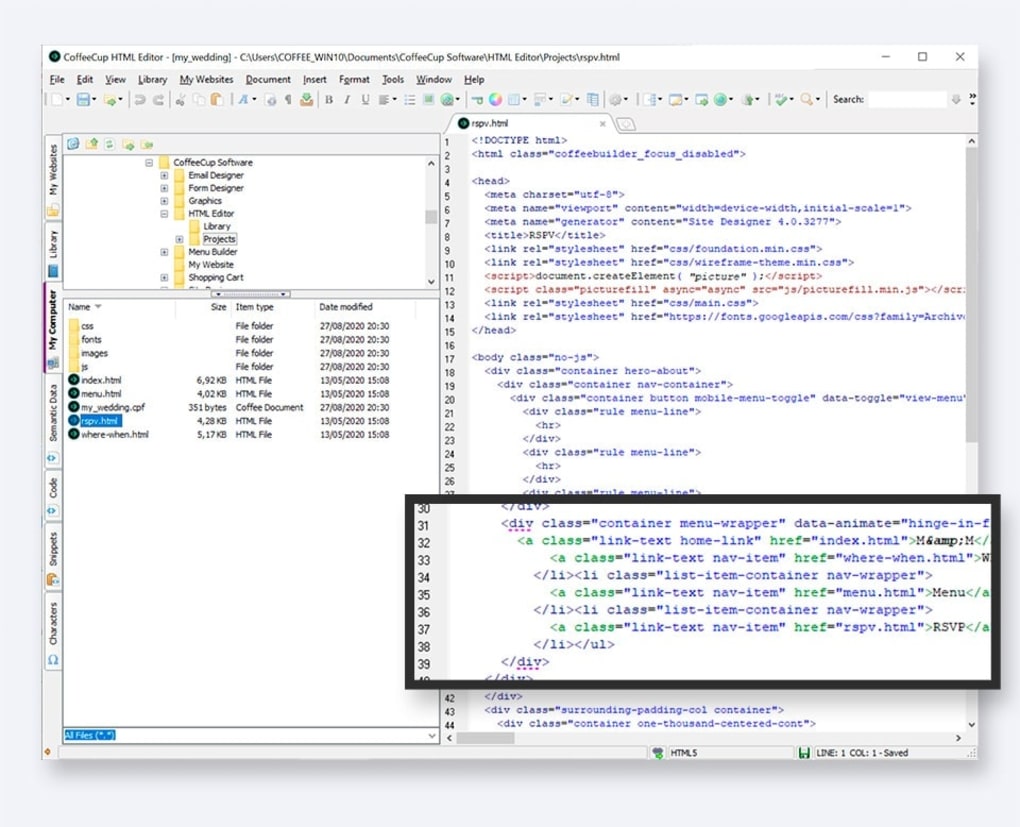
Beyond these core editing modes, CoffeeCup HTML Editor integrates a rich array of tools that enhance design and functionality. It comes loaded with “more than 100 DHTML & Javascripts,” providing ready-to-use interactive elements that can elevate a website’s user experience. A dedicated “DHTML Menu wizard” simplifies the creation of sophisticated navigation systems, a critical component for any modern website. For visual assets, users gain access to a treasure trove of “25,000 Graphics and Photos including over 1,000 XP Style Icons,” significantly cutting down on the time and cost associated with sourcing visual content. Furthermore, the editor offers access to “Free Website Templates,” serving as excellent starting points for various projects. Practical utilities like “Built-in FTP Uploading” eliminate the need for external FTP clients, allowing users to publish their creations directly from the editor. Dedicated and “easy to use Table, Frame, Font, and Form Designers” further simplify common web design tasks, ensuring consistency and ease of implementation. Finally, the “exclusive Split Screen preview” is an indispensable feature, offering real-time visualization of code changes without leaving the editing environment, ensuring that designers and developers always know exactly how their work will be rendered.
Modular Design and Feature Packs: Tailoring Your Development Experience
One of the most distinctive and forward-thinking aspects of the CoffeeCup HTML Editor is its modular design philosophy. In an era where software bloat can often hinder productivity, CoffeeCup Software has opted for an approach that prioritizes a lean core and allows users to selectively enhance functionality through specialized “packs.” This strategy directly contrasts with many competing editors or IDEs that often come as monolithic applications, packed with features that a specific user might never utilize, thereby consuming unnecessary system resources and potentially cluttering the user interface.
The promise of CoffeeCup’s modularity is a “fast and lightweight base.” This means the core application is designed for speed and efficiency, ensuring quick launch times and smooth operation, even on systems with more modest specifications. Users then have the freedom to add capabilities precisely as they’re needed, ensuring that their development environment is always optimized for their current project without any superfluous overhead. This bespoke approach empowers developers to construct an editor that is perfectly aligned with their specific workflow and project requirements.
CoffeeCup offers several distinct Packs, each designed to address a particular facet of web development:
- Sites Pack: This pack is fundamental for anyone looking to create and manage websites. It provides the essential tools and enhancements required for comprehensive site building, from managing multiple pages and assets to ensuring overall site structure and navigation are robust and well-organized. It’s the go-to for general website creation and ongoing maintenance.
- Forms Pack: Data entry and user interaction are crucial for many websites, and the Forms Pack is engineered to make this process both efficient and aesthetically pleasing. It goes beyond basic form creation, enabling users to design nice-looking forms and landing pages. This includes tools for creating various input fields, validation rules, and potentially styling options that ensure forms are not only functional but also integrate seamlessly with the overall website design, enhancing user experience and conversion rates.
- Emails Pack: In the realm of digital marketing and communication, engaging and visually appealing emails are paramount. The Emails Pack focuses on crafting professional emails, newsletters, and other similar documentation. This is particularly challenging given the wide array of email clients and devices, requiring careful attention to responsive design. This pack likely provides templates, design tools, and possibly testing utilities to ensure that emails look great and function correctly across different platforms, helping businesses deliver their messages effectively.
- Developer Pack: For individuals or teams that handle a wide range of web development tasks and require access to all available functionalities, the Developer Pack is the comprehensive solution. It includes all the aforementioned packs, providing a full arsenal of tools readily available and accessible within the CoffeeCup HTML Editor ecosystem. This pack is ideal for full-stack developers, freelancers, or small agencies that need a versatile toolkit without having to purchase each pack individually.
Beyond these feature packs, CoffeeCup also offers S-Drive subscription services. This optional add-on provides integrated web hosting, further consolidating the web development process. The convenience of having your editor and hosting services from the same provider can be significant. It simplifies deployment, potentially offers optimized performance for sites created with CoffeeCup tools, and centralizes support. For users who prefer an all-in-one solution, the S-Drive subscription can be a valuable complement to their CoffeeCup HTML Editor license, reducing the complexity of managing disparate services.
The philosophical implication of this modular design is that it offers flexibility that appeals to a modern developer’s need for efficiency. By choosing only the tools they require, users can avoid the cost and performance overhead associated with bundled features they don’t need. This allows for a highly personalized and efficient development environment, a significant advantage in today’s diverse web development landscape.
User Experience, Performance, and Legacy
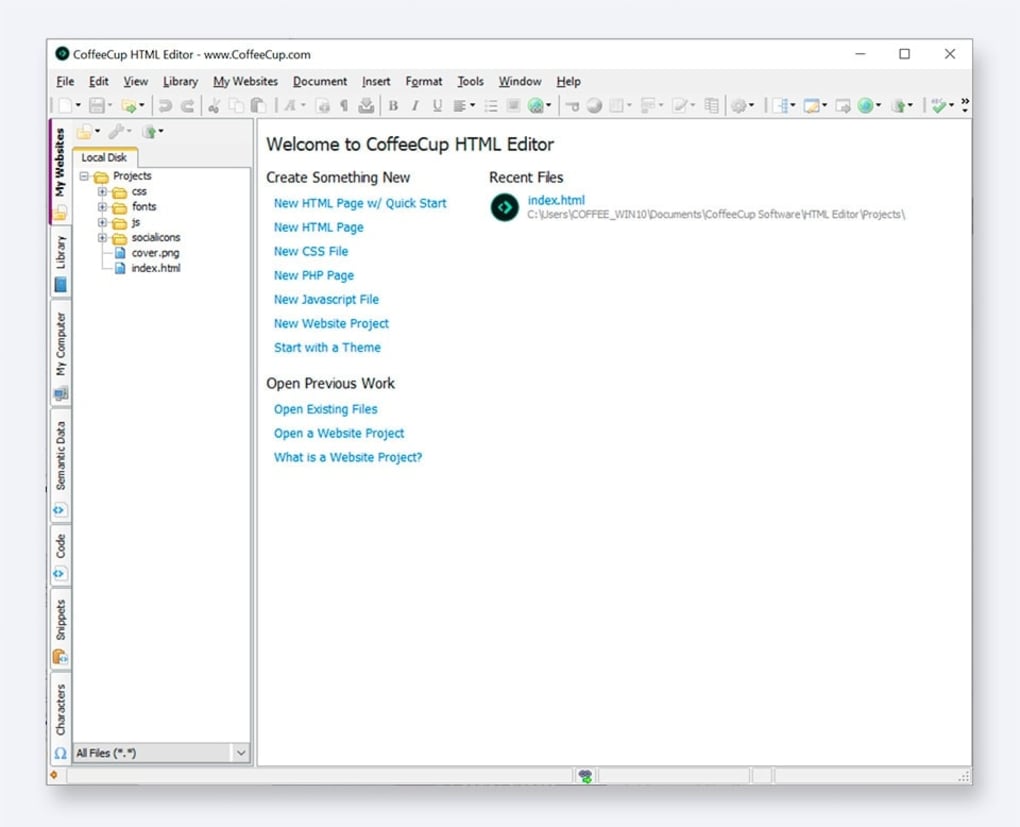
A key component of any software’s success is its user experience, and the CoffeeCup HTML Editor distinguishes itself with a design philosophy centered on clarity and efficiency. From the moment a user launches the application, they are greeted by a “clean and intuitive UI.” This attention to user interface design is critical for both seasoned professionals who appreciate a streamlined workflow and newcomers who might otherwise be intimidated by complex coding environments. The layout is thoughtfully organized, ensuring that essential tools are easily accessible without overwhelming the workspace. This means less time searching for features and more time focusing on creation, allowing for a more productive and enjoyable development process.
Coupled with its accessible interface is the editor’s commitment to performance. CoffeeCup HTML Editor is built upon a “fast and lightweight base.” This foundational design choice translates into tangible benefits for the user: quick application launch times, responsive editing, and smooth operation even when handling larger projects or complex code structures. In an industry where efficiency is paramount, a lightweight editor that doesn’t bog down system resources is highly valued. This performance advantage ensures that the software itself doesn’t become a bottleneck, allowing developers to maintain their flow and concentrate on the task of building websites, rather than waiting for the application to catch up. For many, the speed and responsiveness of a development tool are as crucial as its feature set, directly impacting daily productivity.
The CoffeeCup HTML Editor also boasts a rich and extensive “legacy.” Having “set the standard since 1996,” it represents decades of continuous development, refinement, and adaptation to the evolving web landscape. This long history is a testament to its reliability and the commitment of CoffeeCup Software to its product. Such longevity in the fast-paced tech world signifies a mature and stable platform, one that has weathered numerous technological shifts and user demands. This heritage also implies a deep understanding of web development needs, with features and functionalities that have been refined over time to address real-world challenges. The editor’s consistent updates, with version 17.0-8653.4 being released on July 11, 2023, underscore this ongoing commitment to modern standards and user expectations.
Primarily designed for the Windows platform, the CoffeeCup HTML Editor ensures deep integration with the operating system, promising optimal performance and stability for users running Windows 8 and above. Furthermore, security is a paramount concern for any software, especially those handling code. As per PhanMemFree’s assessment, the CoffeeCup HTML Editor maintains a “Security Status: Clean.” This reassures users that the software is free from known malware or unwanted bundles, providing a safe and trustworthy environment for their web development endeavors. This combination of a user-friendly interface, robust performance, a storied history, and a commitment to security makes the CoffeeCup HTML Editor a compelling choice for many developers.
Understanding the Pricing Structure and Value Proposition
The CoffeeCup HTML Editor is positioned as a “premium editor,” meaning it comes with a cost, setting it apart from numerous free alternatives available in the market. Understanding its pricing structure is crucial for potential users to assess its value proposition against their budget and specific development needs.
The core of CoffeeCup’s licensing model for its editor and feature packs is typically a “one-time purchase license.” This is a significant advantage for many users who prefer to own their software outright rather than being tied to recurring subscription fees, a common model for many modern software tools. A one-time purchase provides perpetual access to the version acquired, often including minor updates within that major version. However, it’s important to note that this one-time purchase applies to the base program and the individual feature “packs” (Sites, Forms, Emails, Developer).
The reference content highlights a critical point regarding the pricing: it can be “pricey for the limited base functionality” when “taken as is.” This observation points to the modular nature of the software. The base editor, while fast and lightweight, offers foundational HTML editing capabilities. To unlock its full potential and access specialized tools for forms, emails, or comprehensive site management, users need to invest in the additional “packs.” For instance, if a user only purchases the base editor and expects a full-fledged IDE experience without the packs, they might find the initial cost high relative to the features immediately available. This means that the real value often emerges when users commit to purchasing one or more packs, or the all-encompassing Developer Pack, which bundles all functionalities.
Complementing the editor’s purchase model, CoffeeCup also offers “S-Drive subscription services” for web hosting. This is a separate, optional service that operates on a subscription basis, providing integrated hosting for websites built with the editor. While the editor itself is a one-time purchase (for the software license), the S-Drive is a recurring cost for a service. This integrated offering can simplify the deployment process for users seeking a seamless experience from creation to publication, potentially justifying the recurring expense through convenience and optimized performance.
Therefore, the value proposition of the CoffeeCup HTML Editor needs to be assessed holistically. For someone who only needs a basic HTML editor, free alternatives like Notepad++ or even simple text editors might suffice. However, for developers and designers who can leverage the editor’s dual code/visual interface, benefit from its integrated tools (DHTML, graphics, FTP), and find specific utility in its modular packs (e.g., extensive form building, professional email design), the investment can be well justified. The “steep cost” becomes more palatable when viewed as an investment in a highly customizable, efficient, and well-supported ecosystem that streamlines a wide range of web development tasks, especially when comparing the combined features to other premium, all-in-one solutions. For those who prioritize a clean, performant, and tailor-made development environment, and are willing to pay for these advantages, CoffeeCup HTML Editor offers a compelling, albeit premium, solution.
Conclusion
The CoffeeCup HTML Editor stands as a formidable contender in the realm of web development tools, offering a compelling blend of features for both seasoned professionals and aspiring web creators. Its unique strength lies in its “two editors in one” architecture, providing the precision and control of a powerful code editor alongside the intuitive, drag-and-drop ease of a WYSIWYG visual editor. This seamless interplay between coding and visual design workflows empowers users to approach web creation with unparalleled flexibility, catering to diverse skill sets and project requirements.
Furthermore, the editor’s modular design, built upon a “fast and lightweight base,” distinguishes it from more monolithic solutions. This approach allows users to customize their development environment with specific “packs”—such as Sites, Forms, or Emails—ensuring that their toolkit is lean, efficient, and perfectly aligned with their needs. The option for an integrated S-Drive web hosting subscription further enhances its appeal, offering a convenient, all-in-one solution for both creation and deployment.
While the CoffeeCup HTML Editor is a “premium editor” with a pricing model that can initially appear “steep for the limited base functionality,” its true value unfolds when considering its comprehensive ecosystem. The one-time purchase for the editor and its packs, combined with the depth of features like integrated DHTML, vast graphic libraries, built-in FTP, and specialized designers, offers a robust platform for serious web development. Its clean and intuitive UI ensures accessibility for all users, while its long-standing legacy since 1996 speaks volumes about its reliability and continuous evolution.
In summary, the CoffeeCup HTML Editor is an excellent choice for individuals and businesses seeking a powerful, customizable, and efficient HTML editing environment. It particularly shines for those who appreciate the synergy between code and visual design, prioritize a lightweight and performant application, and are willing to invest in a premium tool that offers extensive modularity and comprehensive support. For web developers and designers aiming to craft remarkable websites with precision and speed, the CoffeeCup HTML Editor presents a compelling and enduring solution.
File Information
- License: “Full”
- Latest update: “July 11, 2023”
- Platform: “Windows”
- OS: “Windows 8”
- Language: “English”
- Downloads: “20K”
- Size: “49.12 MB”


