
Cradle of Rome, a trial version game available for Windows, transports players to the heart of the ancient Roman Empire. This engaging puzzle game blends classic matching mechanics with a captivating historical setting, allowing players to reconstruct iconic Roman landmarks and experience the grandeur of the city’s golden age. More than just a simple tile-matching game, Cradle of Rome offers a unique blend of strategic puzzle-solving and historical immersion, making it a compelling choice for players seeking a challenging yet rewarding experience.
Reconstructing the Glory of Rome: Gameplay and Mechanics
Cradle of Rome’s core gameplay revolves around a familiar tile-matching mechanic. Players are presented with a board filled with various tiles depicting elements of Roman culture, architecture, and mythology. The objective is to match these tiles, removing them from the board to make way for new tiles and achieve specific goals within a limited number of moves or time. This classic matching concept is enhanced by the addition of strategic elements. The tiles themselves often represent building materials or components of famous Roman structures. Successfully matching sets of tiles allows players to gather resources needed to construct and restore these landmarks.
The game’s progression is structured around the construction of over 20 renowned Roman structures spanning five distinct historical epochs. Each epoch presents its own unique set of challenges and architectural marvels to rebuild. The player’s skill in matching tiles directly impacts their ability to gather the necessary resources, driving the pace of reconstruction and ensuring a continuous sense of achievement. The more efficient the player is at matching tiles, the faster they can complete their building projects and progress through the game’s historical timeline.
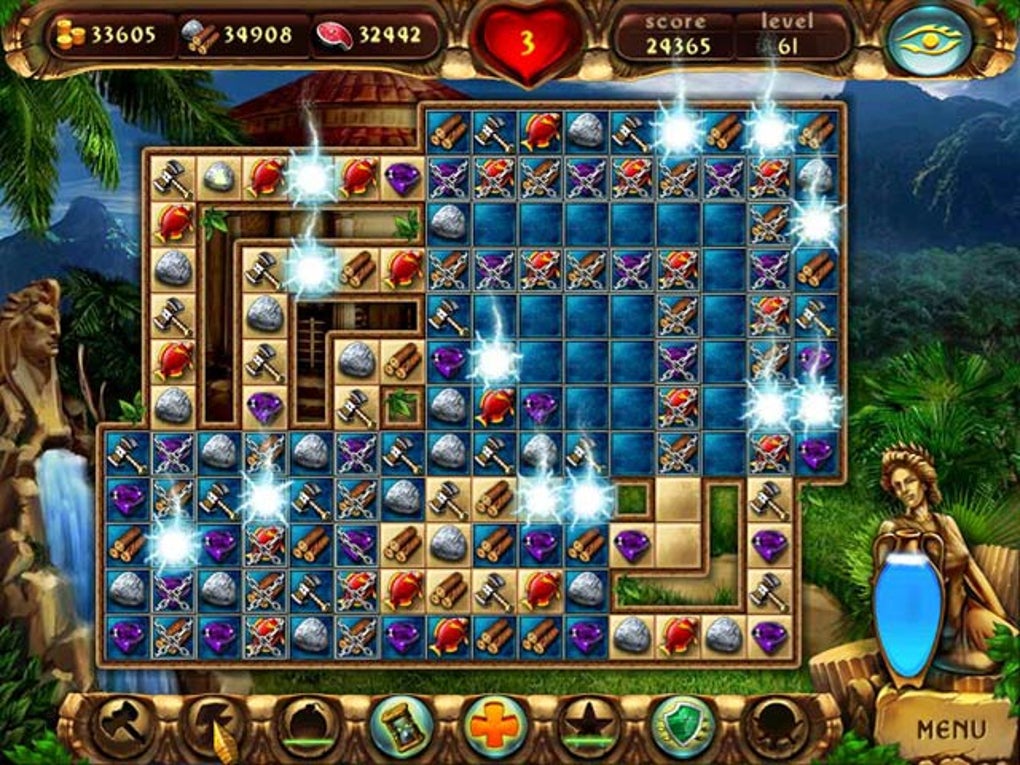
The game introduces a subtle layer of strategic depth. While the core mechanic is straightforward, players must carefully plan their moves to achieve optimal results. Simply clearing tiles randomly won’t suffice; a degree of foresight is needed to efficiently collect the resources required to construct the various structures. Furthermore, the game occasionally presents special challenges or bonus objectives that require specific strategies to overcome. These elements add an extra layer of challenge and engagement, ensuring that the game remains fresh and stimulating throughout the gameplay experience.
A Historical Journey: Epochs and Landmarks
The game’s journey through the epochs of Roman history provides a historical context to the gameplay, seamlessly blending entertainment with educational elements. Players witness the evolution of the Roman Empire as they reconstruct iconic buildings from different periods, each with its unique architectural style and historical significance. This historical progression isn’t merely a backdrop; it’s a driving force in the narrative. Each epoch introduces new challenges, building materials, and architectural styles, keeping the gameplay experience consistently engaging.
From the early days of the Republic to the height of the Empire, players are actively involved in recreating the glory of Rome. The game expertly utilizes visual elements to evoke the atmosphere of each historical period. The graphics, while not photorealistic, capture the essence of Roman architecture and culture, helping players connect with the historical context of the game.
The game also subtly educates players about Roman history and culture through the context of building restoration. While there are no explicit historical lectures, the names and descriptions of the structures players rebuild, along with visual representations of the historical periods, provide an engaging way to learn about Roman civilization and its rich architectural heritage.
The process of rebuilding these iconic structures isn’t simply a matter of clicking buttons; it’s an engaging and interactive experience. Each structure requires a certain number of specific tiles, requiring careful planning and strategic tile-matching to acquire the necessary resources. This blend of resource management and tile-matching makes the game more than a simple puzzle game; it’s a strategic experience that seamlessly blends gameplay mechanics with historical context.
Beyond the Bricks and Mortar: Bonuses and Rewards
Cradle of Rome’s design isn’t confined solely to the core tile-matching mechanism. The game incorporates several bonus features and rewards to enhance the overall gameplay experience. These bonuses aren’t simply arbitrary additions; they’re strategically integrated to enhance the overall player engagement and provide added strategic challenges.
The inclusion of eight unique bonus games adds another layer of gameplay, offering a refreshing change of pace from the main tile-matching puzzle. These bonus games often introduce different game mechanics and challenges, keeping the player engaged and preventing the game from becoming repetitive. The variety of bonus games helps maintain the overall appeal of the game by catering to different player preferences.
Furthermore, achieving milestones within the main game also unlocks additional rewards. These rewards can range from visual enhancements to the game’s interface to new tile sets, each adding a touch of customization and personalization to the experience. The reward system encourages players to continue their journey through the epochs, providing constant motivation to overcome challenges and unlock new content. The game cleverly ties the reward system to the player’s progression through Roman history, further strengthening the narrative connection.
A Lasting Legacy: The Enduring Appeal of Cradle of Rome
The success of Cradle of Rome lies not solely in its innovative gameplay or historically rich setting, but also in its ability to successfully balance challenge and reward. The game’s difficulty curve is carefully calibrated, presenting players with progressively challenging puzzles as they progress through the epochs. The initial levels serve as a gentle introduction to the game’s mechanics, while later levels require increased strategic thinking and skillful tile-matching.
This careful balancing of challenge and reward is crucial in maintaining player engagement. The difficulty level prevents the game from becoming monotonous, while the reward system keeps players motivated to overcome challenges. The continuous unlocking of new structures, bonus games, and customization options ensures that the player’s journey through the Roman Empire remains fresh and captivating throughout the game’s duration.
Moreover, the game’s accessibility makes it enjoyable for a wide range of players. While it presents a rewarding challenge for seasoned puzzle enthusiasts, the game’s straightforward tile-matching mechanics ensure that even casual gamers can easily pick up and enjoy the game. This broad appeal is a testament to the game’s well-designed interface and intuitive gameplay. The game successfully caters to a broad audience without sacrificing depth or complexity.
In conclusion, Cradle of Rome offers more than a simple tile-matching experience. It’s a historical journey disguised as a puzzle game, offering a unique blend of strategic challenge, historical immersion, and captivating rewards. Its enduring appeal is a testament to its well-designed mechanics, engaging narrative, and thoughtful integration of historical context, making it a worthwhile game for both casual and dedicated puzzle enthusiasts.
File Information
- License: “Trial version”
- Latest update: “February 8, 2017”
- Platform: “Windows”
- OS: “Windows 2000”
- Language: “English”
- Downloads: “12.8K”
- Size: “12.72 MB”


