
Derive, a prominent software application for symbolic and numeric mathematics, once held a significant place in the world of scientific computing. While no longer actively supported or available for direct download, its legacy persists through positive user reviews and its lasting impact on the field. This article explores Derive’s capabilities, its historical significance, and its place within the broader landscape of mathematical software.
Derive’s Core Functionality: A Deep Dive into Symbolic and Numeric Calculations
Derive’s core strength lay in its ability to handle both symbolic and numeric mathematical operations with remarkable efficiency. Unlike simpler calculators, Derive wasn’t limited to numerical computations. It could manipulate algebraic expressions, solve equations, perform calculus operations (differentiation, integration), and handle matrix algebra with ease. This symbolic manipulation allowed users to work with variables and formulas directly, providing a level of mathematical abstraction unavailable in purely numerical tools.
The program presented a user interface built around a command line. Users input mathematical expressions, symbols, and commands sequentially, creating a record of their calculations. This approach, while perhaps less intuitive than graphical interfaces prevalent in modern software, allowed for a clear and concise representation of the mathematical process. The use of a command line also provided a level of control and precision, enabling users to fine-tune their calculations and explore mathematical concepts in detail.
While keyboard input was primary, Derive also provided convenient buttons for entering special symbols, making the process smoother even for complex mathematical expressions. The program’s functionality was enhanced by a comprehensive menu system that logically categorized operators and commands, improving usability and accessibility. Combined with a detailed help system, Derive provided a relatively user-friendly experience, provided the user possessed some foundational mathematical knowledge. For those lacking this foundational understanding, the program’s complexities could prove challenging.
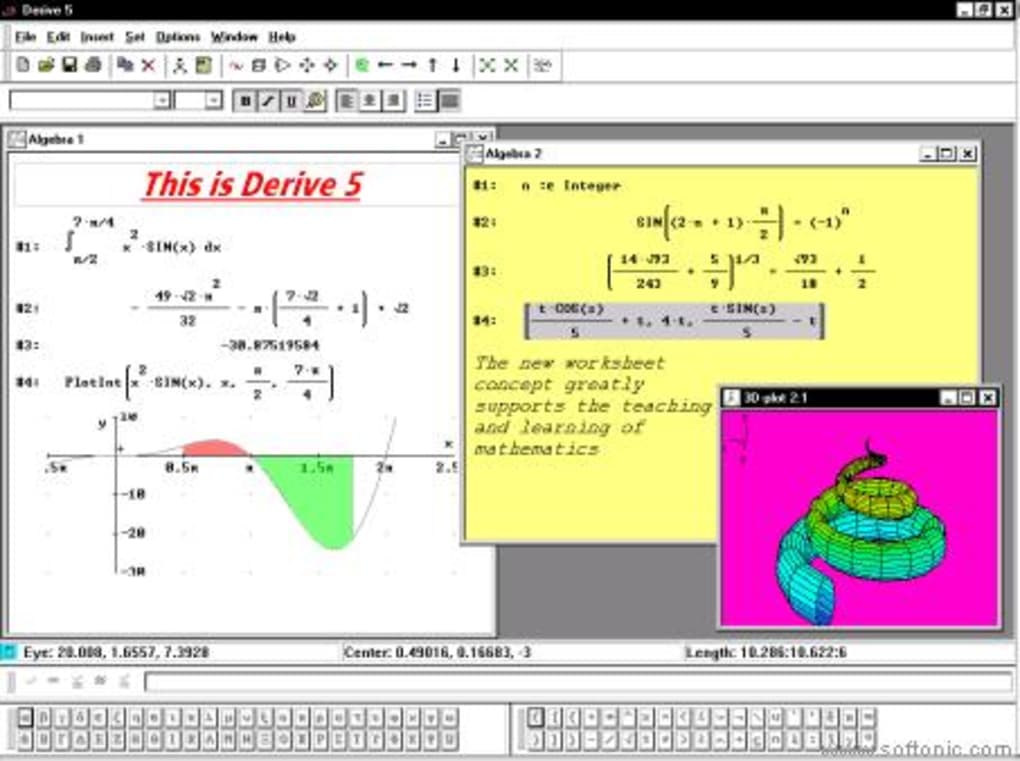
Beyond its computational prowess, Derive facilitated the visualization of mathematical concepts. Results could be displayed graphically, allowing users to plot functions, visualize data, and gain a better intuitive understanding of the mathematical relationships being explored. This visual aspect complemented the symbolic and numeric calculations, enhancing the learning experience and providing valuable insights into the data being analyzed.
The User Experience: A Blend of Power and Accessibility
User reviews consistently highlight Derive’s power and efficiency. Many praised its ability to handle complex symbolic manipulations and solve intricate mathematical problems with ease. The software’s lightweight nature, even by today’s standards, was another recurring positive aspect, ensuring efficient resource utilization. This aspect is particularly noteworthy considering the computational demands of the tasks Derive performed.
The program’s intuitive interface, while text-based, was lauded for its logical organization and ease of navigation. The comprehensive menu system and help files contributed significantly to the user-friendly experience. However, the requirement for some prior mathematical knowledge remains a barrier for complete novices.
However, the absence of a current, supported version represents a significant limitation. The lack of ongoing development means Derive lacks features found in contemporary mathematical software packages. This includes compatibility issues with newer operating systems and the absence of modern graphical user interface elements. The absence of support for tablets and smartphones further restricts its usability in the modern technological landscape.
Derive’s Impact and Legacy in the Field of Mathematics Software
Despite its discontinuation, Derive left a lasting impact on the world of mathematical software. It served as a powerful tool for education, research, and professional use for many years. Its ability to perform complex symbolic and numeric calculations, combined with its relative ease of use, made it a valuable asset for students, teachers, and researchers alike.
Many users remember Derive fondly, describing it as a powerful and efficient tool that significantly aided their mathematical studies or professional work. The lack of a current version is mourned by those who benefited from its capabilities and find modern alternatives lacking in specific aspects.
The program’s legacy serves as a reminder of the evolution of mathematical software. While modern tools offer more advanced features and graphical user interfaces, Derive’s strength in symbolic manipulation and its efficient use of resources remain hallmarks of a highly effective piece of software.
Alternatives to Derive: Exploring Modern Mathematical Software
Given that Derive is no longer supported, numerous alternative software packages cater to the needs of users seeking similar functionality. These alternatives range from free, open-source options to commercial packages with advanced features. Choosing the best alternative depends on the user’s specific needs and level of mathematical expertise.
Some popular alternatives include:
-
Mathematica: A powerful commercial software package offering a wide range of symbolic and numerical computation capabilities, along with advanced visualization tools. It’s known for its extensive functionality but comes with a higher price tag.
-
Maple: Another commercial software package similar to Mathematica in terms of functionality and price. Maple is widely used in academia and industry for its robust symbolic computation capabilities.
-
MATLAB: While primarily focused on numerical computation, MATLAB also offers symbolic capabilities through its Symbolic Math Toolbox. It’s particularly well-suited for tasks involving matrix algebra, signal processing, and other numerical-intensive applications.
-
SageMath: A free and open-source mathematical software system that integrates various open-source packages. It offers a vast range of mathematical capabilities, including symbolic computation, numerical analysis, and visualization.
-
Scilab: Another free and open-source alternative that provides a wide array of mathematical functions, including symbolic computation. It’s often used for scientific and engineering applications.
These are but a few examples, and the optimal choice will depend on individual requirements and budget constraints. Users transitioning from Derive might find that some of these alternatives offer a closer experience, particularly those focused on symbolic computation. However, the ease of use and lightweight nature of Derive may be a challenging feature to find in comparable contemporary software. It remains a testament to the elegant design and effectiveness of Derive that despite its discontinuation, it continues to be fondly remembered and sought after.
File Information
- License: “Trial version”
- Latest update: “January 29, 2025”
- Platform: “Windows”
- OS: “Windows 2000”
- Language: “English”
- Downloads: “220.6K”
- Size: “6.18 MB”


