
Dwarf Fortress stands as a monolithic achievement in the realm of video games, transcending typical genre classifications to deliver an experience of unparalleled depth and complexity. Designed for Windows by the visionary duo known as Bay 12 Games, this intricate roguelike construction and management simulation invites players into a procedurally generated world teeming with untold stories, brutal challenges, and the potential for epic sagas. Unlike almost any other title, Dwarf Fortress isn’t just a game; it’s a universe in miniature, constantly churning with life, death, and emergent narratives that are as unique as they are unforgettable.
At its core, Dwarf Fortress tasks players with guiding a group of dwarves to establish and maintain a fortress in a wild, untamed land. However, this seemingly simple premise belies a staggering level of simulation. Each dwarf is a fully realized individual, boasting a simulated personality, a detailed history, specific preferences, and a complex web of emotions and relationships. These granular details create scenarios where the emotional well-being of your dwarven populace can be as critical to your fortress’s survival as its strategic defenses. From melancholic poets to zealous warriors, every inhabitant contributes to the vibrant, often chaotic, tapestry of your underground empire.
The game thrives on its “losing is fun” mantra, a testament to its challenging nature. Players are expected to learn from past failures, adapting their strategies and understanding of the game’s intricate mechanics through successive, often catastrophic, fortress collapses. This iterative learning process is not merely a hurdle but a fundamental part of the Dwarf Fortress experience, enriching future endeavors with hard-won knowledge and fostering a deep appreciation for the game’s unforgiving yet rewarding design. The combat system, for instance, is robust and merciless, accounting for various skills, individual body parts, and even the material properties of weapons and armor, leading to incredibly detailed and tactical engagements where every blow and parry is meticulously simulated.
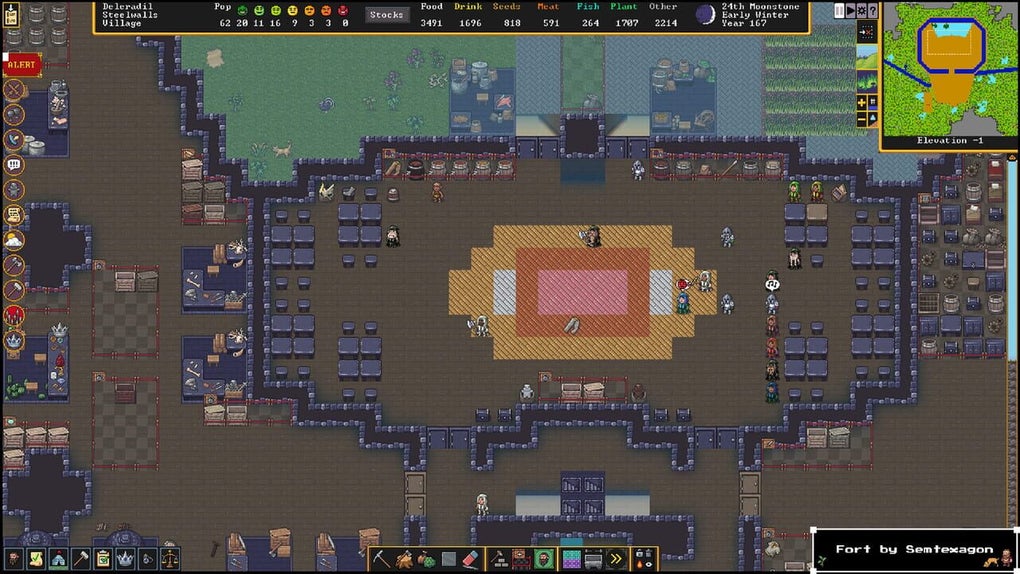
Beyond its mechanical intricacies, Dwarf Fortress crafts a living, breathing world through extensive procedural generation. Players will encounter a rich variety of randomly generated creatures, discover ancient poetry, be moved by unique musical compositions, and contend with dynamic weather patterns that impact everything from farming to mood. The geological environments are equally impressive, integrating over two hundred types of rocks and minerals, each with distinct properties and uses. This profound geological depth influences everything from resource availability to subterranean exploration, ensuring that each generated world presents distinct, fresh challenges and endless opportunities for immersive gameplay.
PhanMemFree recognizes Dwarf Fortress for Windows as a profound example of what independent game development can achieve. It’s a testament to the idea that graphical fidelity can take a backseat to sheer depth and player agency, offering an experience that rewards patience, creativity, and a willingness to embrace the unexpected. While demanding, the journey of building a dwarven civilization, watching it flourish, and perhaps inevitably, fall, is an unmatched adventure in strategic thinking and emergent storytelling.
Games: A Deep Dive into Dwarf Fortress’s Place in Gaming
In a landscape dominated by polished AAA titles and easily accessible mobile experiences, Dwarf Fortress carves out a unique, almost legendary, niche. It’s not a game designed for immediate gratification or casual play; rather, it’s a commitment, a journey into a system-rich world where stories aren’t pre-written but emerge organically from the interactions of countless simulated elements. Its designation as a “Role Playing,” “Simulation,” and “Strategy” game only scratches the surface of its genre-bending ambition.
Compared to more mainstream titles found on platforms like PhanMemFree, such as the charming simplicity of Stardew Valley, the narrative grandeur of Red Dead Redemption II, or the action-packed superheroics of Spider-Man Remastered, Dwarf Fortress stands in stark contrast. Where those games offer meticulously crafted narratives and streamlined gameplay loops, Dwarf Fortress presents a blank slate, an open-ended challenge where the player defines success and failure. Its appeal lies not in its graphical prowess—though recent official graphical updates have made it more accessible—but in the sheer depth of its simulation and the endless replayability it offers. Each new world is a unique snowflake, an alternate history waiting to be written by your actions and the unforgiving whims of its procedural generation.
The game’s long and fabled development history, spanning over two decades under the dedicated stewardship of Tarn and Zach Adams (Bay 12 Games), is a saga in itself. For many years, its iconic ASCII graphics were a badge of honor, a symbol of its uncompromising commitment to complexity over visual flair. This historical context contributes significantly to its enduring appeal. It’s a game that has grown and evolved alongside its dedicated community, a project of passion that has resisted commercial pressures to remain true to its singular vision.
Dwarf Fortress isn’t just played; it’s studied, debated, and celebrated. Its emergent narratives, from the tragic tale of a lone dwarf driven mad by the loss of his beloved sock to the epic defense against a titan of fire and blood, become legends within its community. This focus on emergent storytelling, where the game acts as a grand generative fiction engine, is a core reason for its longevity and profound impact on game design. It taps into the primal human desire to create, to observe, and to tell stories, making every session a potential new chapter in an epic history. Its unique blend of detailed simulation and rogue-like elements ensures that even after hundreds or thousands of hours, players can still discover something new, a testament to the boundless complexity instilled by its creators. It’s a game that defines its own category, a masterpiece of digital world-building that continues to inspire and challenge players worldwide.
The Unparalleled Simulation Engine: Crafting a Living World
At the heart of Dwarf Fortress’s enduring mystique is its unmatched simulation engine, a technical marvel that breathes life into every facet of its procedurally generated worlds. This isn’t just a game with deep mechanics; it’s a meticulously constructed digital ecosystem where every element interacts with myriad others, creating a sense of a truly living, breathing, and often hostile, environment. The level of detail here is what sets it apart from virtually every other simulation game on the market.
One of the most celebrated and often daunting aspects of this simulation is the dwarven personalities and psychology. Each individual dwarf is far more than a simple unit with a job assignment. They possess intricate personality traits, develop preferences (for specific foods, drinks, activities, even types of rock), form memories from their experiences, and forge complex relationships with others. A dwarf witnessing a traumatic event might develop PTSD, leading to angry outbursts or melancholic spirals. The death of a loved one could send another into a spiral of despair, culminating in fits of rage or suicidal tendencies. These emotional states directly influence productivity, social interactions, and ultimately, the stability of the fortress. Managing these delicate psychological ecosystems requires not just strategic thinking but a profound empathy for your digital charges, turning management into a form of interactive storytelling.
Beyond the sentient inhabitants, the very ground beneath your dwarves’ feet is alive with geological richness. The game boasts over two hundred types of rocks and minerals, each with unique properties, densities, and uses. This isn’t just cosmetic; it deeply influences resource gathering, construction, and biome generation. Digging into granite is different from digging into sandstone, requiring different tools and yielding different results. The presence of specific ores dictates industrial development, while veins of precious gems can fuel dwarven economies or attract unwanted attention. Underground aquifers, magma flows, and vast, terrifying cavern layers filled with exotic flora and fauna add layers of geographical complexity, making exploration a perilous but rewarding endeavor. Understanding the geology of your starting biome is crucial for long-term survival and prosperity, turning the very act of digging into a strategic decision.
The dynamic environment extends above and below ground, with realistic weather systems influencing surface operations. Rain can fill cisterns but also create muddy conditions. Blizzards can halt trade and expose dwarves to frostbite. Droughts can wither crops, leading to starvation. These environmental factors force players to adapt, build shelters, manage resources, and plan meticulously. Furthermore, the world is populated by a vast array of randomly generated creatures, from mundane livestock to colossal, terrifying forgotten beasts that slumber in the deep. Their behaviors, diets, and interactions with the environment and your dwarves add an unpredictable element of danger and opportunity, requiring careful planning for defense and resource acquisition.
Perhaps most astonishingly, Dwarf Fortress simulates cultural depth. Each generated world comes complete with its own history, myths, religions, poetry, and musical traditions. These elements are not just flavor text; they can influence dwarven preferences, inspire works of art, or even dictate diplomatic relations with other civilizations. Discovering ancient texts or witnessing a dwarf compose a haunting ballad about a forgotten battle adds immeasurable richness to the experience, cementing the feeling that you are not just playing a game, but interacting with a truly unique, self-sustaining historical engine. This unparalleled simulation engine transforms every playthrough into a distinct epic, ensuring that no two fortresses, or their inevitable doom, are ever quite alike.
Strategic Depth and Roguelike Challenges: The Cycle of Toady One’s Vision
Dwarf Fortress is not merely a simulation; it is a crucible of strategic thinking, where every decision, from the placement of a workshop to the deployment of a military squad, can have monumental, often unforeseen, consequences. Its roguelike elements inject an unforgiving yet thrilling sense of permanence into the gameplay, ensuring that each “run” presents a unique and often brutal learning experience. This fusion of deep strategy with roguelike stakes is central to what Bay 12 Games’ Tarn Adams (known as Toady One) envisioned and continues to evolve.
The core loop of construction and management requires meticulous planning. Players must first survey their chosen site, considering factors like elevation, water sources, natural resources, and potential threats. The initial stages involve digging out basic shelters, securing food and water, and establishing workshops for crafting essential tools and goods. Resource management is paramount: balancing the need for raw materials like stone and wood with the demands of crafting, forging, and farming. As the fortress grows, so does its complexity. Designing efficient layouts, managing refuse, ensuring proper storage, and establishing trade routes become critical. Every wall, tunnel, and trap contributes to the overall defense and functionality of the fortress, creating an intricate subterranean puzzle that is constantly being re-solved.
The combat system is a testament to the game’s commitment to simulation over abstraction. When a goblin siege arrives or a forgotten beast awakens, the battles are not simple dice rolls. Each combatant has individual skills (e.g., swordsdwarf, axedwarf, wrestler), and the outcome is determined by a myriad of factors. The material properties of weapons and armor are crucial: a masterwork steel sword will cut more effectively than a crude copper one, and a plate armor made of iron offers superior protection against a goblin’s scimitar than a leather tunic. Hits are simulated on individual body parts, leading to dismembered limbs, crushed organs, and grisly, realistic injuries. This depth necessitates careful tactical engagements, proper training of military dwarves, and the strategic deployment of squads. Understanding dwarven anatomy and weapon physics becomes a morbidly fascinating aspect of survival.
Crucially, Dwarf Fortress embraces the philosophy that “losing is fun.” Unlike many games where failure means a simple reload, a fortress’s demise in Dwarf Fortress is often permanent, leading to the creation of a new world and a fresh start. This roguelike aspect means that players are constantly learning from their past failures. Did a lack of food lead to widespread starvation? Next time, prioritize farming. Was the fortress overrun by goblins because of inadequate defenses? Then the next fortress will feature layered traps and heavily armed garrisons. This iterative learning process is incredibly rewarding, fostering adaptability and resilience. Each distinct challenge, whether it’s a vampiric dwarf infiltrating the populace, a goblin invasion, an ancient demon bursting from the depths, or the simple logistical nightmare of keeping your dwarves happy and fed, teaches valuable lessons that shape future strategies.
Beyond direct conflict, the game also simulates complex political and social interactions. Other civilizations (elves, humans, goblins, kobolds) exist in the world, with whom dwarves can trade, negotiate, or wage war. Internal dwarven politics, driven by the simulated personalities and ambitions of your populace, can lead to power struggles, coups, and civil unrest. Managing these internal and external pressures requires a keen understanding of both military might and diplomatic finesse, making the strategic layer of Dwarf Fortress incredibly rich and multi-faceted. The cycle of building, thriving, struggling, and often, falling, is the core narrative, driven by both the player’s strategic choices and the game’s relentless, emergent challenges.
Embracing Complexity: Development, Community, and Accessibility
The enduring legacy and unique position of Dwarf Fortress within the gaming world owe much to the dedicated vision of Bay 12 Games and the robust, passionate community that has grown around it. This symbiotic relationship has not only sustained the project for over two decades but has also actively shaped its evolution, making it more accessible without ever compromising its notorious depth.
The Bay 12 Games’ vision, primarily driven by brothers Tarn and Zach Adams, is unlike any other in game development. Their commitment to Dwarf Fortress is almost legendary, with Tarn famously dedicating his entire life to its creation, supported directly by player donations. This independent, long-term approach has allowed them to pursue an uncompromising design philosophy, prioritizing simulation and emergent complexity above all else. They aren’t chasing trends or market demands; they are building the ultimate simulation, one intricate system at a time. This dedication has fostered a deep trust within their player base, who know that every update, every tweak, is aimed at fulfilling the grand, overarching vision of a truly living, breathing digital world. The game, available for Windows, continues to receive updates that expand its already vast scope, a testament to this ongoing, monumental effort.
Given the game’s notorious complexity and initially text-based interface, community contributions have been instrumental in fostering accessibility and enhancing the experience for countless players. The Dwarf Fortress Wiki, maintained by the community, is an encyclopedic resource, almost mandatory reading for new players struggling to grasp the game’s myriad systems. Beyond documentation, the community has developed an extensive ecosystem of mods, utility tools, and visual packs. These range from simple texture replacements that make the ASCII graphics more palatable (long before official graphical updates) to complex utilities that help manage fortress logistics, track dwarven moods, or even visualize the subterranean layers. Tools like Dwarf Therapist, for instance, allow players to easily manage dwarf professions and skills, transforming a tedious task into a manageable one. This collaborative spirit has made the daunting learning curve a shared journey, with veterans guiding newcomers through tutorials, shared stories of fortresses past, and innovative problem-solving.
In recent years, Bay 12 Games has made significant strides in accessibility efforts themselves, notably with the release of the game on platforms like Steam and Itch.io. While the core game remains a Windows experience, these versions introduced official tile-set graphics, making the visual information much easier to parse for new players, and integrated music, enhancing the atmosphere without sacrificing the underlying simulation. This move was a strategic decision to attract new blood to the game while ensuring that the deep, complex gameplay remained intact. It represented a successful balancing act, broadening the appeal of Dwarf Fortress without alienating its hardcore, long-time fans.
The future prospects for Dwarf Fortress are as vast as its simulated worlds. The Adams brothers continue to work on expanding the game’s features, with plans to introduce further layers of simulation, including an adventure mode that’s as rich and complex as the fortress mode. This ongoing development, coupled with a fiercely loyal and constantly innovating community, ensures that Dwarf Fortress will remain a touchstone for simulation gaming and emergent storytelling for many years to come. It stands as a monumental achievement, a living testament to the boundless potential of creative code and the power of a dedicated vision supported by a global community.
File Information
- License: “Full”
- Latest update: “May 25, 2025”
- Platform: “Windows”
- OS: “Windows 11”
- Downloads: “7”


