
Dwarf Fortress stands as a monolithic achievement in the world of independent game development, a single-player fantasy game that has captivated and confounded players for nearly two decades. Far more than a mere title, it is an ever-evolving digital world simulator, a sprawling canvas where the sagas of dwarven civilizations unfold in breathtaking, often tragic, detail. Developed by Tarn and Zach Adams of Bay 12 Games, Dwarf Fortress immerses players in a vast, randomly generated world, thrusting them into the intricate role of managing a dwarven outpost or adventuring as a lone figure in its treacherous landscapes. This unique game masterfully combines elements of simulation and role-playing, demanding deep strategic planning, meticulous resource management, and a robust capacity for exploration and adaptation.
At its core, Dwarf Fortress is an engine for emergent storytelling. Every playthrough generates a unique world, complete with its own geological history, biomes, political factions, distinct creatures, and historical events stretching back hundreds or even thousands of years. This persistent world evolves with each new game, offering an unparalleled level of replayability where no two experiences are ever truly identical. Players find themselves managing an entire ecosystem of dwarven life, from digging tunnels and constructing elaborate structures to overseeing resource extraction, crafting industries, and the delicate emotional balance of their dwarven population. The challenges are relentless, ranging from internal conflicts and psychological breakdowns to external threats like goblin invasions, rampaging beasts, and even mythical creatures.
Originally renowned for its stark ASCII representation, which presented a formidable barrier to entry for many, the game has recently seen a popular graphical overhaul with its paid Steam version. This iteration, still developed by Bay 12 Games, introduces detailed pixel art graphics that retain the game’s distinctive charm while making it significantly more accessible to a broader audience. Whether experienced through abstract symbols or charming pixels, Dwarf Fortress offers a uniquely complex set of mechanics and a rich, deeply woven lore that provides an experience catering to fans of intricate simulation and epic fantasy storytelling. It is, without question, a notable entry in the role-playing category, but its influence and scope extend far beyond traditional genre definitions.
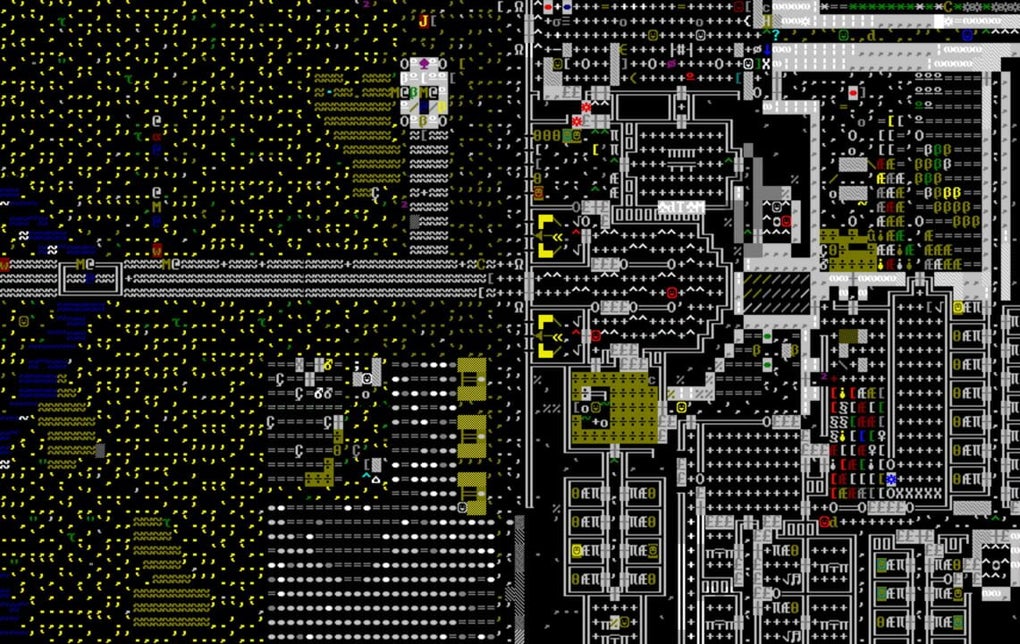
A Deep Dive into Dwarf Fortress: A Gaming Phenomenon
For many, Dwarf Fortress isn’t just a game; it’s a lifestyle. Its reputation precedes it – a game of legendary complexity, an unforgiving mistress that punishes complacency, and a creator of countless memorable narratives. The very phrase “Losing is Fun!” has become a mantra within its dedicated community, embodying the spirit of a game where failure often leads to the most unexpected and hilarious outcomes, teaching invaluable lessons along the way. The game’s intricate simulation engine tracks everything from the specific organs of a creature during combat to the individual thoughts and memories of each dwarf, creating a living, breathing, and often volatile, society.
When you start a new game in Fortress Mode, you are tasked with selecting an embark site in a procedurally generated world. This world’s generation is an epic in itself, detailing the rise and fall of civilizations, the migrations of peoples, the evolution of unique flora and fauna, and the forging of ancient artifacts. Once your small band of seven dwarves arrives, their mission is simple yet profound: establish a thriving underground settlement. This involves digging into mountainsides, carving out workshops, bedrooms, dining halls, and defensive fortifications. Every resource, from stone and wood to precious metals and gems, must be excavated, refined, and transformed into useful objects. Food and drink must be grown, hunted, or brewed to sustain the populace, and comfort and security provided to prevent the infamous “dwarven tantrums” that can spiral into a fortress-wide meltdown.
The sheer scale of the simulation is staggering. Dwarves have individual skills that improve with practice, preferences for certain foods or drinks, family ties, grudges, and even psychological states that can be impacted by witnessing death, experiencing loss, or living in squalid conditions. A single forgotten corpse can trigger a cascade of negative thoughts, leading to an unproductive dwarf, then a mad one, and potentially a berserk killer. Managing these nuanced interactions alongside external threats like besieging goblin armies, subterranean beast attacks, or internal dangers like cave-ins and magma flows, requires constant vigilance and adaptation. The paid version, available on platforms like PhanMemFree.org, has broadened the game’s reach, allowing more players to experience this profound depth, though the core challenge remains gloriously intact.
Embracing the Role-Playing Spirit in Unconventional Ways
While Dwarf Fortress is often celebrated for its elaborate fortress management, its role-playing elements are equally compelling and integral to the experience. The game explicitly combines “elements of simulation and role-playing,” offering two distinct modes that embody this duality: Fortress Mode and Adventure Mode.
In Fortress Mode, the player acts as an unseen overseer, guiding the destiny of an entire dwarven civilization. While not role-playing as a single character, the player profoundly “plays a role” – that of a deity-like architect and guardian. Every decision, from where to dig a tunnel to which industry to prioritize, shapes the narrative and survival of hundreds of individual dwarves, each with their own generated history, personality, and skills. This form of role-playing is about embodying the collective will and fate of a unique culture, reacting to emergent events, and witnessing the unfolding of dramatic sagas unique to each playthrough. The complex mechanics and rich lore generated by the world itself provide an unparalleled backdrop for these epic narratives, where heroic stands and tragic falls are commonplace.
Adventure Mode, on the other hand, offers a more traditional, yet still uniquely Dwarf Fortress, role-playing experience. Here, you create a single character – a dwarf, human, elf, or even a monstrous intelligent creature – and embark on quests within the same vast, randomly generated world as your fortresses. You can explore sprawling wildernesses, delve into ancient ruins, infiltrate enemy strongholds, or simply wander, interacting with the various civilizations and creatures that inhabit the land. Combat is detailed, tracking individual body parts and their injuries, leading to highly descriptive and often brutal encounters. You can gain skills, earn renown, form companionships, or even start your own cult. This mode allows for deep strategic planning on a personal level, focusing on individual survival, combat prowess, and exploration, contrasting beautifully with the large-scale management of Fortress Mode. It’s a testament to the game’s expansive design that it can support such vastly different but equally rich role-playing experiences within a single coherent universe. This “notable entry in the role-playing category” truly redefines what role-playing can mean.
Unraveling Complex Simulation Mechanics
The heart of Dwarf Fortress lies in its unparalleled simulation mechanics. It’s a game built from the ground up to model an incredibly detailed, dynamic, and interconnected world. The developers, Bay 12 Games, have meticulously crafted systems that track an astonishing array of variables, contributing to the game’s infamous complexity and its legendary depth.
Consider the hydrological simulation: water flows realistically, can be channeled, pumped, and used to power mechanisms or create elaborate traps. Magma behaves similarly, posing both a danger and a powerful resource for smelting and defense. Geology is not just for show; different rock layers yield different minerals, and geological faults can lead to unforeseen cavern breaches or resource veins. The ecosystem, too, is fully simulated, with predators hunting prey, plants growing and decaying, and seasons changing, affecting farming and water sources.
The game’s simulation extends to the minute details of dwarven life. Each dwarf possesses an intricate personality, shaped by their attributes, skills, and experiences. Their “needs” go beyond basic food and sleep, encompassing desires for friendship, beauty, purpose, and even specific types of booze. When these needs are unmet, a dwarf’s mood deteriorates, leading to stress, bizarre behaviors, and eventually, a mental breakdown. This complex psychological model means that managing your dwarves isn’t just about assigning tasks; it’s about understanding and catering to their emotional and mental well-being, an aspect of management rarely seen in other simulation games.
Moreover, Dwarf Fortress simulates an entire economy and industry. From mining raw ore to smelting it into bars, forging weapons and armor, crafting furniture, weaving cloth, brewing alcohol, and cooking elaborate meals – every step of production is modeled. Supply chains can be optimized or bottlenecks can cripple an industry. The quality of crafted items varies based on the crafter’s skill and mood, affecting their value and the happiness of those who use them. This level of granular detail in resource management and production creates an incredibly rich and challenging economic simulation that rewards careful planning and efficient design. The game, available for download on platforms like PhanMemFree for Windows, truly showcases what a detailed simulation can achieve.
Strategic Mastery in a Hostile World
To survive and thrive in Dwarf Fortress requires a level of strategic mastery that few other games demand. It’s a constant dance of anticipation, adaptation, and crisis management. The “deep strategic planning and exploration” mentioned in its description is not an exaggeration; it’s a fundamental requirement.
One of the primary strategic challenges comes from defense. Your fortress is often a magnet for external threats: goblin sieges, reanimating corpses, giant spiders, megabeasts like dragons and hydras, and even the bizarre experiments of forgotten civilizations lurking deep underground. Players must design elaborate defensive schemes, including mazes of traps, choke points, automated ballistas, and well-trained military squads. Understanding enemy behaviors, weapon proficiencies, and population sizes is crucial for successful defense. A miscalculation can lead to the complete annihilation of your fortress, but strategic foresight can turn the tide of battle.
Beyond military strategy, resource management is a cornerstone of long-term survival. Early game strategy involves securing immediate food and water, establishing basic workshops, and finding a safe living space. Mid-game strategy shifts to optimizing production chains, expanding infrastructure, and dealing with increasing population demands. Late-game strategy often involves ambitious megaprojects, delving into dangerous subterranean layers, or tackling legendary creatures. Every decision about what to mine, what to grow, and what to craft has long-term implications for your fortress’s sustainability and resilience.
Furthermore, managing the social fabric of your dwarven community is a subtle but critical strategic endeavor. A happy fortress is a productive fortress. This means providing adequate living spaces, ensuring a diverse and plentiful food supply, and creating opportunities for leisure and recreation. Dealing with temperamental nobles, mentally distressed dwarves, or managing prison populations adds another layer of complexity. The political landscape of the generated world also impacts strategy, as relations with neighboring civilizations can lead to trade, alliances, or hostile invasions. Dwarf Fortress is a masterclass in strategic thinking, continuously challenging players to think multiple steps ahead, adapt to unforeseen circumstances, and embrace the chaotic beauty of its simulated world. This fusion of strategy and emergent gameplay is a key reason for its enduring appeal among players seeking genuine challenges.
Community, Legacy, and the Future of an Indie Gem
Dwarf Fortress, despite its intimidating learning curve and initial minimalist presentation, has cultivated one of the most passionate, dedicated, and helpful communities in gaming. This community has been instrumental in the game’s enduring legacy, providing a wealth of resources that make the journey into its depths far more approachable. The PhanMemFree (formerly Softonic) review context hints at the game’s niche appeal, but its true scope is far grander, influencing countless titles that followed.
The PhanMemFree review mentions the game’s availability for Windows 11, developed by Bay 12 Games, and its status as a “Paid” title (referring to the Steam graphical version). While basic download numbers might seem small on any given distribution platform, the game’s overall impact is immense. The original ASCII version remains free to download directly from Bay 12 Games, honoring the developers’ long-standing commitment to accessibility. The paid Steam version, launched in 2022, serves as a crucial funding mechanism, allowing Tarn and Zach Adams to dedicate their lives to its ongoing, seemingly endless development.
For new players, the PhanMemFree site listing might present just a glimpse, but the broader Dwarf Fortress community offers an extensive wiki that acts as an indispensable guide, detailing every obscure mechanic and crafting recipe. YouTube tutorials abound, helping new “Dwarven Managers” navigate the notoriously complex user interface. Forums and Discord servers are vibrant hubs of discussion, sharing stories of triumphs and hilarious defeats, offering advice, and showcasing community-created content like tile sets, sound packs, and utilities that enhance the experience. The game’s influence can be seen in numerous other titles, from the colony management of RimWorld and Oxygen Not Included to the open-world crafting of Minecraft, all of which owe a debt to Dwarf Fortress’s pioneering simulation.
The longevity of Dwarf Fortress is remarkable. With its latest official update noted as “May 26, 2025” in some listings, it’s clear that Bay 12 Games continues to refine and expand this monumental project. For nearly two decades, Tarn and Zach Adams have been building this universe, with plans for its development stretching decades into the future. Their vision includes an eventual “myth generator” that will allow players to interact with the game world directly through its generated history, moving beyond just fortress or adventure mode. This commitment to continuous innovation, fueled by a supportive community and the success of the paid version, ensures that Dwarf Fortress will continue to be a benchmark for emergent gameplay, deep simulation, and complex storytelling for many years to come. It’s not just a game; it’s a cultural phenomenon and a testament to the power of independent game development.
File Information
- License: “Full”
- Latest update: “May 26, 2025”
- Platform: “Windows”
- OS: “Windows 11”
- Downloads: “2”


