
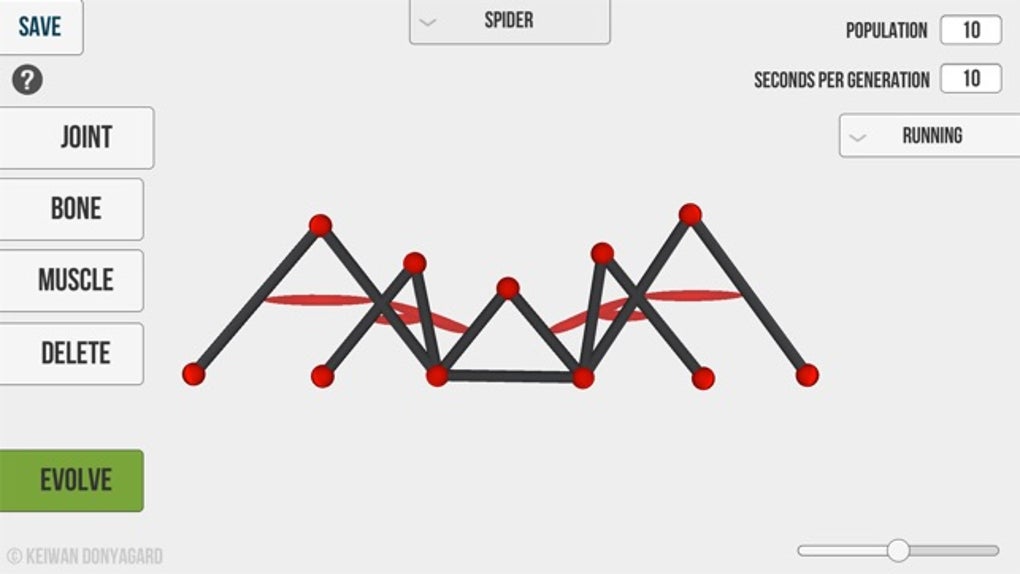
Evolution is a unique creature-creation simulation software developed by Keiwan Donyagard. Unlike many commercially released games, Evolution functions more as an experimental simulator, reminiscent of aspects found in the Spore series, but with a far more simplified and focused approach. The core mechanic revolves around building basic creatures using a limited set of components: joints, bones, and muscles. The user’s task is to design creatures capable of navigating a simple environment, overcoming obstacles by running, jumping, and climbing.
The Evolutionary Process: A Blend of Neural Networks and Genetic Algorithms
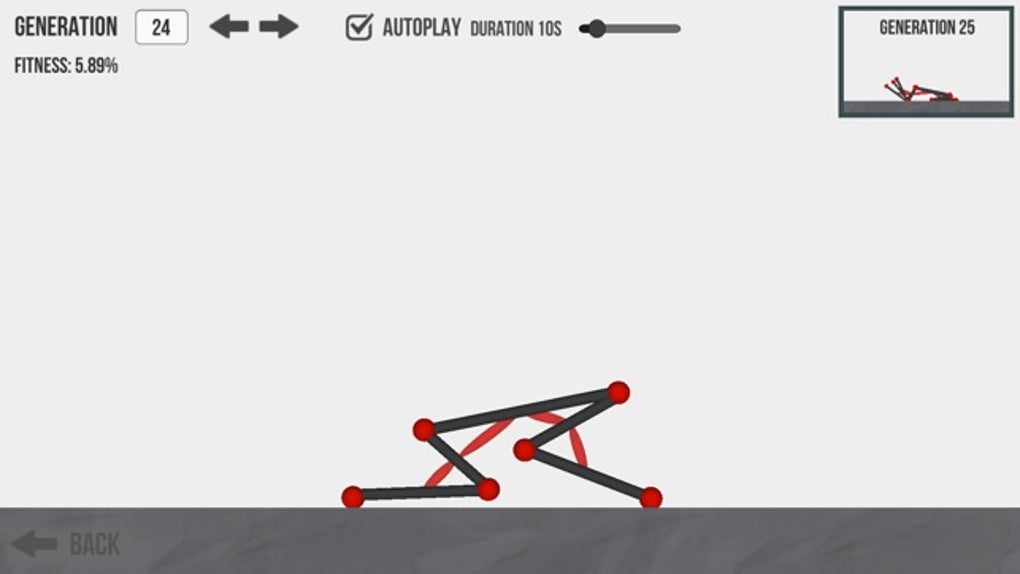
A key feature differentiating Evolution from other creature simulators is its incorporation of sophisticated AI mechanisms. Once a creature is designed and the “Evolve” button is clicked, the program automatically assigns it a brain. This brain, implemented through a neural network, allows the creature to learn and improve its performance over time. Furthermore, a genetic algorithm is employed to drive the evolutionary process. The software evaluates the success of each generation of creatures in accomplishing set tasks. The most successful creatures are then selected, and their genetic blueprints are used as templates for the next generation. This iterative process mirrors natural selection, leading to gradual improvements in creature design and performance. Users can leverage this evolution process by modifying their designs based on the outcomes, thus actively participating in shaping the creatures’ adaptations.
Gameplay and Challenges: Beyond Simple Game Mechanics
While Evolution might not offer the typical rewards and achievements found in traditional games, such as points or unlockable content, its challenge lies in the intricate process of creature design and the unpredictability of the evolutionary algorithm. There is no hand-holding or explicit tutorial, requiring users to experiment and learn through trial and error. This learning curve introduces a unique challenge, forcing players to grasp the fundamental mechanics of biomechanics and AI-driven evolution to create successful creatures. The design constraints also contribute to the difficulty, compelling players to think creatively and efficiently within the confines of the available building blocks.
.jpg)
The default behavior of generating batches of creatures for the evolution process might seem overwhelming at first. This is primarily a feature driven by the simulation’s design for efficiently exploring the vast possibilities of creature designs and emergent behaviors within the confines of the simple parameters given. Understanding how the interplay between various body parts affects locomotion and obstacle navigation is paramount. Small changes to a creature’s skeletal structure or muscular arrangement can drastically impact its capabilities. This experimentation fosters deeper engagement and understanding of the underlying principles of the evolutionary process.
Saving and Loading: Limitations and Future Potential
A notable limitation of Evolution is the restricted save/load functionality. Currently, users can only save and load creatures using the downloaded application. This restricts the ability to easily share designs or easily continue work on a project from different devices. The lack of cloud-based saving limits the accessibility and ease of use, a significant drawback for a software centered around iterative design and experimentation. However, this restriction could be viewed as an opportunity for future development; integrating cloud saving capabilities and community-based features would greatly enhance the user experience, fostering collaboration and knowledge sharing.
Visual Feedback and User Interface: Room for Improvement
The absence of a comprehensive visual tutorial, or any form of explicit guidance, presents a learning curve for new users. The intuitive nature of the interface might be overshadowed by the lack of explanation, particularly in understanding the relationship between the creature’s anatomy and its movements. Enhanced visual feedback during the evolutionary process would also improve understanding, allowing users to clearly observe how the genetic algorithm is shaping the evolution of their designs. Features such as detailed performance metrics or visualizations of the neural network’s activity would further enhance the educational aspect of the simulation.
While the simple interface and direct control over creature creation is a strength, the lack of detailed visual feedback hinders the learning experience for newcomers. Introducing visual aids, such as highlighting the areas of a creature that are most effective for a specific task or showing the neural pathways within the creature’s brain, would significantly improve the user’s understanding and facilitate further experimentation.
Evolution’s Purpose: A Tool for Exploration and Learning
Ultimately, Evolution’s value lies not in its game-like qualities, but its educational and exploratory potential. The software serves as a tangible demonstration of the principles of evolutionary biology and artificial intelligence. Users actively participate in shaping an evolutionary process, witnessing firsthand how incremental adaptations can lead to significant improvements in creature functionality. This hands-on experience offers a unique insight into the complexities of both biological evolution and neural networks, providing an engaging and intuitive learning platform.
The simplified nature of the simulation, while limiting in terms of visual complexity and game mechanics, enhances its educational value. By stripping away unnecessary elements, Evolution allows users to focus on the core mechanics of the evolutionary process. The focus on fundamental building blocks encourages experimentation and fosters a deeper understanding of how small changes in design can lead to significant variations in outcome.
Comparing Evolution to Similar Software
When comparing Evolution to other simulation software, the distinctions become more apparent. While games like Spore offer a more expansive and visually engaging world, Evolution prioritizes direct manipulation and a deeper understanding of the underlying mechanics. Other AI-driven simulators may focus on specific aspects, such as neural network training or genetic algorithm optimization. Evolution’s unique strength is in seamlessly integrating both elements into a user-friendly, yet challenging, environment. This blend allows for a unique learning experience, blending theoretical concepts with practical application.
.jpg)
The lack of overtly competitive gameplay aspects sets it apart from other simulation games focused on scoring or achievement hunting. Evolution promotes a more contemplative and experimental approach, encouraging players to focus on the evolutionary process itself, rather than external rewards. This shift in focus positions Evolution as more of a scientific tool than a game, offering a valuable educational resource while remaining engaging through the challenge of efficient design and optimization.
Potential for Future Development and Expansion
While the current version of Evolution presents a compelling simulation, several potential avenues for improvement and expansion exist. The implementation of more complex environments, with diverse challenges and obstacles, would enhance the difficulty and deepen the learning experience. The introduction of more advanced components, such as sensory organs or internal organs, would further complicate the design process, leading to more intricate evolutionary pathways.
Expanding the range of possible creature interactions, including social dynamics or predator-prey relationships, would further enrich the simulation, adding an extra layer of complexity to the evolutionary process. These additions would not only make the game more engaging but would also provide more opportunities for learning and research. The introduction of mutations, either random or user-induced, would add another dimension to the evolutionary process, providing further insight into the unpredictable nature of natural selection.
Further integration of AI features, such as more sophisticated learning algorithms or advanced genetic operators, could dramatically expand the capabilities of the simulation, leading to even more complex and unpredictable evolutionary patterns. This would allow for a deeper examination of evolutionary biology principles and allow users to design creatures with more advanced behaviors and capabilities.
In conclusion, Evolution presents a unique blend of simulation and learning. Although lacking some features found in commercially-released games, its strengths lie in its educational value and the unique insights it provides into the mechanics of evolution and artificial intelligence. While the current version has limitations, the potential for future development and expansion is considerable, promising a richer and more informative experience in future iterations.
File Information
- License: “Free”
- Latest update: “May 24, 2023”
- Platform: “Windows”
- OS: “Windows 8”
- Language: “English”
- Downloads: “8.4K”


