
Lode Runner, a 2D puzzle-platform arcade game originally published by Broderbund in 1983, stands as a testament to enduring game design. Its simple yet captivating premise—collect all the gold while evading persistent enemies—has captivated players for decades, cementing its place as a timeless classic within the gaming world. Drawing inspiration from the earlier title Space Panic, Lode Runner masterfully blends puzzle-solving with precise platforming, offering a unique and consistently challenging gameplay experience.
The Mechanics of Evasion and Ingenuity
The game’s core mechanics are deceptively simple yet profoundly effective. Players control a stick-figure protagonist navigating a multi-story world constructed from bricks, ladders, and hand-to-hand bars. The objective of each level is clear: collect all the gold pieces scattered across the screen. However, the path to victory is fraught with peril. Relentless guards patrol the levels, constantly pursuing the player. Unlike many games of the era, the player character lacks any direct means of combat. The player’s primary defense, and indeed their offensive strategy, lies in their ability to dig holes in the brick floors.
By strategically digging holes, players can trap their pursuers, creating brief moments of respite to collect gold or navigate particularly treacherous sections of the level. The AI of the guards is surprisingly sophisticated for its time, exhibiting natural movement patterns that require players to adapt their tactics. A simple change in approach or a hasty move can often result in capture, demanding careful planning and precise execution. The challenge is not merely to avoid the guards but to cleverly manipulate their movements to create opportunities for gold collection and safe passage.
Level Design and Progressive Difficulty
Lode Runner features 150 levels, each meticulously designed to present increasingly complex challenges. The early levels serve as a gentle introduction to the game’s mechanics, allowing players to grasp the fundamentals of digging, movement, and guard evasion. However, as players progress, the level design grows exponentially more intricate. Levels become larger, more labyrinthine, and introduce a wider array of obstacles and environmental hazards.
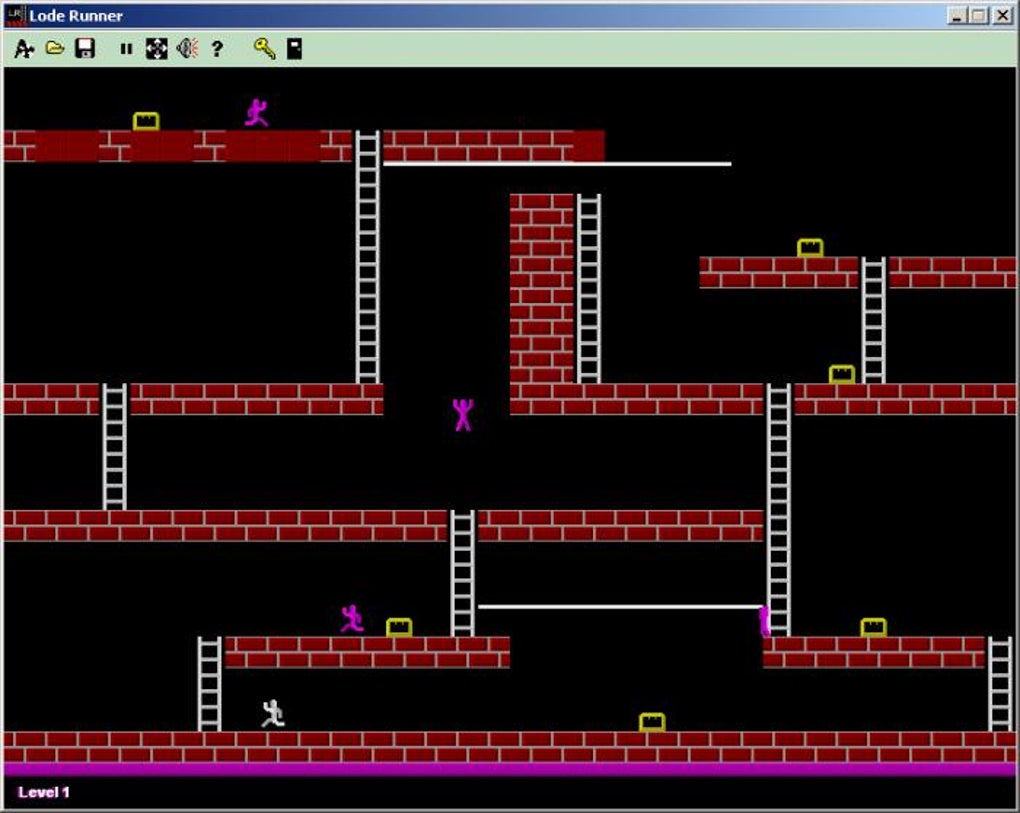
The placement of gold pieces often necessitates elaborate maneuvers, requiring players to plan several steps ahead to avoid being trapped or cornered. The challenge is not simply about reacting to the guards’ movements but about anticipating their behavior and strategically positioning themselves to outsmart them. This strategic depth, coupled with the precision required for successful navigation and digging, gives Lode Runner a significant replay value, as players constantly seek more efficient and elegant solutions to each level.
Intuitive Controls and Immersive Presentation
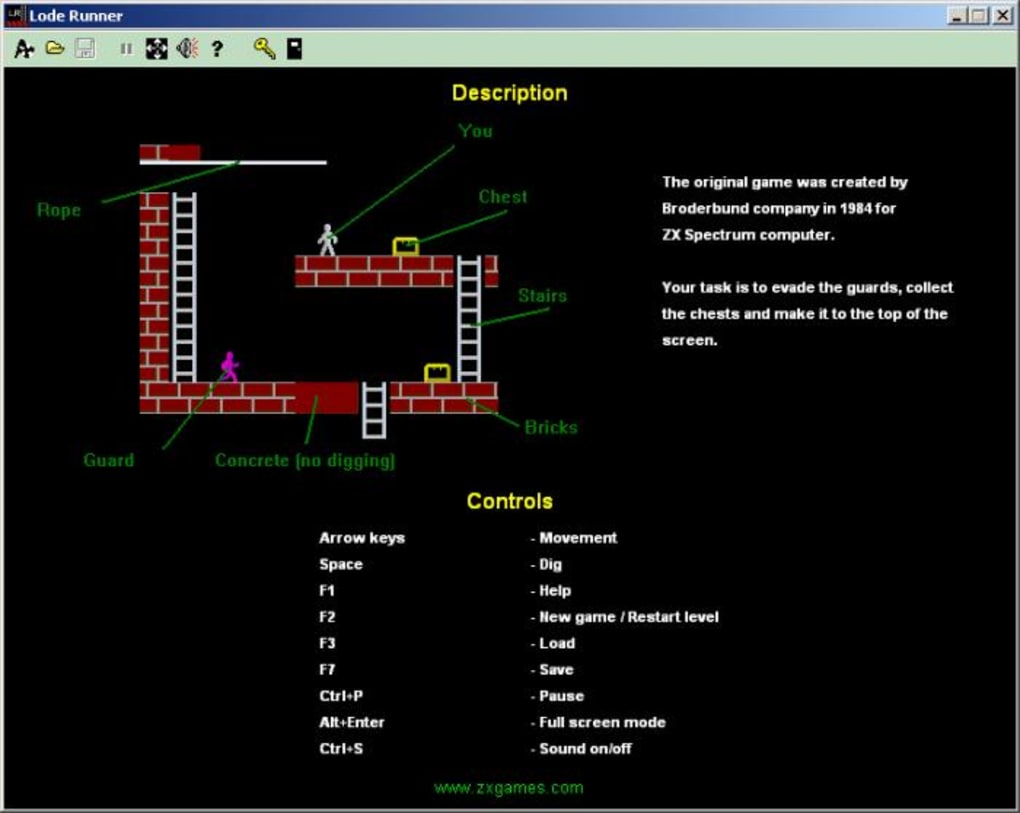
Despite its demanding gameplay, Lode Runner boasts remarkably intuitive controls. The simple commands – movement using arrow keys and digging using the spacebar – are easily learned, allowing players to focus on the strategic aspects of the game rather than wrestling with complex control schemes. The game’s graphics, though simple by today’s standards, are effective in conveying the game’s world and atmosphere. The minimalist design enhances the overall clarity and allows players to easily discern the various elements within the gameplay environment.
The sound design, while equally understated, contributes to the game’s atmosphere. The distinct sounds of digging, footsteps, and the guards’ movements provide subtle yet essential audio cues that enhance the overall player experience. This combination of intuitive controls and effective, albeit simple, graphics and sound design creates a timeless and engaging gaming experience that remains enjoyable even decades after its initial release.
Endless Creativity: The Level Editor
One of the most remarkable features of Lode Runner is the inclusion of a level editor. This allows players to design their own levels, sharing their creations with other players, thereby significantly expanding the game’s replayability and longevity. This feature fostered a thriving community of players who not only played the game but also contributed to its ongoing evolution by crafting their own unique and challenging levels, some exceeding the complexity and sophistication of the original levels.
This aspect extends the game’s lifespan far beyond what would be possible with a fixed set of levels, making it a platform for community-driven content generation and fostering a sense of collaboration among players. The creative potential unleashed by the level editor serves as a testament to the game’s enduring appeal, transforming it from a single-player experience into a platform for ongoing creation and interaction.
Shortcomings and Challenges
Despite its many strengths, Lode Runner is not without its shortcomings. The game’s reliance on a singular set of mechanics – digging and collecting – can feel somewhat repetitive to players seeking a broader variety of gameplay elements. The challenge is predominantly based on precision and strategic thinking, and those seeking more action-oriented experiences may find the gameplay loop somewhat limiting. This may not appeal to players who prefer more diverse mechanics or dynamic action sequences.
Furthermore, the game’s difficulty curve can be quite steep. While the initial levels offer a gentle introduction, the difficulty increases rapidly, potentially leading to frustration for those unaccustomed to the precision and strategic thinking demanded by classic platformers. The later levels require exceptional skill and planning, potentially resulting in a significant challenge even for seasoned gamers. This steep learning curve can be a barrier to entry for many casual players, while experienced players will revel in the challenge.
Lode Runner: A Legacy of Innovation
Despite these minor drawbacks, Lode Runner remains a significant achievement in game design. Its simple yet engaging premise, coupled with its strategic gameplay and intuitive controls, have established it as a timeless classic. The game’s enduring appeal is a testament to its effective combination of puzzle-solving and platforming elements, presenting a challenge that rewards skillful play and strategic thinking. The inclusion of a level editor further cemented its legacy, allowing for continuous player interaction and content generation, effectively extending the lifespan of the game far beyond its original release.
Lode Runner’s lasting influence can be seen in numerous subsequent games that adopted and expanded upon its core mechanics and design philosophy. Its legacy lies not just in its individual merit but also in its impact on the gaming landscape, inspiring countless developers and shaping the evolution of the puzzle-platform genre. It stands as a reminder that simplicity and elegance in game design can often be more effective and enduring than complex mechanics and flashy visuals. The game’s enduring popularity is a testament to its effective and timeless design, proving that a well-crafted core gameplay loop can transcend generations of gamers. In conclusion, Lode Runner offers a captivating and nostalgic adventure, a true classic that deserves its place in gaming history.
File Information
- License: “Trial version”
- Version: “1.5”
- Latest update: “July 4, 2024”
- Platform: “Windows”
- OS: “Windows XP”
- Language: “English”
- Downloads: “81.2K”
- Size: “724.94 KB”


