
Mathematica, a flagship product from Wolfram Research, stands as a premier technical computing software package. For over three decades, it has consistently evolved, integrating cutting-edge algorithms and a user-friendly interface to address the complex computational needs of researchers, engineers, and developers across diverse fields. This comprehensive analysis explores Mathematica’s capabilities, advantages, limitations, and its place within the broader landscape of technical computing software.
Unmatched Computational Power and Versatility
Mathematica distinguishes itself through its robust computational engine, leveraging advanced algorithms to perform calculations with remarkable speed and accuracy. Unlike general-purpose software, Mathematica is specifically designed for handling intricate mathematical problems, symbolic manipulations, and large-scale data analysis. This specialized design translates into significant efficiency gains, often completing tasks in a fraction of the time required by alternative platforms. Its capabilities extend far beyond basic numerical computations; it excels in areas such as:
-
Symbolic calculations: Mathematica performs symbolic manipulation of mathematical expressions, simplifying, solving, and transforming equations with ease. This capacity is invaluable in fields like theoretical physics, mathematics research, and algorithm development, where understanding the underlying structure of equations is crucial. It handles integrals, derivatives, differential equations, and other complex mathematical operations with precision and efficiency.
-
Numerical computation: While symbolic manipulation forms a core strength, Mathematica also offers robust numerical computation capabilities. It handles numerical integration, differentiation, solving equations numerically, and performing sophisticated statistical analysis with high accuracy and speed. This combination of symbolic and numerical capabilities makes it exceptionally versatile.
-
Data science and visualization: The software provides a comprehensive suite of tools for data manipulation, analysis, and visualization. Import, clean, transform, and analyze large datasets using built-in functions. Create interactive visualizations, charts, and graphs to explore patterns and trends within data, facilitating effective data-driven decision-making. Advanced statistical modeling and machine learning algorithms are also readily accessible within the environment.
-
Image processing: Mathematica’s image processing capabilities are extensive, allowing for tasks ranging from basic image manipulation (resizing, cropping, color adjustments) to sophisticated techniques like image segmentation, feature extraction, and image recognition. Its ability to seamlessly integrate image processing with other computational tasks makes it ideal for applications in medical imaging, computer vision, and scientific research.
-
Virtual visualizations: Mathematica’s visualization capabilities extend beyond simple 2D plots and graphs. It enables the creation of complex 3D visualizations, interactive models, and animations, facilitating a deeper understanding of intricate data sets and processes. This feature is particularly useful in fields like engineering, physics, and biology, where visualizing complex systems is often essential for interpretation and understanding.
-
Document creation: Mathematica allows for the creation of highly interactive documents that seamlessly integrate text, code, calculations, and visualizations. These documents are not merely static reports; they are dynamic, allowing users to explore the computational process and manipulate parameters to see the effects in real time. This functionality is highly useful for documenting research findings, developing interactive tutorials, and creating professional-quality technical reports.
Intuitive Design and Accessibility
Despite its power, Mathematica strives for user-friendliness. Its highly integrated design minimizes the need for context switching between different tools, promoting a smooth workflow. The intuitive interface, coupled with extensive documentation and a large community of users, facilitates a relatively gentle learning curve, even for those without extensive prior experience in technical computing.
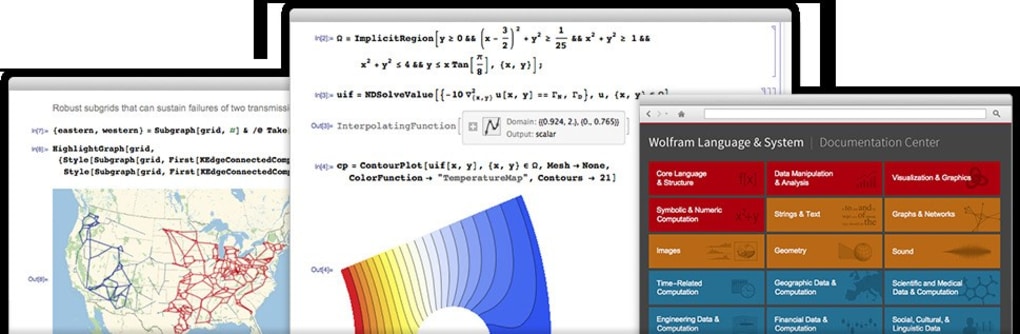
The software’s vast library of built-in functions, encompassing a wide range of mathematical, scientific, and engineering domains, significantly reduces the need for manual coding for many common tasks. This accelerates development time and minimizes the potential for errors. Moreover, the extensive documentation center, boasting over 150,000 examples, provides ample support and guidance for users of all levels. This extensive documentation provides practical examples demonstrating the application of various functions and techniques, enabling users to quickly learn and apply Mathematica’s capabilities to their specific needs.
Cloud Integration and Ecosystem
Mathematica leverages cloud computing for enhanced functionality and collaboration. The seamless integration with the Wolfram Cloud allows users to access vast computational resources, share work collaboratively, and deploy applications online. This cloud connectivity facilitates both individual productivity and collaborative projects, fostering innovation and knowledge sharing.
The Mathematica ecosystem extends beyond the core software. It encompasses a wide range of add-on packages, extending its functionality into specific domains. These packages cater to diverse needs, from specialized statistical methods to advanced simulations in specific fields. The availability of these add-ons significantly broadens Mathematica’s applicability and adapts it to an even wider spectrum of research and development tasks.
Limitations and Considerations
While Mathematica offers considerable advantages, it’s important to acknowledge certain limitations:
-
Cost: Mathematica is a commercial product with a substantial price tag. This cost may be prohibitive for individual users or smaller organizations with limited budgets. This financial investment should be carefully considered in relation to the software’s potential benefits and the availability of alternative, potentially less expensive, options.
-
Learning curve: While the interface is generally intuitive, mastering Mathematica’s full capabilities requires time and effort. New users may need to invest considerable time in learning the software’s syntax, functions, and overall workflow before achieving optimal productivity. While the documentation is extensive, the initial learning phase can be challenging for users without a strong mathematical or programming background.
-
Resource requirements: Mathematica demands significant system resources, particularly for handling large datasets or complex computations. Users should ensure their hardware meets the software’s requirements to avoid performance bottlenecks. Running computationally intensive tasks might require high-end hardware specifications to ensure smooth operation and prevent delays.
-
Limited novice-friendliness: Although efforts have been made to improve user-friendliness, Mathematica remains a sophisticated tool best suited for users with a reasonable level of mathematical or programming proficiency. Novices without this foundation might struggle with the software’s advanced capabilities and might benefit from starting with more basic or introductory software before delving into Mathematica.
Conclusion
Mathematica remains a powerful and versatile tool for technical computing. Its combination of symbolic and numerical capabilities, coupled with its extensive library of functions, intuitive interface, and cloud integration, makes it an attractive option for researchers, engineers, and developers across a wide spectrum of disciplines. While the cost and learning curve pose potential barriers, the significant efficiency gains and enhanced analytical power often outweigh these challenges for those who require the software’s advanced capabilities. Its broad application across scientific, engineering, and data-intensive domains continues to solidify its position as a leading software in advanced technical computing. The ongoing development and expansion of its functionality ensure it remains a relevant and invaluable tool in an ever-evolving technological landscape.
File Information
- License: “Full”
- Version: “14.2”
- Latest update: “July 28, 2025”
- Platform: “Windows”
- OS: “Windows 7”
- Language: “English”
- Downloads: “50.1K”


