
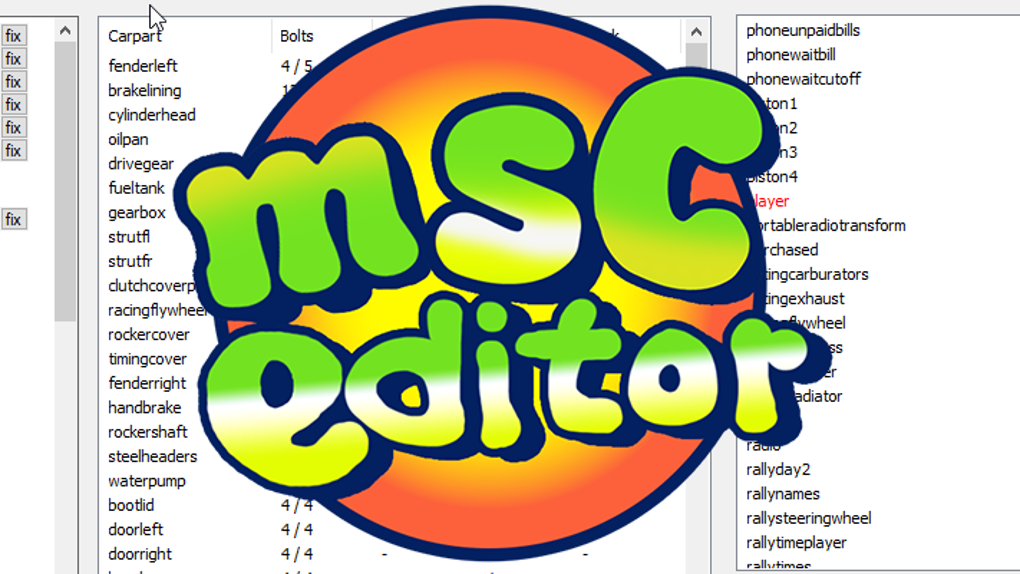
MSCEditor is a game modification tool exclusively designed for Windows Vista. While its current availability and functionality may be limited due to its age and the obsolescence of the operating system it targets, understanding its capabilities provides a fascinating glimpse into the early days of advanced game modding. This article delves into the features, limitations, and historical context of MSCEditor, exploring its impact and legacy within the gaming community.
MSCEditor’s Core Functionality: Modifying the Game Experience
At its core, MSCEditor allowed users to directly edit their saved game files, offering a level of customization previously unseen in many games. This powerful tool provided access to various game elements, enabling modifications to:
-
Fonts: Users could alter in-game text fonts, changing the visual style and readability of menus, dialogues, and other textual information. This allowed for increased personalization and potentially even the creation of custom fonts for specific aesthetic effects.
-
Textures: MSCEditor facilitated the modification of game textures, the visual surfaces of in-game objects and environments. This enabled users to replace existing textures with their own custom creations, dramatically altering the look of the game world. Imagine replacing the standard grass texture with something more fantastical, or re-skinning characters with different outfits.
-
Shaders: By allowing modification of shaders, MSCEditor provided a pathway to influence the lighting, shading, and overall visual effects within the game. This advanced functionality allowed for significant alterations to the game’s atmosphere and visual style, enhancing or completely changing the aesthetic appeal.
-
Particles: The ability to modify particles offered control over visual effects such as smoke, fire, sparks, and other dynamic elements. This allowed users to tweak the realism of existing effects or create entirely new particle systems, enriching the game world with custom visual spectacle.
The combination of these modification options meant MSCEditor provided a significant level of control over the visual presentation of games, allowing for significant aesthetic changes and potentially enabling players to create unique game experiences.
Limitations and Compatibility Challenges: The Audio Decoder Issue
Despite its potential, MSCEditor suffered from significant limitations, the most notable being its initial inability to decode audio files within the Windows Vista environment. This severely hampered its functionality, as audio is a crucial component of most video games. The absence of audio decoding capabilities meant that any attempts to modify audio aspects of a game would be rendered useless. This flaw significantly undermined MSCEditor’s overall utility.
Fortunately, this limitation was addressed by the community. Recognizing the significant deficiency, a collaboration, possibly involving members of the k-lite codec team, developed a solution to improve compatibility with Windows Vista video card drivers. This breakthrough enabled MSCEditor to function more effectively, though the specifics of the collaboration and the exact nature of the solution remain somewhat obscure.
Video Conversion Capabilities: Bridging the Gap
Beyond game modification, MSCEditor unexpectedly showcased video conversion capabilities. The program’s encoder could convert Windows videos into alpha formats suitable for output to AVI, MPEG-2 AVI, or other lossless video formats. This feature demonstrated a surprising versatility beyond its core gaming focus, although it’s unclear how widely utilized this functionality was.
However, the effectiveness of the video conversion heavily depended on the user’s graphics card. The program’s documentation strongly suggested that optimal performance and output quality required a graphics card specifically designed for, or at least well-suited to, MSCEditor’s functionalities. Using an incompatible graphics card resulted in poor video quality, effectively rendering this feature unreliable for many users.
A Case Study: The Game “Kilju Master”
The provided text mentions the game “Kilju Master” as an example of a game that received positive reviews, presumably after being modified using MSCEditor. This section offers a brief overview of the game’s narrative, highlighting the potential impact of MSCEditor on the player experience.
“Kilju Master” appears to be a game revolving around a young boy named Kilju (possibly a reference to the Korean word for alcohol, highlighting a cultural element) living in a town named Kilju, interpreted as “Kingdom of Korea.” The game’s storyline focuses on Kilju’s journey, involving tasks such as caring for an orphan, a pirate-fighting mission, and a quest to uncover the fate of a dragon-like hero. This brief synopsis demonstrates a narrative filled with adventure and mystery, suggesting a potential rich gaming experience that could be further enhanced through the use of MSCEditor. However, without further information, it remains unclear what specific aspects of the game were modified using the application. The positive reviews suggest that, whatever the modifications were, they contributed positively to the overall gaming experience.
MSCEditor’s Legacy and Modern Relevance
MSCEditor, despite its limitations and focus on an outdated operating system, serves as a testament to the early stages of sophisticated game modification tools. While it may not be directly relevant to modern gaming, its functionalities foreshadow the advanced modding capabilities present in contemporary games and modding communities. The core principles – manipulating game files to alter textures, fonts, shaders, and other elements – remain fundamental to the art of game modding today. Furthermore, the challenges faced during MSCEditor’s development, specifically the audio decoding issue and the hardware dependence of video conversion, highlighted crucial aspects of software development and compatibility that continue to be relevant in modern software engineering.
Its existence highlights the ingenuity of early modders and developers in pushing the boundaries of game customization, even with limited resources and technological constraints. Understanding MSCEditor’s strengths and weaknesses provides a valuable historical perspective on the evolution of game modification, serving as a stepping stone in the broader narrative of gaming technology. While not actively used today, it stands as a precursor to the vastly more sophisticated and widely accessible modding tools we see in modern gaming environments.
Technical Specifications and Availability
MSCEditor was a free application available for Windows operating systems, specifically targeting Windows Vista. The latest version, 1.12, was reportedly last updated on July 16, 2025 (although the accuracy of this date may be questionable due to the age of the software and lack of readily available updated information). Its relatively small file size (22.51 MB) reflects the technological limitations of its era. The developer is listed as “durkhaz,” although further information about this developer is unavailable. The application’s availability now is likely highly limited, if available at all, due to its age and dependence on a no longer supported operating system.
User Reviews and Community Feedback
As the provided text mentions, there are currently no user reviews available for MSCEditor. This lack of readily available feedback highlights the age and obsolescence of the software. However, the limited information suggests that, at least for some users, the application provided a positive modding experience. Further research into online gaming forums or archives from the era might reveal more detailed user experiences and feedback regarding MSCEditor.
The absence of user reviews underscores the importance of considering the historical context when evaluating the software. The limited accessibility of the software and the obsolescence of its target operating system directly impact the availability of reviews and community feedback.
Conclusion: A Look Back at a Pioneering Modding Tool
MSCEditor’s place in gaming history might be small, but it’s significant. It represents an early attempt at providing sophisticated game modification capabilities. While its limitations, particularly its dependence on Windows Vista and initial lack of audio support, significantly restricted its usefulness, it laid the groundwork for the more advanced modding tools available today. Analyzing MSCEditor’s functionality, its shortcomings, and the solutions developed to address them provides a valuable insight into the challenges and triumphs of early game modding. Ultimately, MSCEditor stands as a testament to the enduring creativity and resourcefulness of gamers and developers who pushed the boundaries of game customization, shaping the path toward the more sophisticated modding landscape we enjoy today.
File Information
- License: “Free”
- Version: “1.12”
- Latest update: “July 16, 2025”
- Platform: “Windows”
- OS: “Windows 10”
- Language: “English”
- Downloads: “11.8K”
- Size: “22.51 MB”


