
Nanny Mania is a fast-paced simulation game that throws players into the chaotic yet engaging world of childcare and household management. Stepping into the shoes of a nanny, players are tasked with juggling a multitude of responsibilities within a bustling household, racing against the clock to complete tasks and progress to increasingly challenging levels. The game’s addictive gameplay, coupled with its surprisingly detailed graphics and animations, makes it a captivating experience for fans of time management and simulation genres. While the core gameplay loop remains consistent throughout, the escalating difficulty and the sheer volume of tasks ensure a constantly stimulating experience, making it easy to lose track of time while immersed in the virtual world of domestic duties.
A Day in the Life (and Levels) of a Virtual Nanny

Nanny Mania presents players with a top-down perspective, offering a comprehensive view of the household. This bird’s-eye view allows for efficient navigation and prioritization of tasks. The player’s home base is a large house with multiple rooms, each demanding attention. The rooms typically include a kitchen, children’s bedrooms, a living area, and potentially other areas, each presenting unique challenges. The objective is simple: keep the family happy, maintain a tidy home, and successfully complete all assigned tasks within a given time limit. These tasks are diverse, encompassing a wide range of household chores, from preparing meals and cleaning rooms to attending to the needs of the family members—primarily the children, but also often including parents.
The initial levels introduce players to the basic mechanics and the rhythm of the game. The family is relatively small, consisting of a child, a mother, and a father. The tasks are straightforward: feed the child, clean up messes, make the beds, and prepare simple meals. However, as the player progresses through the levels, the complexity increases significantly. The family expands, adding more children with unique needs and temperaments. The number of chores increases, and their complexity escalates, demanding greater speed and efficiency from the player. This could involve managing multiple children simultaneously, preparing more elaborate meals, dealing with unexpected situations (like spills or tantrums), and ensuring all areas of the house are maintained in a satisfactory state. This increasing difficulty curve keeps the game consistently engaging, preventing monotony and maintaining the thrill of the challenge.
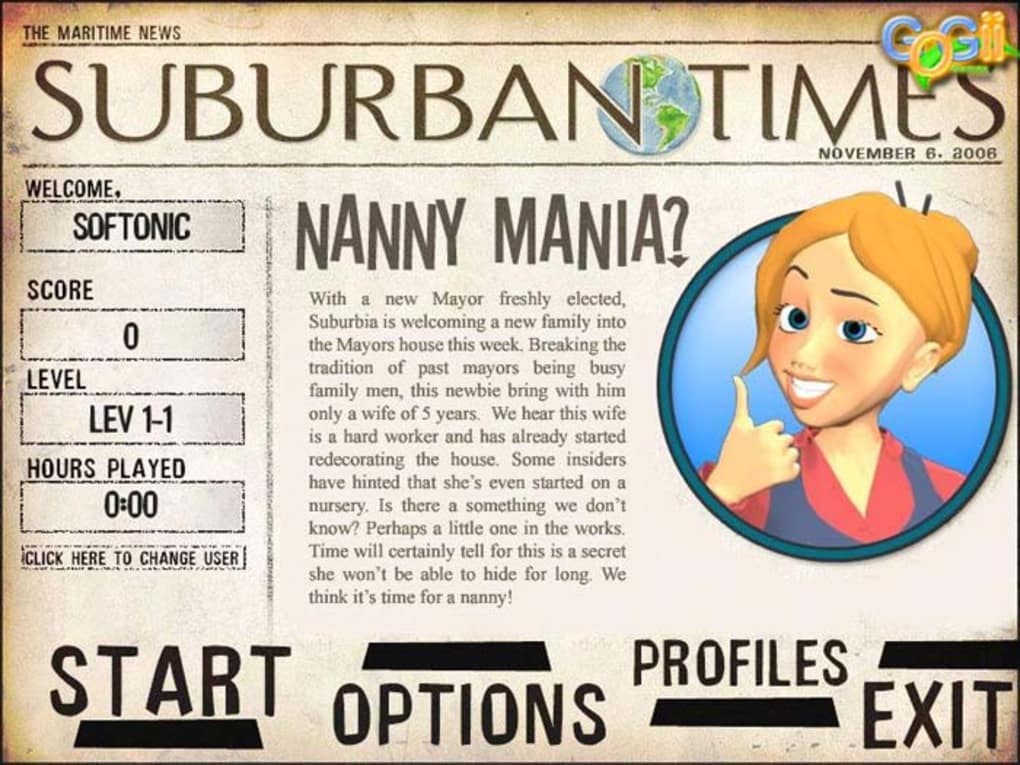
The progression system is tied to successful completion of levels. Each level presents a new set of challenges within a time limit. Successfully managing all tasks within the allotted time results in progression to the next level, which introduces new challenges and demands. Failure to complete all tasks or exceeding the time limit might result in a “game over” scenario, requiring the player to replay the level. This creates a motivating structure that encourages strategic planning and efficient task management.
Gameplay Mechanics and User Interface
Nanny Mania’s user interface is designed for intuitive navigation and efficient task completion. The game’s top-down view allows players to see the entire house at once, easily assessing which tasks require immediate attention. The tasks themselves are generally represented by clear visual cues, such as dirty dishes in the kitchen, messy rooms, or children requiring attention. The user interface employs simple click-and-drag mechanics for many actions, facilitating a smooth and intuitive playing experience. Players simply click on a task or object to initiate the corresponding action. For instance, clicking on a child might initiate a feeding sequence, while clicking on a dirty plate might prompt a cleaning animation.
The time management aspect is crucial to the gameplay. Players must carefully prioritize tasks and manage their time effectively to complete all chores before the time runs out. This necessitates a level of strategic thinking, requiring the player to anticipate the needs of the family and adapt their actions to the unfolding events. The time pressure adds to the overall excitement and engagement, enhancing the game’s addictiveness. The game is designed so that there isn’t a single ‘optimal’ solution for each level; there’s an element of trial-and-error, adapting to the evolving situation. A player who might prioritize cleaning first in one level might find it more efficient to prioritize child care in another.

Comparisons and Genre Similarities
Nanny Mania sits comfortably within the casual game genre, sharing similarities with other popular titles such as Diner Dash and The Sims. Like Diner Dash, Nanny Mania emphasizes fast-paced gameplay and efficient task management within a time-constrained environment. Players need to quickly and efficiently navigate a series of tasks, prioritizing actions to maximize productivity. The overall feeling of being overwhelmed by a constant influx of tasks mirrors that of Diner Dash, creating a similar feeling of controlled chaos. The fast-paced action keeps players constantly engaged, preventing boredom.
The game also shares some conceptual similarities with The Sims, in the sense of managing the needs and behaviors of virtual characters. Though less complex than The Sims, Nanny Mania involves observing and responding to the needs of the virtual family members, ensuring they are fed, clothed, and entertained. This element of character interaction, albeit simplified, adds a layer of depth to the gameplay, moving beyond mere task management and introducing a degree of relationship-building. Unlike The Sims, however, Nanny Mania lacks the extensive customization and open-endedness that define The Sims’ experience. The focus is solely on managing the household and its inhabitants within the boundaries of each level’s objectives.
Strengths and Weaknesses
One of Nanny Mania’s biggest strengths lies in its addictive gameplay. The fast-paced nature, coupled with the progressively challenging levels, keeps players engaged for extended periods. The combination of time management, task juggling, and the satisfaction of completing each level successfully creates a compelling loop that encourages continuous play. The game’s visuals, while not hyper-realistic, are attractive and contribute to its overall charm.
However, the game’s relatively limited variation in gameplay represents a potential weakness. The core gameplay loop remains largely unchanged throughout, with the primary differences stemming from the increasing number of tasks and family members. While the escalating difficulty maintains some level of novelty, more diverse gameplay mechanics or side objectives could enhance the long-term appeal. The repetitive nature of the tasks, although individually satisfying to complete, might become monotonous for some players over time, especially those seeking greater depth and complexity in their simulation game experiences.
Despite this limitation, Nanny Mania remains a solid entry in the casual game genre, offering an accessible and engaging experience for players who enjoy fast-paced time management and simulation games. Its simplistic yet effective mechanics, combined with its addictive quality, make it a worthwhile download for those seeking a lighthearted and challenging gaming experience. The game’s accessibility and ease of play make it ideal for casual gamers looking for a quick and fun diversion, while the ever-increasing difficulty challenges even experienced players. The game successfully balances simplicity and challenge to create a game that is both approachable and rewarding.
File Information
- License: “Full”
- Version: “demo”
- Latest update: “May 17, 2018”
- Platform: “Windows”
- OS: “Windows 98 SE”
- Language: “English”
- Downloads: “129.8K”
- Size: “20.03 MB”


