
In the intricate world of network protocols, where the giants like FTP (File Transfer Protocol) and HTTP (HyperText Transfer Protocol) handle complex, secure data exchanges, there exists a simpler, more specialized sibling: TFTP (Trivial File Transfer Protocol). While its name might imply limited utility, TFTP is an indispensable tool for specific network operations, particularly in environments demanding efficiency, speed, and minimal overhead. For network administrators, IT professionals, and those managing industrial automation systems, a reliable TFTP server is not just a convenience, but a critical component of their infrastructure. This is precisely where Open TFTP Server steps in, offering a free, multi-threaded utility designed to meet the nuanced demands of TFTP operations with remarkable efficiency and an exceptionally small system footprint.
Open TFTP Server is a dedicated solution primarily for Windows operating systems (and capable of running as a daemon on Unix-like systems), engineered to streamline the management of simultaneous TFTP device instances. Its functionality extends far beyond basic file transfers, encompassing robust support for critical network functions such as PXEBOOT (Preboot Execution Environment), comprehensive firmware management, and the crucial task of maintaining configuration files for a wide array of network equipment. The core philosophy behind its design is resource optimization, making it an ideal choice for environments where system overhead must be kept to an absolute minimum. This comprehensive guide will delve into the foundational aspects of TFTP, explore the powerful capabilities of Open TFTP Server, illuminate its ideal deployment scenarios, and provide insights into why this free utility stands as a go-to solution for specific, yet vital, network administration challenges.
Understanding TFTP: The Core Protocol and Its Applications
To fully appreciate the value of Open TFTP Server, it’s essential to first establish a solid understanding of TFTP itself – what it is, how it operates, and why it remains relevant in modern networking. TFTP, or Trivial File Transfer Protocol, is a high-level protocol specifically designed for transferring files between network devices. Its “trivial” designation is a direct reference to its intentionally minimalistic design, stripping away the complexities and overhead associated with more feature-rich protocols like FTP and HTTP. This simplicity makes TFTP exceptionally efficient for tasks where robust authentication, directory browsing, or advanced security mechanisms are either unnecessary or would impede performance.
The most fundamental difference distinguishing TFTP from its more common counterparts lies in its transport layer protocol. Unlike FTP and HTTP, which rely on TCP (Transmission Control Protocol) for reliable, ordered, and error-checked data delivery, TFTP utilizes UDP (User Datagram Protocol). UDP is a connectionless protocol; it does not establish a persistent connection or handshake between the client and server before transmitting data. Instead, it fires off data packets without explicit acknowledgments of receipt from the destination. This approach makes UDP inherently faster and significantly less resource-intensive than TCP, which involves a three-way handshake, flow control, congestion avoidance, and guaranteed delivery through retransmissions at the transport layer.
While UDP’s connectionless nature grants TFTP its speed advantage, it comes at the cost of inherent security and reliability. TFTP, by design, provides no user authentication, no encryption, and no mechanism for listing directories. Its operations are strictly limited to either a “get” (retrieve a file) or “put” (send a file) command for a specific file name. If a packet is lost during transfer, TFTP typically relies on simple timeout and retransmission mechanisms at the application layer, without the sophisticated windowing and congestion control of TCP. This stark simplicity is both TFTP’s greatest asset and its primary limitation.
Historically, TFTP emerged in the early days of computing and networking as a lightweight method for bootstrapping devices over a network. Its primary applications quickly became centered around scenarios where devices needed to load initial configurations or operating system components without the need for local storage or complex software stacks. Key use cases where TFTP continues to be indispensable include:
- PXE Boot (Preboot Execution Environment): This is arguably TFTP’s most prevalent and critical application. PXE allows a computer to boot directly from its network interface card (NIC), downloading its initial boot image (e.g., a network boot loader, kernel, or an entire mini-operating system) from a designated TFTP server. This functionality is vital for deploying operating systems across a large number of machines, managing diskless workstations, or performing system recovery and diagnostics in data centers and enterprise environments.
- Firmware Updates and Management: Numerous network devices, ranging from enterprise-grade routers, switches, and firewalls to IP phones, industrial controllers, and IoT devices, utilize TFTP as a simple and efficient method to download and update their firmware. The low overhead of TFTP makes it ideal for these devices, which often possess limited processing capabilities and memory resources. An Open TFTP Server can centralize the storage and distribution of these critical firmware images.
- Configuration File Backups and Deployments: Similar to firmware, configuration files for a wide variety of network equipment can be effortlessly uploaded to or downloaded from a TFTP server. This enables network administrators to easily back up current device configurations, restore previous states, or push standardized configurations to multiple devices efficiently, which is particularly beneficial in large-scale deployments, managed service provider (MSP) operations, or industrial automation settings.
- Booting Diskless Clients: In environments where client machines are designed to operate without local hard drives, TFTP plays a crucial role in loading the initial boot loader and operating system kernel, allowing the workstation to become operational before accessing network file systems for further resources.
The enduring relevance of TFTP, despite its age and intentional simplicity, highlights its focused utility in specific, mission-critical network niches. While modern networking prioritizes robust security, TFTP’s directness and minimal overhead remain invaluable for device-level operations within controlled environments. It is imperative, however, that TFTP servers are deployed judiciously, typically confined to secure, internal network segments, and never exposed directly to the public internet due to its inherent lack of security. Open TFTP Server is meticulously engineered to serve these practical and essential applications, providing a stable, efficient, and feature-rich platform for all TFTP-based operations.
Key Features and Capabilities of Open TFTP Server
Open TFTP Server is far more than a rudimentary TFTP daemon; it’s a sophisticated, multi-faceted utility packed with features designed to meet the rigorous demands of contemporary network environments. Its principal strengths lie in its advanced multi-threading architecture, comprehensive support for industry-standard TFTP extensions, detailed logging capabilities, and highly configurable settings. These attributes coalesce to form an exceptionally functional and efficient tool for network administrators.
At the heart of Open TFTP Server’s robust design is its multi-threading capability. This means the server can adeptly handle multiple concurrent TFTP requests without introducing bottlenecks or necessitating individual server instances for each operation. For network administrators tasked with managing a significant number of devices that might simultaneously require firmware updates, configuration files, or PXE boot images, this feature offers a profound advantage. Imagine a factory floor where dozens, or even hundreds, of industrial controllers, IP phones, or embedded systems are all attempting to update their firmware or retrieve new configuration profiles. Open TFTP Server can seamlessly manage these simultaneous interactions, ensuring that each device receives its data promptly and without contention. This ability to “run different processing threads simultaneously” allows for real-time monitoring and efficient management of multiple TFTP device interactions, leading to enhanced operational efficiency and significantly fewer delays.
Beyond just its multi-threading prowess, Open TFTP Server boasts support for nearly every industry-standard TFTP feature. This extensive feature set is what truly distinguishes Open TFTP Server from more simplistic alternatives. Key functionalities include:
- Comprehensive PXE Boot Support: As a cornerstone of modern network deployment strategies, PXE Boot is fully supported, allowing administrators to deploy operating systems, diagnostic tools, or custom boot environments to bare-metal machines over the network without physical media.
- Reliable Firmware Load Management: Critical for maintaining network device health and security, the server handles firmware transfers dependably, ensuring that vital updates are applied accurately to devices ranging from routers to VoIP phones.
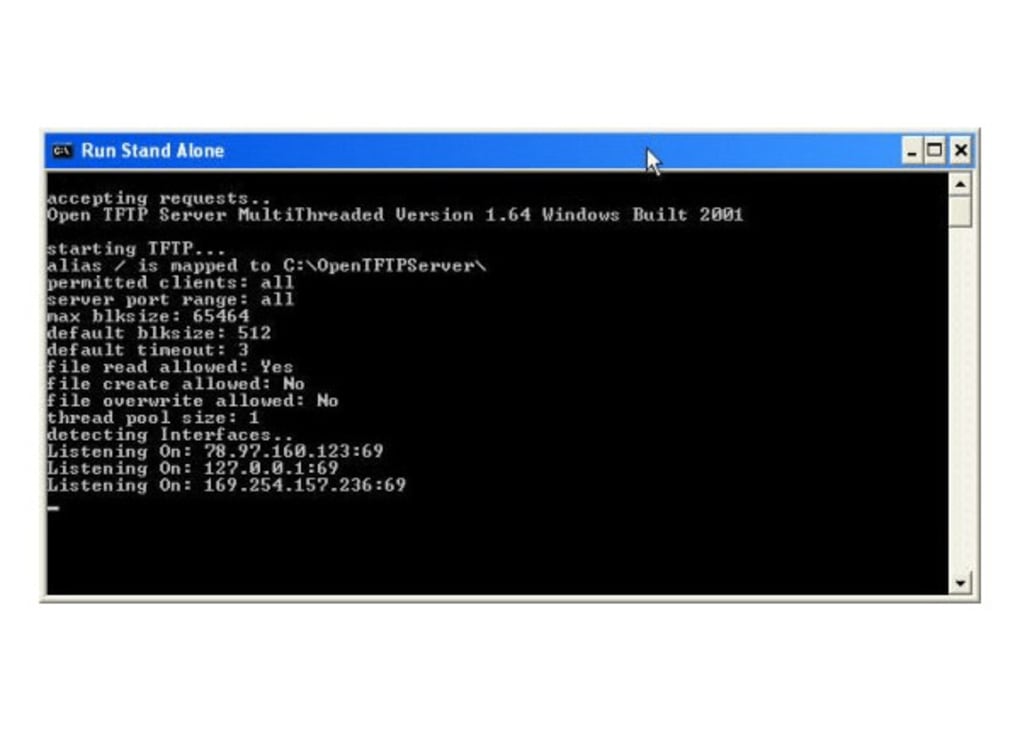
- Configurable Port Ranges and Thread Pools: Flexibility is paramount in diverse network configurations. Open TFTP Server empowers administrators to define custom port ranges for TFTP operations, which can be invaluable in segmented networks or environments with specific firewall rules. Similarly, the ability to adjust the size of thread pools allows for fine-tuning the server’s performance to match the available system resources and anticipated load, thereby optimizing overall efficiency and responsiveness.
- Advanced Block Size and Block Number Rollover for Large Files: Traditional TFTP transfers data in fixed-size blocks (typically 512 bytes). While efficient for small files, this can become impractical for larger files such as operating system images or substantial firmware packages. Open TFTP Server not only supports configurable block sizes (often utilizing the
tsizeoption in TFTP extensions) but, crucially, also incorporates block number rollover. This innovative feature overcomes the limitation of the standard 16-bit block number field in TFTP, which would otherwise cap file sizes at approximately 32 MB. With block number rollover, the block counter resets to zero after reaching its maximum value, enabling the reliable transfer of significantly larger files—an absolute necessity for contemporary firmware and OS deployments. - Adjustable Interval Time: This setting, though sometimes overlooked, can be instrumental in enhancing network stability, especially in environments with less-than-ideal network conditions. It allows for precise tuning of retransmission timeouts, ensuring robust transfers even across lossy links.
Another critical capability is the server’s extensive logging and historical logging features. In the realm of network administration, thorough visibility and robust auditing are non-negotiable. Open TFTP Server provides meticulous logs of all transfer activities, including source IP addresses, file names involved, transfer status (success/failure), and precise timestamps. This real-time logging is invaluable for immediate troubleshooting, proactive security auditing, and comprehensive network activity monitoring. The inclusion of historical logging further enhances this capability by archiving past events, which proves immensely useful for:
- Forecasting Future Needs: Analyzing historical data patterns can help predict future network load and resource demands, enabling administrators to proactively scale their infrastructure and prevent potential bottlenecks.
- In-depth Root Cause Analysis: Identifying recurring patterns, such as repeated transfer failures from a specific device or unexpected file requests, can quickly reveal underlying network issues, misconfigurations, or even potential security breaches.
- Compliance and Regulatory Requirements: For organizations operating in regulated industries, maintaining detailed records of network device configurations and update histories is often a mandatory compliance requirement. Open TFTP Server’s logging capabilities directly support these needs.
Finally, a significant differentiating factor for Open TFTP Server is its extremely small system resource utilization and remarkably small footprint. The application’s installer size is a mere 175.07 KB, which is extraordinarily lightweight for a server application of its caliber. This characteristic is profoundly beneficial for administrators who are concerned with resource overutilization, allowing the server to operate efficiently on older hardware, virtual machines allocated with minimal resources, or alongside other critical applications without causing any perceptible performance degradation. It fully embodies the “trivial” aspect of TFTP in its operational overhead, ensuring it remains unobtrusive while performing its vital file transfer functions.
In summation, Open TFTP Server skillfully consolidates a powerful suite of features into an incredibly lightweight package. Its inherent ability to manage multiple concurrent threads, robust support for essential TFTP extensions, comprehensive and detailed logging, and its capacity to operate with minimal system resources collectively make it an indispensable tool for network administrators and IT professionals whose operations rely heavily on TFTP for reliable device management and efficient network booting.
Strategic Deployment: Use Cases, Performance, and Recommendations
Open TFTP Server’s unique combination of efficiency, specialized functionality, and simplicity renders it exceptionally well-suited for specific operational environments. While its design inherently precludes it from being a suitable solution for general business file transfers or operations that require exposure to untrusted networks, it performs admirably and reliably within controlled, internal network segments, particularly in industrial and factory settings, and for specialized IT administration tasks.
The original source material emphatically states that the application is “especially well-suited to automation and factory environments.” This emphasis is fundamental to understanding its niche value. In these types of environments, one frequently encounters a dense population of embedded systems, programmable logic controllers (PLCs), legacy industrial equipment, VoIP phones, network cameras, and other specialized machinery—many of which rely exclusively on TFTP for various operational tasks. These devices typically operate with constrained processing power and limited memory, making the lightweight nature of TFTP, and consequently Open TFTP Server, an ideal and practical match.
Consider a sprawling modern manufacturing facility. Here, Open TFTP Server can be pivotal for:
- Industrial Automation System Management: PLCs often receive firmware updates, operating system images, or configuration files via TFTP. An Open TFTP Server can centralize the storage and management of these critical files, ensuring consistent and rapid deployment across numerous identical machines throughout the production line, thereby minimizing downtime and ensuring operational continuity.
- Maintenance of Legacy Equipment: Many factories continue to operate with robust, albeit older, machinery that might not support contemporary, more complex protocols like SFTP or SCP. These systems often rely solely on TFTP for their basic file transfer requirements. Open TFTP Server provides a vital bridge to maintain and manage these essential, yet aged, assets, preventing the need for costly premature equipment upgrades.
- VoIP Phone System Deployments: Large-scale deployments of IP phones routinely utilize TFTP to retrieve their initial configuration files (e.g., SIP server details, dial plans, user credentials) and occasionally firmware during their boot sequence. A single Open TFTP Server can efficiently serve these configuration files to hundreds or thousands of phones, drastically simplifying initial setup and ongoing management.
- Network Device Provisioning and Configuration: For network administrators provisioning new routers, switches, access points, or firewalls within a secure internal network, TFTP is frequently used to initially load configuration files or boot images before more secure management protocols are fully enabled. Open TFTP Server streamlines this provisioning process, allowing for rapid and consistent deployment and configuration of essential network infrastructure.
- Bulk Firmware Upgrades: When a specific security vulnerability is identified in the firmware of a range of network devices, or a new feature needs to be rolled out across an entire fleet, Open TFTP Server can be utilized to efficiently and simultaneously distribute the new firmware image to all affected devices.
The value of “maintaining configuration files for old equipment” cannot be overstated. Legacy systems, though resilient, often come with specific protocol dependencies that modern software may no longer support. Open TFTP Server ensures that organizations are not compelled to prematurely retire functional, often expensive, equipment simply due to a lack of a compatible file transfer mechanism. It serves as a reliable repository and delivery system for these critical configuration backups and updates, thus preserving operational continuity and maximizing equipment lifespan.
Moreover, the “minimal resource requirements” of Open TFTP Server make it exceptionally versatile for deployment on various types of hardware. It can run unobtrusively in the background on an existing network administration workstation, a low-power single-board computer, or a virtual machine with modest allocated specifications, all without negatively impacting the performance of other critical applications. This inherent cost-effectiveness and deployment flexibility are highly prized in environments where budgetary constraints or hardware resource limitations might be a concern.
However, it is imperative to re-emphasize the stated “Cons: Not suitable for business use.” This limitation directly stems from the fundamental design of the TFTP protocol. TFTP inherently lacks critical security features such as user authentication, data encryption, and robust access control mechanisms. This means:
- Absence of User Authentication: Any client capable of connecting to the TFTP server can request or upload files from the designated root directory (if write access is enabled). There are no usernames or passwords required.
- Lack of Data Encryption: All data transferred via TFTP is sent in plain text, making it highly susceptible to eavesdropping, interception, and tampering by anyone with network access.
- Limited Access Control: Unlike FTP or HTTP servers that offer granular user permissions and directory restrictions, TFTP typically relies on basic read/write access to the entire root directory, without per-user or per-file security.
- Vulnerability to Network Attacks: The inherent lack of security makes TFTP servers, if improperly secured at the network layer, vulnerable to various attacks, including denial-of-service, unauthorized file access, or the distribution of malicious boot images or configurations.
Therefore, the caveat “not suitable for business use” specifically refers to its unsuitability for general corporate file sharing, the transfer of sensitive or confidential company data, or any application where data confidentiality, integrity, and user authentication are paramount. Open TFTP Server should never be exposed directly to the public internet or to untrusted internal network segments without extremely robust and carefully configured firewall rules and network isolation. It is a highly specialized tool designed for specialized tasks, not a general-purpose secure file server.
The Final Assessment: Who Benefits Most?
Open TFTP Server is an outstanding choice for:
- Network Administrators and Engineers: For essential tasks such as PXE booting new systems, deploying firmware updates to network devices (routers, switches, firewalls, access points), and backing up or restoring device configurations within secure, internal network environments.
- IT Technicians and Helpdesk Staff: When setting up IP phones, network printers, or other embedded devices that rely on TFTP for their initial configuration or firmware updates.
- Industrial Control System Engineers: For managing configuration files, firmware, and boot images for PLCs, SCADA systems, and a wide array of other industrial automation and control equipment.
- Home Lab Enthusiasts and Researchers: For experimenting with network booting, deploying custom firmwares, or setting up small-scale network device management within a secure home network environment.
In conclusion, Open TFTP Server is an exceptionally effective and highly specialized utility that excels within its designated operational domain. Its freeware status, ease of deployment, robust multi-threaded capabilities, and remarkably minimal resource consumption make it a superior choice for specific network administration and industrial automation tasks. However, users must maintain an acute awareness of its inherent security limitations, which are intrinsic to the TFTP protocol itself. When deployed judiciously within a securely segmented network and utilized for its intended strengths, Open TFTP Server proves to be an invaluable asset in the IT toolkit, efficiently managing the trivial yet critical file transfers that ensure the continuous operation and smooth functioning of countless networks and systems worldwide.
File Information
- License: “Free”
- Version: “1.66”
- Latest update: “July 15, 2022”
- Platform: “Windows”
- OS: “Windows 10”
- Language: “English”
- Downloads: “2.6K”
- Size: “175.07 KB”


