
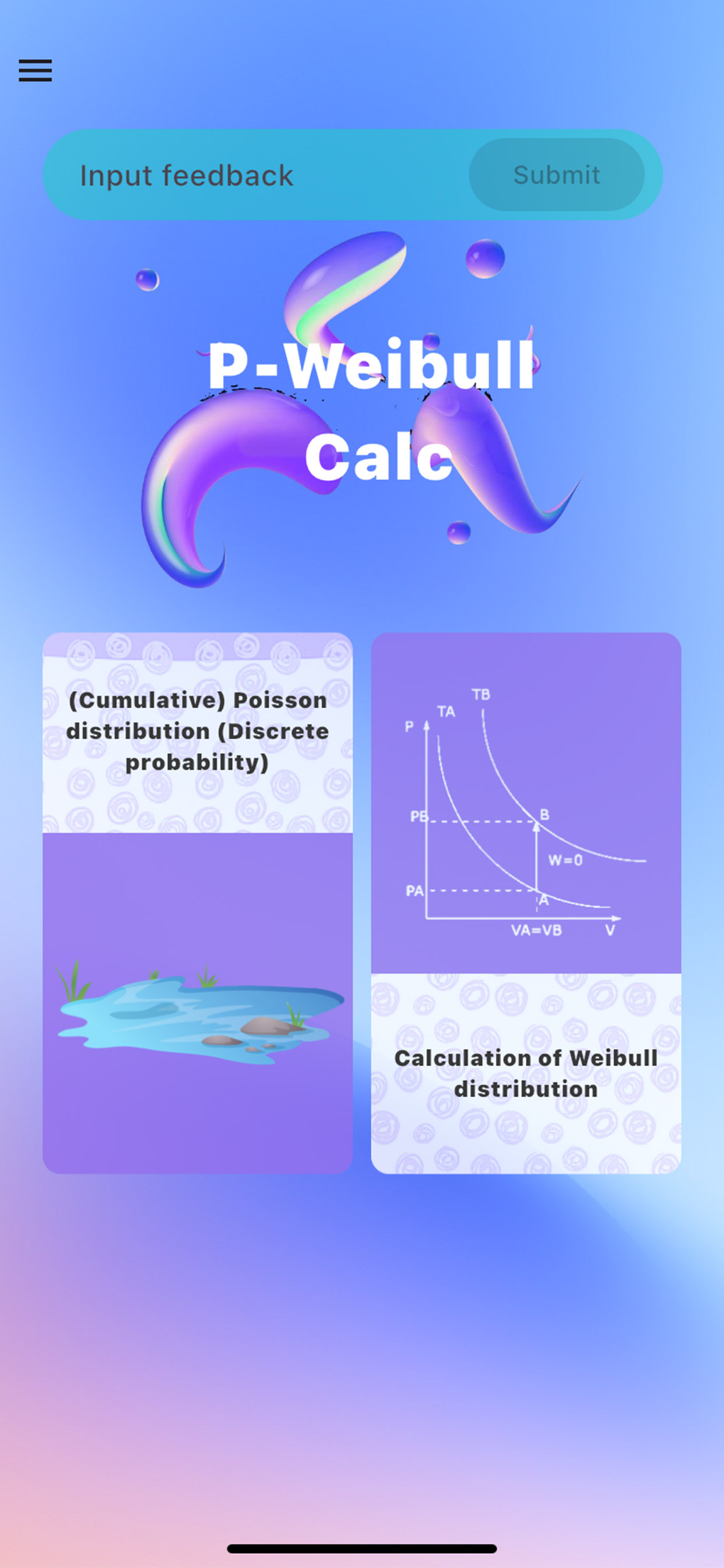
PCalc: Weibull was a free utility application specifically designed for iPhone users, providing a focused approach to statistical calculations. This app’s primary function centered around P-Weibull calculations, enabling users to perform both cumulative Poisson distribution calculations and Weibull distribution analyses. Its streamlined design made it a valuable tool for various professionals, including statisticians, engineers, and researchers, who frequently require quick and accurate probability computations in their work.
The application’s intuitive user interface facilitated straightforward data input and provided instantaneous results. This feature significantly reduced the time and effort needed for complex statistical analyses, allowing users to concentrate on interpreting the data and drawing meaningful conclusions. By simplifying the process of statistical calculations, PCalc: Weibull empowered users to focus on the application of their findings rather than the mechanics of computation.
The app’s core strength lay in its ability to handle discrete probability and distribution calculations efficiently. This capability made it highly relevant across numerous fields heavily reliant on statistical data analysis. The concise focus on these specific calculations distinguished PCalc: Weibull from more general-purpose calculator apps, providing users with a highly specialized tool ideally suited to their specific needs.
Understanding the Weibull Distribution and its Applications
The Weibull distribution is a flexible probability distribution with a wide range of applications in various fields. Its versatility stems from its ability to model diverse phenomena exhibiting different failure rates, making it particularly useful in reliability analysis, survival analysis, and other areas where modeling time-to-event data is crucial. Understanding the characteristics of the Weibull distribution is paramount to effectively utilizing PCalc: Weibull and interpreting its results.
The Weibull distribution is characterized by two key parameters: the shape parameter (k) and the scale parameter (λ). These parameters dictate the shape and scale of the distribution, significantly influencing the interpretation of the results. The shape parameter (k) determines the shape of the distribution, indicating whether the failure rate is constant, increasing, or decreasing over time. A value of k=1 represents an exponential distribution with a constant failure rate. Values of k>1 suggest an increasing failure rate, implying that the likelihood of failure increases over time. Conversely, values of k<1 indicate a decreasing failure rate, where the likelihood of failure diminishes over time.
The scale parameter (λ) governs the scale of the distribution, influencing the average time to failure. A larger value of λ indicates a higher average time to failure, suggesting a higher reliability. Conversely, a smaller value of λ signifies a lower average time to failure, implying lower reliability.
The combined influence of the shape and scale parameters makes the Weibull distribution incredibly versatile. This adaptability allows it to accurately model a broad spectrum of phenomena, from the lifespan of electronic components to the survival times of patients undergoing medical treatment.
PCalc: Weibull’s Functionality and User Experience
PCalc: Weibull offered a straightforward user interface, minimizing the learning curve for users of varying technical expertise. The app was designed with ease of use in mind, prioritizing accessibility and intuitive navigation. This user-friendly design allowed users to quickly input data and receive immediate results, maximizing efficiency.
The application’s core functionalities revolved around the computation of both the cumulative Poisson distribution and the Weibull distribution. The cumulative Poisson distribution is crucial for modeling the probability of a certain number of events occurring within a specified timeframe. This distribution finds frequent applications in scenarios where events are discrete and occur randomly over time. The ability to calculate this distribution was integral to PCalc: Weibull’s overall utility.
The app’s calculation of the Weibull distribution, however, formed the centerpiece of its functionality. This calculation allowed users to determine the probability of an event occurring within a specific timeframe, given the shape and scale parameters of the distribution. This capability was particularly useful in reliability engineering, where understanding the probability of failure within a given period is critical for product design and maintenance.
The user experience was further enhanced by the app’s rapid computation times and immediate display of results. This speed was crucial for users needing quick statistical insights without prolonged waiting periods. The app’s efficiency improved overall workflow, enabling users to swiftly process data and proceed to the interpretation and application of their findings.
Limitations and Alternatives
While PCalc: Weibull provided a valuable service during its availability, it unfortunately is no longer available for download. This unavailability may be due to various reasons, including discontinuation by the developer, the discovery of security vulnerabilities, or other unforeseen circumstances.
The removal of the app from the app store leaves users seeking comparable functionalities with several alternatives. The most straightforward alternatives are likely to be other statistical calculators or software packages offering similar capabilities. While a direct replacement might not exist, several apps and software packages provide comprehensive statistical analysis tools encompassing the functionalities offered by PCalc: Weibull.
One such alternative is the full version of PCalc, a paid application offering a broader range of mathematical functions beyond those specifically tailored for Weibull calculations. This application provides a more general-purpose approach to mathematical and statistical computations, but at a cost.
Another option is PCalc Lite, a free alternative offering a subset of the full PCalc application’s features. While it may not include all the specific functionalities of PCalc: Weibull, it still provides a range of basic calculation tools which could be helpful.
Other general statistical analysis applications and software packages may also be explored. These more comprehensive options usually offer a wide variety of statistical methods, including those related to the Weibull distribution and beyond, but may necessitate a steeper learning curve compared to the targeted focus of PCalc: Weibull.
Conclusion
PCalc: Weibull served as a valuable, specialized tool for iPhone users requiring rapid and accurate Weibull and Poisson distribution calculations. Its intuitive interface and efficient computation made it a popular choice among statisticians, engineers, and researchers. Although the application is no longer available, its legacy underscores the importance of readily accessible statistical tools for various professional fields. The unavailability necessitates a search for alternative applications or software packages to meet the demands of similar statistical analyses. While a direct replacement may not exist, several options offer similar capabilities, albeit sometimes with a broader scope or cost implication. The focus on usability and speed exhibited by PCalc: Weibull, however, should remain a benchmark for future development in this niche area of statistical calculation tools.
File Information
- License: “Free”
- Version: “2.0”
- Latest update: “November 14, 2024”
- Platform: “iPhone”
- OS: “iOS 16.4”
- Language: “English”
- Downloads: “2.1K”


