
In the intricate world of computing, the visual interface serves as our primary gateway to digital interaction. Central to this experience is the display resolution – the number of pixels displayed on a screen, dictating the clarity, sharpness, and overall size of on-screen elements. While modern operating systems like Windows offer built-in functionalities to adjust these settings, the process can often feel cumbersome, requiring navigation through multiple menus and sub-menus. This is where specialized tools come into play, designed to simplify and expedite such essential tasks. Among these, QuickChangeResolution emerges as a compelling solution, a lightweight, open-source application meticulously developed by Jacek Pazera. It promises to transform the way Windows users manage their screen resolution, offering unparalleled ease and speed, far surpassing the native system’s capabilities in both convenience and option breadth.
Understanding Display Resolution and Its Importance
Before delving into the specifics of QuickChangeResolution, it’s crucial to grasp what display resolution entails and why its management is so vital to the user experience.
What is Display Resolution?
Display resolution is defined by the number of distinct pixels in each dimension that can be displayed by a screen. It’s typically expressed as “width × height,” for example, 1920 × 1080, meaning the screen displays 1920 pixels horizontally and 1080 pixels vertically. The higher the resolution, the more pixels are packed into the same physical space, leading to sharper images, finer details, and the ability to display more content simultaneously without needing to scroll. Conversely, a lower resolution results in larger, more pixelated images and fewer items fitting on the screen.
Beyond the raw pixel count, resolution is intricately linked with other display characteristics, such as the aspect ratio (the proportional relationship between the width and height of the screen) and the physical size of the monitor. A resolution that perfectly matches the monitor’s native resolution ensures the sharpest image, as each pixel on the screen directly corresponds to a pixel in the image data. Using a non-native resolution can lead to scaling artifacts, where images appear blurry or distorted because the graphics card has to interpolate pixels.
Why Change Resolution? Adapting to Diverse Needs
The need to change display resolution isn’t merely an aesthetic preference; it’s a practical necessity driven by a myriad of use cases and specific user requirements. While most users typically stick to their monitor’s native resolution, there are several compelling reasons to adjust it:
- Gaming: Many modern games allow players to adjust the in-game resolution. Lowering the resolution can significantly improve frame rates on less powerful hardware, ensuring a smoother gaming experience at the cost of some visual fidelity. Conversely, high-end gamers might push their resolution beyond native (if supported by their monitor and GPU) for an ultra-crisp visual.
- Graphic Design and Video Editing: Professionals in these fields often require precise control over screen real estate. A very high resolution allows designers to view more of their canvas or timeline simultaneously, while specific projects might demand switching to a particular resolution for testing or export purposes.
- Presentations: When connecting a laptop to a projector or an external display, especially older models, it’s common to encounter compatibility issues with high-resolution output. Adjusting the laptop’s resolution to match the projector’s native capabilities ensures that the presentation content is displayed correctly and without distortion for the audience.
- Accessibility: For users with visual impairments, a lower resolution can make text and icons appear larger and easier to read. While scaling options exist in Windows, changing the resolution offers a different approach to enhancing visibility.
- Troubleshooting: Sometimes, a software application or a driver issue can cause display problems. Changing the resolution can be a basic troubleshooting step to see if the issue persists or is resolved.
- Testing and Development: Web developers and software engineers often need to test how their applications behave or appear at various screen resolutions to ensure responsiveness and proper layout across different devices.
- Legacy Applications: Older software programs might have been designed for specific, lower resolutions and may not display correctly or function optimally at very high modern resolutions.
- Screen Recording and Streaming: When capturing screen activity or streaming content, a particular resolution might be preferred to optimize file size, processing load, or compatibility with streaming platforms.
Manually navigating through the display settings in Windows for these frequent changes can quickly become tedious. This is precisely the problem QuickChangeResolution aims to solve, offering a streamlined, accessible pathway to managing your digital canvas.
Introducing QuickChangeResolution: A Solution for Windows Users
Developed by Jacek Pazera, QuickChangeResolution is a specialized personalization software crafted to simplify the often-repeated task of modifying display resolution on Windows desktops. Its very existence addresses a common pain point: the native Windows system, despite offering resolution adjustment capabilities, buries them several clicks deep within menus. QuickChangeResolution aims to bring this essential function to the forefront, making it instantly accessible and remarkably straightforward.
Core Functionality and Design Philosophy
At its heart, QuickChangeResolution is built on a philosophy of minimalist efficiency. It recognizes that users often need to switch resolutions quickly and with minimal fuss. Instead of replicating the complex array of display options found in Windows settings, it focuses solely on its namesake function: swiftly changing resolution. This singular focus allows it to be incredibly lightweight and fast, consuming negligible system resources.
The application is notable for its open-source nature, a significant advantage for users who value transparency, security, and the potential for community-driven enhancements. Being open-source also reinforces its “free to download and use” status, making it accessible to a broad audience without any financial barriers. Furthermore, its portability means it doesn’t require a formal installation process; it can be run directly from an executable file, making it an ideal tool for IT professionals, technicians, or anyone who needs to carry their utilities on a USB drive.
Another thoughtful inclusion for a global user base is its multi-language support. QuickChangeResolution isn’t confined to English-speaking users; it embraces diversity by offering its interface in five languages: English, Greek, Japanese, Polish, and Portuguese. This commitment to accessibility ensures that users from various linguistic backgrounds can leverage its functionality without hindrance.
Key Features at a Glance
QuickChangeResolution isn’t just about changing numbers; it’s about enhancing the user experience through a suite of well-thought-out features:
- Instantaneous Resolution Changes: The primary selling point, allowing users to apply new resolutions immediately, seeing the effect on their desktop monitor in real-time.
- Streamlined Process: By consolidating the resolution change into a single, dedicated application, it bypasses the multi-step navigation required by the native Windows interface.
- Comprehensive Resolution Options: The software provides a more extensive list of available screen resolutions compared to the default Windows settings. This includes options for both very low and very high resolutions, giving users greater control and flexibility.
- Minimalist User Interface: A clean, uncluttered interface ensures that users can quickly locate and select their desired resolution without distractions.
- Portable Application: No installation required, enabling users to run it from any location, including removable media.
- Open-Source and Free: Offers transparency, security, and zero cost, fostering trust and accessibility.
- Multi-Language Support: Caters to an international audience with interface options in multiple languages.
- Command-Line Script Support: For advanced users and automation enthusiasts, the ability to alter display resolution via command-line scripts adds another layer of versatility.
- Temporary Resolution Setting: A crucial feature that allows users to test resolutions temporarily, automatically reverting to the previous setting upon reboot if specified, preventing potential display issues from becoming permanent.
These features collectively position QuickChangeResolution not merely as an alternative, but as a superior, more user-friendly method for managing one of the most fundamental aspects of a computer’s visual output.
Diving Deeper: How QuickChangeResolution Works
The true ingenuity of QuickChangeResolution lies in its elegant simplicity and efficiency. While the core functionality of changing display resolution is inherently complex, involving communication with the graphics driver and display hardware, QuickChangeResolution abstracts this complexity into a user-friendly experience.
The User Interface: Simplicity in Action
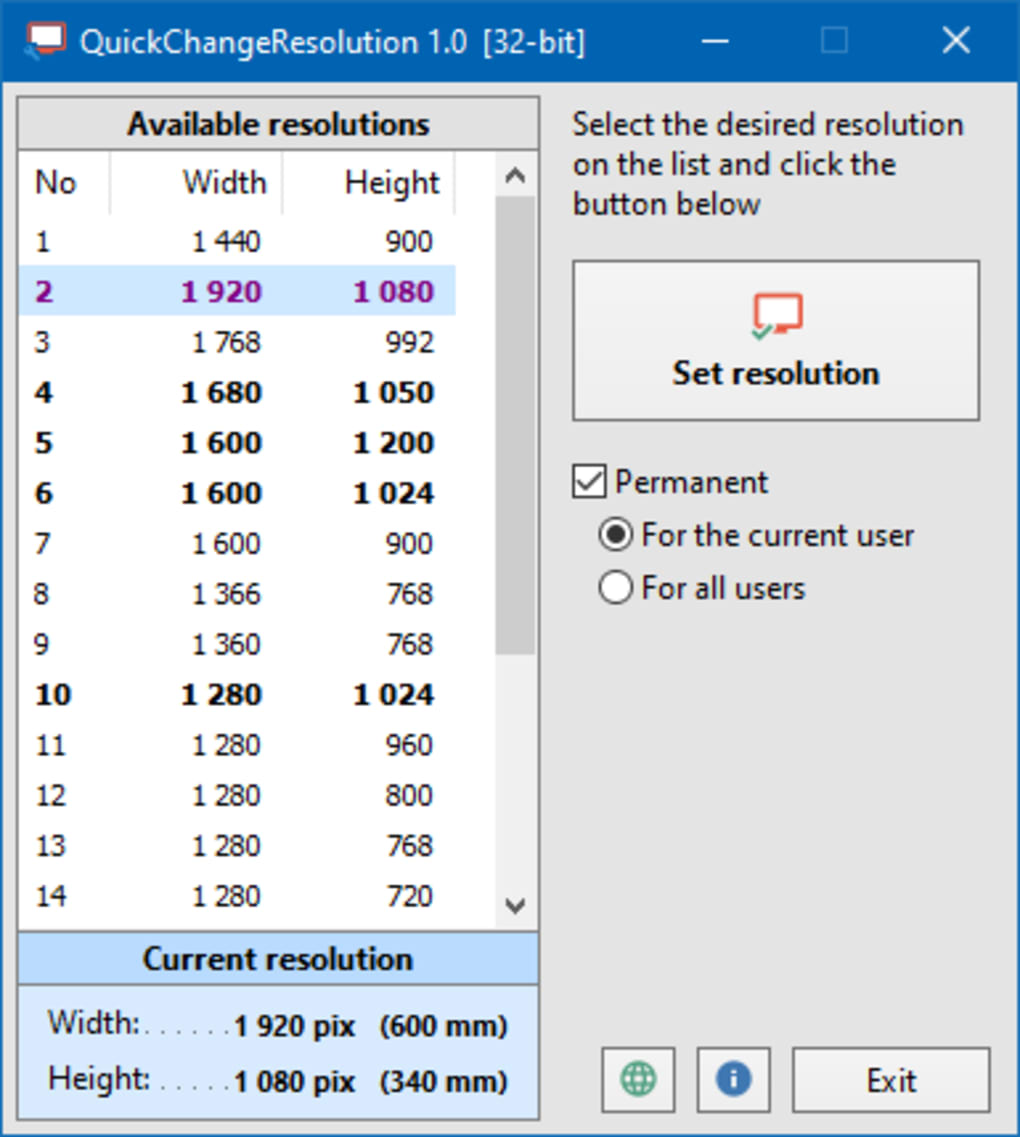
Upon launching QuickChangeResolution, users are greeted by an incredibly plain and straightforward interface. This minimalist design is a deliberate choice, reflecting the application’s focus on a singular task. There are no convoluted menus, no unnecessary animations, and no overwhelming array of options. Instead, the interface presents precisely what’s needed to get the job done efficiently.
The layout is intuitive:
- Left Sidebar: Dominating the left side of the window is a comprehensive list of available screen resolutions. These resolutions are clearly presented in pixel measurements, typically as “width x height.” The breadth of this list is one of QuickChangeResolution’s strong suits, often showcasing a wider array of choices—from ultra-low to exceedingly high resolutions—than what Windows natively presents.
- Current Resolution Indicator: For immediate context, the resolution currently in use on your system is highlighted within this list. Additionally, it’s often cited just below the left sidebar, providing a clear reference point without requiring the user to search.
- “Set Resolution” Button: On the right side of the interface, a prominent “Set Resolution” button awaits. This is the primary action trigger.
- Permanent Box (Checkbox): A small but significant checkbox labeled “Permanent Box” or similar. This controls whether the selected resolution change is temporary or permanent.
The process of changing the resolution is remarkably simple:
- Launch the application.
- Review the list in the left sidebar to identify your preferred resolution.
- Click on your desired resolution from the list. It will typically highlight to indicate selection.
- Decide on permanence: If you intend to use the new resolution only temporarily (e.g., for testing, gaming, or a specific task), ensure the “Permanent Box” is unchecked. If checked, the resolution will persist even after rebooting. If unchecked, the system will automatically revert to your previous default settings upon the next computer reboot. This “revert on reboot” feature is a safety net, preventing users from getting stuck with an unusable resolution.
- Click the “Set Resolution” button.
The result is, as the name suggests, instantaneous. The desktop display immediately shifts to the newly selected resolution, allowing for immediate visual confirmation of the changes. This rapid feedback loop is invaluable for testing different settings without committing to a potentially suboptimal one.
Beyond the Basics: Advanced Options and Considerations
While designed for simplicity, QuickChangeResolution also caters to more advanced users through its support for command-line scripts. This feature opens up possibilities for automation, allowing users to incorporate resolution changes into batch files, scripts, or scheduled tasks. For instance, a user could create a script that automatically switches to a specific resolution when launching a particular game or application, and then reverts to the default when the program closes. This level of programmability significantly enhances the utility of the application for power users and system administrators.
However, one notable absence in QuickChangeResolution’s feature set is support for hotkey combinations. Hotkeys would allow users to assign specific key presses (e.g., Ctrl+Alt+1 for 1920x1080, Ctrl+Alt+2 for 1280x720) to instantly switch between predefined resolutions without opening the application’s interface. While not a deal-breaker for most, the inclusion of hotkey support would undoubtedly elevate the convenience factor, particularly for users who frequently toggle between resolutions. This is a common feature in other utility software designed for similar purposes, and its absence is one of the few criticisms one might level against an otherwise exemplary tool. Despite this, the application’s overall speed and directness largely mitigate the need for hotkeys for many common scenarios.
QuickChangeResolution vs. Native Windows Settings
To truly appreciate the value proposition of QuickChangeResolution, it’s essential to compare its functionality and user experience with the built-in display settings offered by the Windows operating system. While Windows undoubtedly provides the means to adjust resolution, the differences lie in efficiency, accessibility, and the breadth of options.
Efficiency and Accessibility
The most significant distinction between QuickChangeResolution and native Windows settings is the streamlined process. In Windows, changing the display resolution typically involves:
- Right-clicking on the desktop.
- Selecting “Display settings” (or similar, depending on Windows version).
- Scrolling down to the “Display resolution” dropdown menu.
- Clicking the dropdown.
- Selecting the desired resolution.
- Clicking “Keep changes” or allowing the timer to revert.
This multi-step journey, though not overly complex, can become tedious when performed frequently. Each click and menu navigation adds micro-delays and requires user attention.
QuickChangeResolution, by contrast, condenses this entire process into a direct, single-window interaction. Launch the app, select from the visible list, and click “Set Resolution.” The “small and portable” nature of the software further enhances its accessibility, allowing it to be pinned to the taskbar, placed on the desktop, or accessed from a quick launch menu, making it literally a single click away from opening its interface. This immediate access dramatically shortens the time and effort required to effect a change, transforming a minute-long task into a mere few seconds.
Expanded Resolution Options
Another area where QuickChangeResolution shines is in the sheer number of resolution options it presents. While Windows typically offers a selection of common resolutions that are well-suited for your monitor’s native capabilities and standard aspect ratios, it often omits less common or extreme resolutions. For example, a gaming monitor might have a native 2560x1440 resolution, but Windows might not easily expose 800x600 or ultra-wide legacy resolutions that a specific application or game might perform best at.
QuickChangeResolution, however, frequently offers a much broader spectrum of choices. This extended list is invaluable for users who require highly specific or unusual resolutions for particular purposes, such as:
- Retro gaming: Many classic games were designed for lower resolutions like 640x480 or 800x600.
- Specific media playback: Certain video codecs or players might prefer specific resolutions for optimal performance or aspect ratio handling.
- Testing obscure display modes: Developers might need to test how their software renders under various, less common display settings.
The freedom to select a low or high-level resolution that might not be readily available in Windows’ default dropdown gives QuickChangeResolution a distinct advantage for niche and specialized use cases.
Limitations and Workarounds
While QuickChangeResolution offers significant advantages, it’s also important to acknowledge its primary limitation: the lack of hotkey support. For users who frequently switch between a very small set of predefined resolutions (e.g., gamers alternating between two settings for different titles), hotkeys provide the ultimate in speed and convenience. With hotkeys, the user wouldn’t even need to bring up an interface; a simple keyboard combination would suffice.
However, considering the command-line support, it’s possible to create a workaround for this limitation. Advanced users could create simple batch scripts that execute QuickChangeResolution with specific resolution parameters and then assign hotkeys to these batch scripts using third-party utilities or Windows’ own shortcut properties. This would achieve a similar effect to native hotkey support, albeit with an additional layer of setup.
Despite this minor drawback, for the vast majority of users who prioritize ease of access, a broad range of options, and a simple graphical interface for resolution changes, QuickChangeResolution remains a superior and more user-friendly alternative to the native Windows display settings.
Practical Applications and Use Cases
The utility of QuickChangeResolution extends across various user profiles and scenarios, making it a valuable addition to many Windows desktops.
- For Gamers: As mentioned, adapting resolution is crucial for balancing performance and visual quality in games. QuickChangeResolution allows gamers to quickly swap resolutions before launching a demanding title or to test different settings without having to exit and re-enter the game’s graphical options or navigate deep into Windows settings. The “uncheck Permanent Box” feature is particularly useful here, letting them revert to their optimal desktop resolution automatically after a gaming session and reboot.
- For Graphic Designers and Multimedia Professionals: These users often juggle multiple monitors or frequently need to test their creations at different screen dimensions. QuickChangeResolution offers a swift way to simulate various viewing environments or to maximize canvas space temporarily.
- For Presenters and Educators: When connecting to different projectors or screens in various classrooms or conference rooms, the native resolution of the external display can vary wildly. QuickChangeResolution provides a quick fix for display compatibility, ensuring that presentations look correct and professional every time.
- For IT Support and Technicians: When troubleshooting display issues, installing drivers, or setting up new systems, having a portable tool that can quickly cycle through resolutions is indispensable. Its lightweight nature means it can be carried on a USB stick and run instantly on any Windows machine.
- For Software Testers and Developers: Ensuring applications render correctly across a multitude of screen resolutions is vital. QuickChangeResolution facilitates rapid testing by allowing developers to switch display modes on the fly.
- For Users with Vision Impairments: While Windows offers text scaling, some users might find that a lower overall resolution provides better legibility and reduces eye strain. QuickChangeResolution makes this adjustment simple and reversible.
- For Optimizing Performance on Older Hardware: If a user has an older PC struggling with demanding tasks, temporarily lowering the screen resolution can free up GPU resources, leading to a snappier, more responsive system for general use.
In each of these scenarios, the core benefit remains the same: eliminating friction and saving time when adjusting display settings, thereby enhancing overall productivity and user satisfaction.
Installation, Portability, and Open-Source Advantage
QuickChangeResolution stands out not just for its functionality but also for its foundational characteristics: its status as an open-source, portable application. These attributes contribute significantly to its appeal and practical utility.
The Power of Portability
One of QuickChangeResolution’s most practical features is its portability. Unlike traditional software that requires a formal installation process (which often writes files to various system directories and creates registry entries), QuickChangeResolution is a standalone executable. This means:
- No Installation Required: Users can simply download the single executable file and run it. There’s no setup wizard, no EULA to click through, and no installation progress bar.
- Run from Anywhere: The application can be launched directly from a USB drive, a network share, cloud storage, or any folder on your hard drive. This makes it an ideal tool for computer technicians, IT professionals, or anyone who frequently works on different machines.
- Clean System: Since it doesn’t install itself, it leaves no traces on the system registry or file system once it’s closed or deleted. This is excellent for maintaining a clean and clutter-free operating system.
- Minimal Footprint: The application is incredibly lightweight, with a size of just 978.58 KB (less than 1 MB). This small footprint ensures it loads quickly and consumes minimal memory and storage resources.
This portability factor aligns perfectly with the tool’s purpose: quick, on-demand resolution changes without the overhead of permanent software residency.
Open-Source: Transparency and Trust
The open-source nature of QuickChangeResolution is a powerful testament to its developer’s commitment to transparency and community.
- Transparency and Security: With the source code publicly available, anyone with the technical expertise can inspect how the software works. This transparency is crucial for security, as it allows for peer review to identify and eliminate potential vulnerabilities or malicious code. Users don’t have to simply trust the developer; they can verify the application’s integrity.
- No Hidden Agendas: Unlike some proprietary software that might bundle unwanted adware or collect user data without explicit consent, open-source projects are generally free from such practices due to public scrutiny.
- Community Contribution: While the primary development is by Jacek Pazera, the open-source model allows for potential contributions from the broader developer community. This can lead to bug fixes, feature enhancements, and further language localizations over time, fostering continuous improvement.
- Cost-Free Access: Being open-source almost invariably means the software is free to use. This makes QuickChangeResolution an accessible tool for everyone, regardless of budget.
The combination of being free, open-source, and portable makes QuickChangeResolution an exceptionally attractive utility, embodying the best aspects of community-driven software development for a widely useful function.
Conclusion
In the multifaceted landscape of Windows utilities, QuickChangeResolution carved a niche for itself by expertly addressing a common user need: the swift and effortless modification of display resolution. Developed by Jacek Pazera, this lightweight, open-source application transforms what can often be a tedious, multi-step process within native Windows settings into an immediate, single-window interaction. Its minimalist interface, coupled with an expanded list of resolution options, delivers a superior user experience for a diverse range of purposes, from gaming and graphic design to presentations and system troubleshooting.
QuickChangeResolution’s core strengths—its portability, allowing it to run without installation from virtually any location, and its open-source nature, fostering transparency and trust—underscore its commitment to user-centric design. While the absence of hotkey support remains a minor point of improvement, the application’s overall efficiency, breadth of choices, and ability to handle temporary resolution changes with an automatic revert-on-reboot feature firmly establish its position as an indispensable tool. It provides a simple, direct, and free pathway to precisely control your digital canvas, ensuring optimal visual fidelity and a more productive computing experience. For anyone seeking a less cumbersome solution to manage their PC’s display resolution, QuickChangeResolution, available for free download at PhanMemFree, is not just a viable alternative but a compelling enhancement to the standard Windows environment.
File Information
- License: “Free”
- Version: “1.0”
- Latest update: “February 1, 2023”
- Platform: “Windows”
- OS: “Windows 10”
- Language: “English”
- Downloads: “8K”
- Size: “978.58 KB”


