
The enduring popularity of The Elder Scrolls V: Skyrim is a testament not only to its meticulously crafted open world and deep lore but also to the vibrant and dedicated modding community that has continuously breathed new life into the game. Among the pantheon of essential Skyrim mods, RaceMenu stands out as a critical enhancement, transforming the often-limited vanilla character creation process into an extensive, highly customizable experience. This free, comprehensive utility completely overhauls the default character creation menu, offering players an unprecedented degree of control over their in-game persona’s appearance.
Before RaceMenu, players were confined to a relatively basic set of sliders and presets, often leading to characters that felt generic or struggled to capture the unique vision players had for their Dragonborn. RaceMenu shattered these limitations, introducing a suite of advanced customization features that allow for intricate detailing, from multiple body paints and RGBA war paints to specific foot and hand paints. This level of granular control is not just about aesthetics; it profoundly impacts the player’s connection to their character, enhancing immersion and the overall role-playing experience in the vast lands of Tamriel. The evolution of RaceMenu, with its feature-equivalent alpha releases, highlights its continuous development and the community’s demand for deeper customization. While other notable Skyrim mods like Cloaks of Skyrim, Skyrim Script Extender, and Alternate Start focus on adding content, improving performance, or altering starting scenarios, RaceMenu carves its niche by perfecting the initial spark of player identity: character creation. It’s an indispensable tool for anyone looking to truly make their mark on Skyrim.
Games: Redefining Role-Playing Character Creation
At its core, Skyrim is a role-playing game (RPG), and the essence of role-playing lies in embodying a character that resonates with the player. The vanilla character creation system, while functional, often fell short of allowing players to fully actualize their unique visions. RaceMenu steps in as a game-changer, fundamentally redefining how players interact with their character’s appearance, moving it from a mere formality to an engaging, creative endeavor.
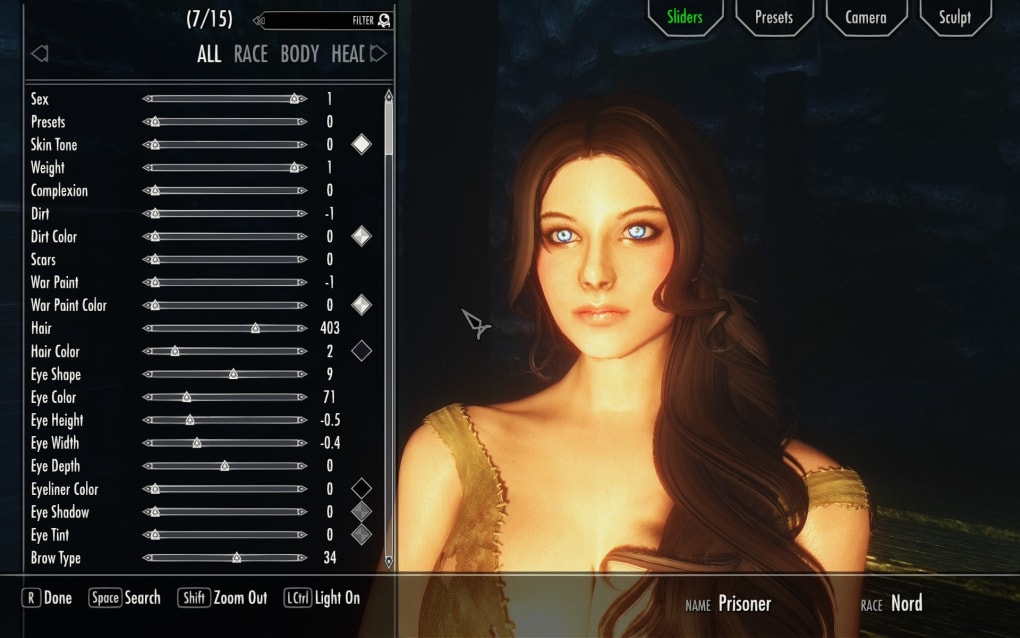
The mod’s most celebrated features revolve around its extensive painting options. Imagine wanting to portray a seasoned warrior whose battles have left intricate scars and symbols on their body, or a mystical mage adorned with arcane markings. RaceMenu provides the tools for this. With multiple body paints, RGBA war paints, foot paints, and hand paints, players are no longer restricted to simple facial markings. They can apply complex designs across their character’s entire body, choosing from an expansive palette of colors thanks to the RGBA (Red, Green, Blue, Alpha) support, which allows for precise color selection and transparency. This means not just choosing a color, but the exact shade you envision, adding layers of depth to character design that were previously impossible.
Beyond paints, RaceMenu significantly enhances the traditional slider system. One of its most user-friendly additions is the numeric display for sliders. In vanilla Skyrim, adjusting a character’s features involved vague sliders where precise control was often a guessing game. RaceMenu eliminates this frustration by showing exact numerical values for each adjustment, whether it’s the width of a nose, the height of a brow, or the fullness of lips. This precision is invaluable for players who want to replicate a specific look, tweak a feature to perfection, or even share their character’s exact dimensions with others in the community. This seemingly small feature dramatically improves the user experience, transforming a tedious process into one of precise artistic control.
Furthermore, RaceMenu moves beyond mere additions by streamlining existing options. It categorizes vanilla options to match the SkyUI appearance, a widely adopted interface mod that brought significant quality-of-life improvements to Skyrim’s menus. By integrating seamlessly with SkyUI’s aesthetic and organizational principles, RaceMenu ensures that the character creation menu remains intuitive and easy to navigate despite the vast increase in available options. This thoughtfulness in design underscores the mod’s commitment to enhancing the overall in-game experience, making it accessible even to casual gamers who might be intimidated by extensive modding.
The impact of RaceMenu extends beyond initial character creation. For hardcore Skyrim gamers who view their playthroughs as deeply personal narratives, the ability to craft a character that is truly unique and reflective of their imagination is paramount. A distinct appearance fosters a stronger connection to the digital avatar, encouraging deeper immersion in the game’s world and storyline. Whether it’s creating an imposing Nord with tribal war paint, a graceful Altmer with subtle arcane tattoos, or a rugged Breton sporting the marks of a seasoned adventurer, RaceMenu empowers players to turn their character into something truly unique, ensuring they stand apart from the crowd and embody the role they wish to play in Tamriel. This robust modification, therefore, is not just about visual flair; it’s about enriching the very core of the role-playing experience.
Development & IT: The Technical Foundation of Advanced Modding
The sophistication of RaceMenu, like many other advanced Skyrim modifications, is built upon a crucial technical foundation: the Skyrim Script Extender (SKSE). The original description explicitly states, “in order for the mod to work, you need to run the Skyrim Extender on your PC.” This requirement highlights a fundamental aspect of modding complex games like Skyrim, where developers need to expand beyond the capabilities of the game’s default scripting engine.
SKSE serves as a robust framework, essentially a “development kit” for modders, enabling them to implement features and functionalities that the vanilla game engine does not inherently support. It does this by extending the game’s scripting capabilities, allowing for more complex operations, access to additional functions, and interaction with game data in ways that would otherwise be impossible. For RaceMenu, SKSE is not just a dependency; it’s the enabler for its advanced customization options. Without SKSE, features like multiple body paints, RGBA war paint support, and the granular control offered by numeric sliders would likely be beyond the scope of a standard mod. The mod’s redesign, with the objective of “using SKSE to allow more customization options,” clearly indicates its reliance on this extended scripting environment.
However, the path of mod development is not without its challenges. The description also mentions a significant caveat: “Unfortunately, the Skyrim modification still doesn’t solve the issues with the internal class of the menu. It only redesigns the menu and adds more features.” This statement provides a glimpse into the complexities and limitations faced by mod developers. “Internal class issues” likely refer to deeper, hard-coded aspects of the game’s engine or user interface systems that are incredibly difficult, if not impossible, for external mods to alter without direct access to the game’s source code or extensive reverse engineering. This limitation underscores the difference between modifying a game’s interface and fundamentally rewriting its core logic. RaceMenu, therefore, operates brilliantly within the boundaries it can control, redesigning the visible interface and adding features on top of existing structures, rather than attempting to fix underlying architectural quirks.
The creation and maintenance of a mod like RaceMenu also mirrors professional development practices. The developer, “Expired,” demonstrates a dedication to user experience (UI/UX design, seen in the SkyUI integration) and functionality (precise control with numeric sliders). Like any software project, modding involves problem-solving, understanding existing code (or reverse-engineering it), writing new scripts, debugging, and iterative development. The release of a “feature-equivalent to the alpha” version indicates a structured development process, where features are implemented, tested, and gradually refined.
Furthermore, the existence of such a comprehensive mod underscores the collaborative and open-source spirit prevalent in the modding community. While RaceMenu is a standalone mod, it exists within an ecosystem where tools like SKSE are developed and maintained by a different group, showcasing a layered approach to extending game functionality. This mirrors real-world “Development & IT” environments where various libraries, frameworks, and APIs are utilized to build complex applications. The skills honed in modding—such as understanding game engines, scripting, UI design, and compatibility management—are directly transferable to software development roles, making the modding scene a fertile ground for aspiring IT professionals. RaceMenu stands as a prime example of how community-driven development, supported by foundational tools like SKSE, can push the boundaries of a commercial game far beyond its original scope.
Utilities & Tools: Streamlining the Modding Experience
While RaceMenu itself is a powerful modification, its effective implementation and enjoyment are often intertwined with a broader set of “Utilities & Tools” that streamline the modding experience. For many users, especially those new to Skyrim modding, the sheer volume of available mods and the technicalities of installation can be daunting. This is where tools designed for “File Managers,” “Backup & Cloud Storage,” and even basic “Manual & Tutorials” become indispensable.
First and foremost, the installation of RaceMenu, like most Skyrim mods, typically involves a mod manager. While manual installation (copying files directly into the game directory) is possible, it is generally not recommended for complex mods. Mod managers, such as Nexus Mod Manager (NMM), Mod Organizer 2 (MO2), or Vortex, act as sophisticated “File Managers” specifically tailored for game modifications. These utilities simplify the process of installing, updating, and uninstalling mods. They handle file conflicts, manage load orders (the sequence in which mods are loaded by the game), and often provide options for virtual installations, which keep the game’s core directory clean. For RaceMenu, a mod manager ensures that its files are correctly placed within the Skyrim data folder and that it activates properly alongside SKSE and other dependencies.
The importance of “Backup & Cloud Storage” also cannot be overstated in the modding world. Installing multiple mods, especially large overhauls or those that modify core game files, carries an inherent risk of instability, crashes, or save game corruption. Savvy modders routinely back up their game installations and save files before introducing new mods. Cloud storage services can offer an additional layer of security for these crucial backups, safeguarding hours of gameplay and customization efforts. This practice minimizes the “data recovery” headache if a mod conflicts or an installation goes awry. RaceMenu itself is a robust mod, but its interaction with hundreds of other mods in a typical Skyrim load order makes proper backup practices essential.
Furthermore, the entire modding ecosystem thrives on “Education & Reference” resources, often delivered through “Manual & Tutorials.” Websites like Phanmemfree.org (formerly Softonic.com) are invaluable platforms for distributing mods like RaceMenu, but they also serve as repositories for information. The “Information” section for RaceMenu on such sites provides critical details like its version, update date, platform compatibility, and size. Beyond this, community forums (often linked from mod pages), YouTube tutorials, and dedicated modding wikis provide comprehensive guides on everything from installing SKSE to troubleshooting complex load orders. These resources teach users “how to use RaceMenu” effectively, ensuring they get the most out of its features and resolve any compatibility issues with other mods they might be running. The collective knowledge shared by the modding community acts as a powerful utility, enabling users to navigate the complexities of altering a game like Skyrim.
In essence, RaceMenu is a tool within a larger toolkit. While it provides the creative freedom for unparalleled character customization, its full potential is realized when used in conjunction with a suite of modding utilities and a supportive knowledge base. These complementary tools and resources transform what could be a technically challenging endeavor into an accessible and rewarding experience for millions of Skyrim players worldwide.
Personalization: Crafting a Unique Digital Identity in Skyrim
The act of “Personalization” is at the very heart of the appeal of RaceMenu. In a world brimming with digital content and mass-produced experiences, the ability to tailor an individual’s virtual presence – whether it’s a smartphone “Wallpaper,” unique “Cursors & Fonts,” or custom “Ringtones & Sounds” – holds significant value. For gamers, this drive for personalization often culminates in the creation of a unique in-game avatar, and RaceMenu stands as a paramount example of facilitating this in The Elder Scrolls V: Skyrim.
RaceMenu transforms the Dragonborn from a predefined canvas into a deeply personal artistic statement. Its comprehensive features, from “multiple body paints” to “RGBA war paints,” empower players to go far beyond mere aesthetic choices. These aren’t just superficial alterations; they are tools for crafting a visual narrative, reflecting the character’s backstory, personality, and role within the sprawling world of Tamriel. A character adorned with tribal markings might suggest a wild, untamed spirit, while subtle tattoos could hint at a mysterious magical heritage. This level of visual storytelling through character design directly impacts how players perceive their own journey and how they interact with the game world.
Consider the detailed control offered by RaceMenu’s numeric sliders. This precision allows players to sculpt facial features and body proportions with an exactness that transcends the generic. Every curve, every angle, every dimension can be fine-tuned to match a specific vision, whether it’s replicating a favorite fictional character, designing an idealized self, or simply creating something entirely new. This granular control elevates character creation from a mere selection process to an act of digital sculpting, where the player is the artist and the Dragonborn is their masterpiece.
The mod also embraces the spirit of “Themes” in a broader sense. Just as operating systems allow users to change their entire visual theme, RaceMenu enables players to impose a distinct visual “theme” onto their character. This theme can align with a particular playstyle (e.g., a sneaky rogue with dark, muted tones; a valiant knight with bold, heroic markings) or reflect a specific cultural aesthetic within Skyrim’s diverse races. By allowing for “numerous colors to choose from for the character’s appearance” – applicable to clothes, body modifications, hair, and other elements – RaceMenu ensures that the visual identity is cohesive and reflective of the player’s intent.
The enduring success of Skyrim and its modding community is significantly bolstered by tools that enable deep personalization. Players invest hundreds, if not thousands, of hours into their characters. RaceMenu ensures that this investment begins with a strong foundation: a character that truly feels like theirs. This personal connection fuels replayability, encourages experimentation with different builds and appearances, and ultimately extends the lifespan of the game itself. It’s a testament to the idea that in open-world RPGs, the ability to craft a unique digital identity is not just a feature, but a fundamental pillar of engagement and immersion. By providing such extensive options, RaceMenu doesn’t just improve a menu; it enriches the entire gaming journey, allowing every player to leave their indelible, personalized mark on the legends of Tamriel.
Conclusion
RaceMenu stands as a monumental achievement within the Skyrim modding community, cementing its place as an indispensable utility for millions of players. It transcends the limitations of the vanilla character creation system, offering an unparalleled suite of customization features that empower players to craft truly unique and deeply personal digital identities. From the intricate detail afforded by multiple body paints and RGBA war paints to the precision of numeric sliders and the seamless integration with SkyUI, RaceMenu redefines what’s possible in the initial stages of a Skyrim playthrough.
Its reliance on the Skyrim Script Extender (SKSE) highlights the sophisticated technical underpinnings required for such advanced modifications, showcasing the ingenuity and dedication of mod developers like Expired. While it doesn’t solve deeper “internal class issues,” its focus on enhancing the user interface and expanding aesthetic options proves to be a blessing, allowing for creative expression without delving into the complexities of core game engine alterations.
Furthermore, RaceMenu’s success is a microcosm of the broader modding ecosystem, which thrives on a combination of powerful “Utilities & Tools” for installation and management, and a rich tapestry of “Education & Reference” resources that guide and support players. Ultimately, RaceMenu is more than just a mod; it’s a testament to the power of “Personalization” in gaming. It fosters a deeper connection between player and character, extending the longevity and replayability of Skyrim by allowing every Dragonborn to embark on their epic journey with an appearance as unique and legendary as their deeds. For any player seeking to leave an indelible, personalized mark on the vast lands of Tamriel, the PhanMemFree RaceMenu download remains an essential gateway to limitless creativity.
File Information
- License: “Free”
- Version: “0.4.16”
- Latest update: “September 19, 2021”
- Platform: “Windows”
- OS: “Windows 10”
- Language: “English”
- Downloads: “127”
- Size: “8.48 MB”


