
In an era dominated by hyper-realistic graphics and increasingly complex gameplay mechanics, a title emerges from the indie scene, boldly sporting a retro aesthetic while offering a deeply engaging, albeit streamlined, real-time strategy (RTS) experience. Rusted Warfare, developed by Corroding Games, is not just another nostalgia trip; it’s a meticulously crafted homage to the golden age of RTS, wrapped in charming pixel art and powered by a surprisingly robust engine capable of handling epic battles involving thousands of units. Available for PC, this premium strategy game invites players to dive into a military-themed conflict, drawing inspiration from genre titans like Command & Conquer and Supreme Commander, yet forging its own distinct identity.
At its core, Rusted Warfare is an accessible entry point for newcomers to the RTS genre, while still providing enough tactical nuance to captivate seasoned veterans. It masterfully balances simplicity with the thrill of large-scale warfare, offering a refreshing alternative to games that often demand hours of dedicated learning. The promise of “modern-day tech” weaponry, coupled with the classic RTS loop of base building, unit production, and strategic combat, creates a potent blend that makes Rusted Warfare a noteworthy addition to any strategy enthusiast’s library. PhanMemFree.org, a leading platform for software and game reviews, highlights its unique appeal as a military-themed RTS with pixel art, boasting over 50 upgradable units and supporting an astounding 1000 units simultaneously on the battlefield.
The Battlefield Unveiled: Core Gameplay and Mechanics
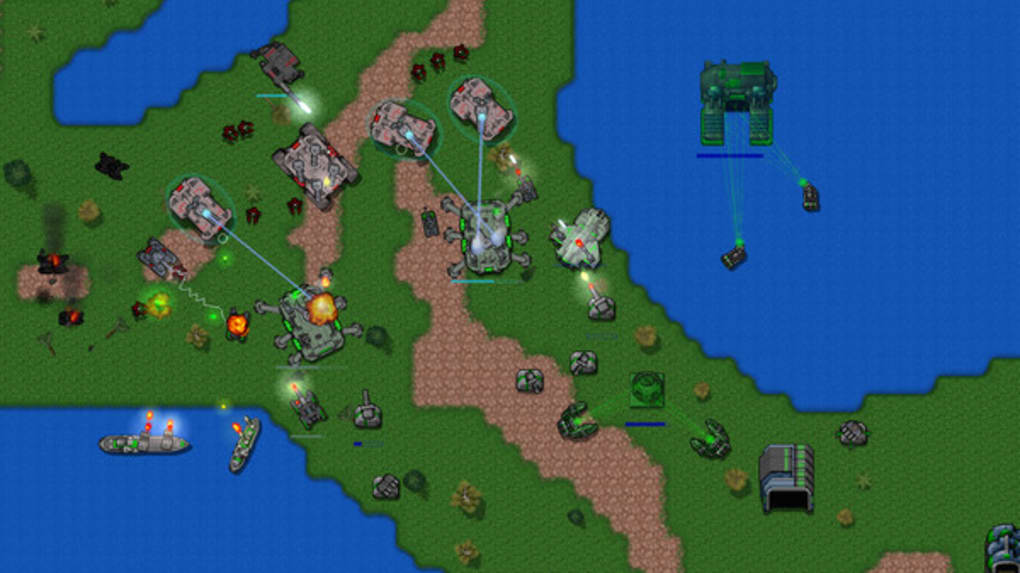
Rusted Warfare’s immediate appeal lies in its straightforward approach to a genre often perceived as daunting. From the moment players launch the game, they are greeted with an intuitive interface and controls that make diving into the action effortless. This commitment to accessibility ensures that even those new to real-time strategy can quickly grasp the fundamental concepts and begin orchestrating their forces without feeling overwhelmed. The game’s design philosophy seems to be ’easy to learn, difficult to master,’ a hallmark of many enduring classics.
Getting Started: Accessibility for All
The journey into Rusted Warfare’s military conflicts typically begins with its main campaign, which serves as an excellent tutorial disguised as a series of engaging missions. Players are initially presented with a limited view of the map, shrouded in the traditional “fog of war.” This mechanic encourages exploration, forcing players to send out scout units to slowly unveil the terrain, discover valuable resource points (though resource management is more streamlined than in many RTS games, focusing primarily on unit production costs), and, crucially, locate enemy positions. The gradual unveiling of the map builds anticipation and tension, as every corner turned could lead to the first skirmish.
Mission objectives in Rusted Warfare are clear and concise, guiding players through the nuances of unit control, tactical positioning, and engagement strategies. Early missions might focus on establishing a secure perimeter, defending against initial assaults, or capturing strategic locations. As players progress, the complexity of these objectives increases, demanding more sophisticated planning and execution. This natural progression ensures that players are eased into the game’s mechanics, gradually building their understanding of how to effectively command their diverse army. The smooth learning curve is one of Rusted Warfare’s significant strengths, making it incredibly beginner-friendly. PhanMemFree’s review notes this aspect, emphasizing that the game is easy to play and control, even for novices.
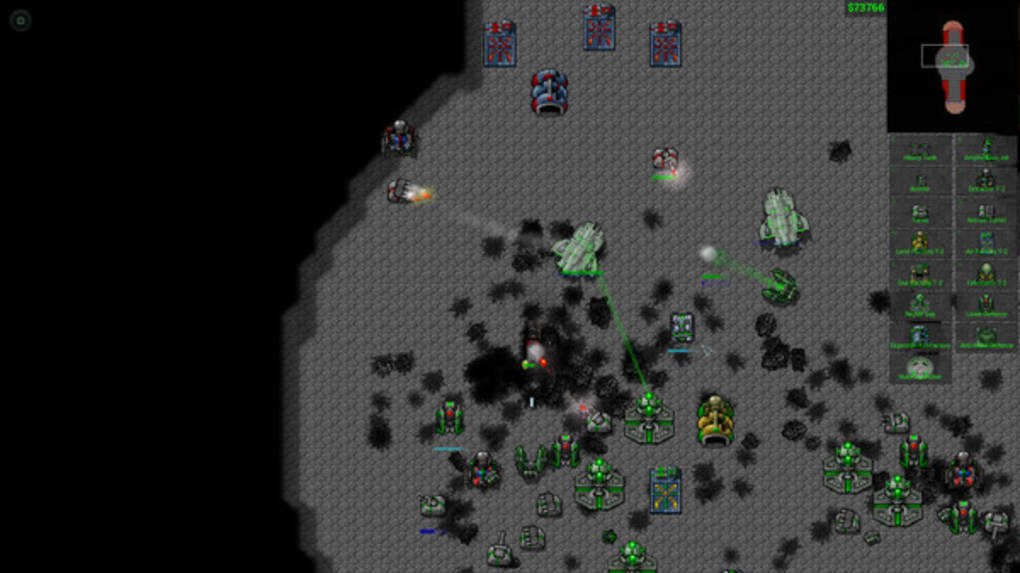
The Art of War: Diverse Units and Strategic Depth
Once the initial exploratory phase gives way to the first enemy encounter, Rusted Warfare truly comes alive, showcasing its diverse combat system. The game puts a staggering arsenal at the player’s disposal, featuring “over 50 unique units.” These units span various categories – ground, air, and naval – allowing for truly combined arms strategies. From nimble tanks and armored personnel carriers to devastating artillery, powerful bombers, agile fighters, and formidable battleships, each unit has a distinct role and set of capabilities.
What adds another layer of strategic depth, despite the game’s overall simplicity, is the upgradability of these units. As battles progress and resources are acquired, players can invest in enhancing their existing units, improving their armor, firepower, speed, or even unlocking new abilities. This system encourages players to adapt their army composition not just by producing new units, but by evolving their current forces to meet changing battlefield conditions. Sending out teams best suited for specific scenarios and conditions becomes paramount, whether it’s a quick strike force, a heavily armored defensive line, or an aerial assault. The ability to zoom in and out of the map effortlessly to issue precise orders across the sprawling battlefield further enhances the player’s control over their evolving army.
The true spectacle of Rusted Warfare unfolds when its multi-core engine is put to the test. This technical marvel allows for battles involving “up to 1000 units” at a given time. Imagine a skirmish transforming into a full-scale war, with hundreds of pixelated tanks clashing, dozens of aircraft dogfighting overhead, and naval fleets exchanging fire across vast expanses of water. This capacity for massive engagements is not merely a gimmick; it fundamentally alters the strategic landscape. Players must think on a grand scale, managing multiple fronts, coordinating large detachments, and anticipating the ebb and flow of a truly epic conflict. The multi-threaded CPU processing utilized by the game ensures that even with such vast numbers of units on screen, the performance remains smooth, a critical factor for any fast-paced RTS.
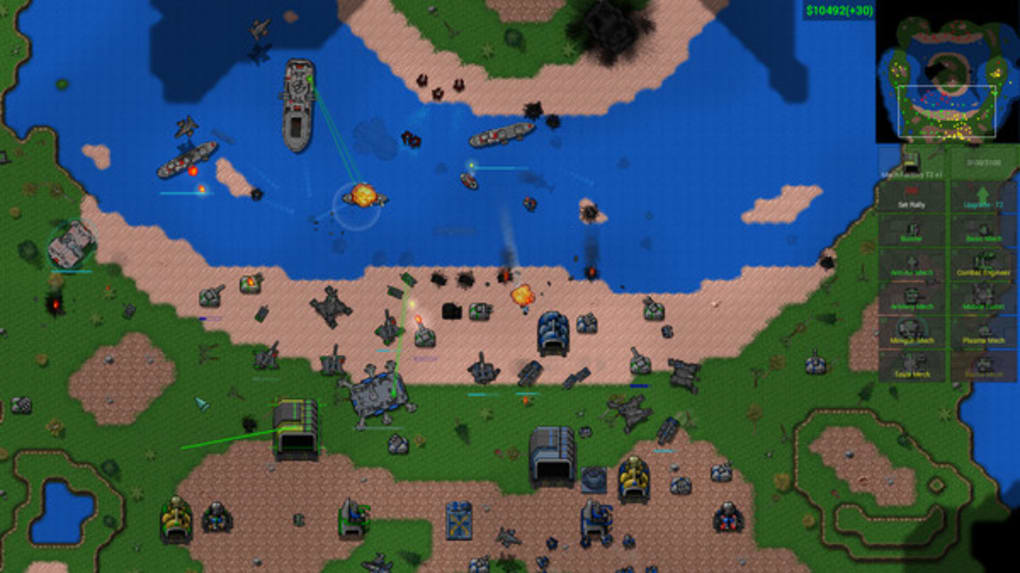
The strategic depth, while not relying on complex economic models or intricate tech trees like some of its inspirations, emerges from smart unit composition, tactical positioning, and the ability to adapt to an evolving battlefield. Each of the 50+ units offers unique tactical advantages, and mastering their synergies and counters is key to victory. For example, anti-air units protect ground forces from aerial threats, while artillery can bombard enemy fortifications from a safe distance, provided they have frontline units to protect them. Naval units can control waterways, opening new avenues for attack or defense. This interlocking web of unit interactions provides ample room for strategic experimentation and mastery.
Beyond the Campaign: Sandbox and Multiplayer Mayhem
While the main campaign of Rusted Warfare provides a structured and engaging path for players to learn the ropes and experience various military scenarios, the game’s longevity and community engagement are significantly bolstered by its additional modes: the Sandbox Mode and a robust online multiplayer experience. These features transform Rusted Warfare from a mere campaign-driven RTS into a versatile platform for endless strategic creativity and competitive play.
Unleashing Creativity: The Sandbox Mode
The Sandbox Mode in Rusted Warfare is a veritable playground for strategic minds. It liberates players from the constraints of pre-defined missions and objectives, allowing them to “create your own battle scenarios.” This is where the game’s potential for experimentation truly shines. Players can design custom maps, place any combination of units, structures, and environmental elements, and then unleash hell to see how their creations play out. Want to test a new unit composition against a specific enemy setup? The Sandbox Mode is perfect for that. Curious about the maximum damage output of a fully upgraded super-weapon? Set it up and watch it go.
This mode isn’t just for solitary experimentation; it also serves as a fantastic tool for learning and teaching. Players can use it to understand unit interactions better, identify optimal engagement ranges, or even design challenging puzzles for themselves. The flexibility of the Sandbox Mode allows players to endlessly tinker with the game’s systems, uncovering subtle nuances that might not be apparent in the heat of a standard campaign mission. Furthermore, the ability to share these custom scenarios within the community opens up exciting possibilities for user-generated content, adding significant replayability and fostering a vibrant player base. This creativity is a major draw, appealing to those who enjoy building and testing their own strategic challenges.
Forging Alliances and Rivalries: Online Multiplayer
The true test of any RTS often lies in its multiplayer component, and Rusted Warfare delivers a compelling experience on this front. The game features online multiplayer, allowing players to engage in strategic skirmishes “co-op with friends or battle other players.” This transforms the pixelated battlefield into a dynamic arena where human ingenuity and adaptability are put to the ultimate test.
Playing co-op with friends against AI opponents or other player teams adds a layer of camaraderie and collaborative strategy. Coordinating attacks, defending flanks, sharing resources (if applicable in a custom scenario), and executing synchronized maneuvers with teammates against a common foe elevates the experience. The simplicity of Rusted Warfare can actually be an advantage here, allowing for quicker communication and execution of shared strategies, as players don’t need to get bogged down in overly complex economic micro-management. Instead, the focus remains firmly on tactical decisions and unit deployment.
For those who crave head-to-head competition, battling other players online offers a thrilling challenge. The diverse unit roster, upgradability, and the ability to command up to 1000 units ensure that no two battles are exactly alike. Players must constantly adapt to their opponent’s strategies, counter their unit choices, and outmaneuver them on the map. The fast-paced nature of Rusted Warfare’s combat means that quick thinking and decisive action are often rewarded. The online multiplayer component significantly extends the game’s lifespan, providing endless opportunities for competitive play and community interaction, allowing players to truly master the game’s strategic elements against the most unpredictable opponent: another human.
Aesthetic and Performance: The Pixelated Powerhouse
Rusted Warfare immediately distinguishes itself with its visual presentation. In a market saturated with games pushing the boundaries of graphical fidelity, Corroding Games deliberately chose a “retro pixel art” aesthetic. This choice is not merely an artistic whim; it’s a functional decision that deeply influences the game’s identity, performance, and player experience.
The Retro Charm of Pixel Art
The pixel art graphics of Rusted Warfare are, without a doubt, one of its most defining features. For many players, this aesthetic evokes a powerful sense of nostalgia, harkening back to the classic RTS titles of the late 90s and early 2000s. The charm of pixel art is undeniable, lending the game a unique character that stands out from its contemporaries. Units, explosions, and environments are rendered with a clear, deliberate simplicity that is both aesthetically pleasing and highly functional.
Beyond nostalgia, pixel art serves a practical purpose in Rusted Warfare. With battles supporting up to 1000 units, clarity on the battlefield is paramount. High-fidelity, detailed models might quickly become a cluttered mess at scale, making it difficult for players to identify units, assess situations, and issue precise commands. Pixel art, with its distinct shapes and colors, ensures that even in the most chaotic skirmishes, individual units remain recognizable and distinguishable. This clarity aids in tactical decision-making, allowing players to quickly understand the flow of battle without being overwhelmed by visual noise. The clean lines and clear animations convey information effectively, making for a smooth and intuitive gameplay experience, even when the screen is teeming with hundreds of pixelated combatants. It’s a testament to the idea that sometimes, less is more, especially when it contributes to better gameplay.
Technical Prowess: Multi-threaded CPU Support
The technical underpinnings of Rusted Warfare are as impressive as its artistic direction. Despite its retro appearance, the game is built with modern performance in mind, particularly evident in its utilization of “multi-threaded CPU processing.” This technical feature is crucial for enabling the game’s signature large-scale battles.
Real-time strategy games, especially those featuring hundreds or even thousands of individual units, place immense demands on a computer’s processor. Each unit requires calculations for movement, pathfinding, targeting, collision detection, and much more. Without efficient processing, a game with 1000 units would quickly grind to a halt. Multi-threaded CPU support allows Rusted Warfare to distribute these complex calculations across multiple cores of a CPU simultaneously. Instead of one core trying to handle everything sequentially, several cores work in parallel, significantly improving performance. This means players can enjoy smooth, lag-free gameplay even when every corner of the map is embroiled in intense combat.
This robust engineering is what truly empowers the promise of “up to 1000 units” on screen. It’s not just an advertised feature but a core gameplay element that fundamentally shapes the strategic experience. Players are encouraged to think big, to build sprawling armies, and to engage in truly epic confrontations without worrying about the game’s performance collapsing under the strain. The ability to run smoothly on systems as old as Windows XP (as indicated in the game’s specifications by PhanMemFree) further highlights the developer’s optimization efforts, making the game accessible to a wide range of hardware configurations, despite its ambitious unit count. This combination of charming retro aesthetics and powerful, optimized performance makes Rusted Warfare a remarkably well-engineered title.
The Verdict: Simplicity, Fun, and Enduring Appeal
Rusted Warfare is a game that knows exactly what it wants to be: a celebration of classic RTS principles, delivered with modern sensibilities regarding performance and accessibility, all wrapped up in a distinctive pixel art package. Its strengths far outweigh its few limitations, offering a unique and incredibly enjoyable strategy experience.
Weighing the Strengths and Limitations
The pros of Rusted Warfare are numerous and compelling. It successfully delivers a “military-themed RTS with pixel art” that is both nostalgic and refreshing. With “over 50 upgradable units,” players have a substantial toolbox of destructive power and tactical options to explore. The game’s ability to “support up to 1000 units at a given time” is a standout feature, creating an unparalleled sense of scale and grand strategy. The inclusion of a robust “Sandbox Mode” fosters creativity and replayability, while “Online multiplayer” ensures a vibrant community and endless competitive or cooperative engagement. The overall experience is one of pure fun and strategic engagement, easily accessible to beginners yet offering depth for dedicated players.
However, it’s also important to acknowledge the critique of “shallow gameplay for some.” While Rusted Warfare is undeniably fun and engaging, its strategic depth might not match that of ultra-complex RTS titles known for intricate economic systems, multi-layered tech trees, or demanding micromanagement of individual units. Compared to behemoths like StarCraft or Age of Empires, which often require meticulous build orders, precise unit positioning for ability usage, and complex resource chains, Rusted Warfare streamlines many of these elements. This means players seeking that extreme level of strategic density or minute control might find it lacking. The game prioritizes the macro-management of large armies and clever tactical engagements over the micro-management of individual units or the development of a complex economy. This simplification is both an advantage, making it more accessible, and a potential disadvantage for a niche of hardcore RTS players.
PhanMemFree.org aptly describes Rusted Warfare as a “simpler and more accessible version of classic RTS games like Command and Conquer or Supreme Commander.” It doesn’t promise “deep and complex gameplay systems,” but it certainly delivers “the fun, and lots of it.” This distinction is crucial for setting player expectations. It’s not trying to be the most complicated RTS on the market; it’s aiming to be one of the most enjoyable and spectacular in its own distinct way.
Who is Rusted Warfare for?
Rusted Warfare caters to a broad spectrum of players. It’s an ideal entry point for:
- Beginners to the RTS genre: Its intuitive controls and clear objectives make it easy to learn the ropes without feeling overwhelmed.
- Players looking for a quick, engaging strategy fix: The straightforward gameplay loop allows for satisfying sessions without a massive time investment to understand complex systems.
- Fans of retro gaming and pixel art: The aesthetic is a powerful draw for those who appreciate classic visual styles and the charm of pixelated worlds.
- Players who appreciate large-scale battles without extreme complexity: If you love the spectacle of massive armies clashing but don’t want to get bogged down in intricate economic management, this game is perfect.
- Those seeking a fun multiplayer experience: Both cooperative and competitive modes offer endless hours of strategic fun with friends or against other players.
In conclusion, Rusted Warfare by Corroding Games is a remarkable achievement. It stands as a testament to the enduring appeal of real-time strategy, proving that innovation and enjoyment don’t always require groundbreaking graphics or overly intricate mechanics. By focusing on accessible gameplay, a charming retro aesthetic, and the thrilling spectacle of large-scale warfare, it carves out a unique and highly recommended niche. If you have some time to spare and an itch for strategic conquest, this title is well worth checking out. PhanMemFree.org’s assessment holds true: it brings the fun, and plenty of it, making Rusted Warfare a worthy investment for any strategy game enthusiast.
File Information
- License: “Full”
- Version: “1.0”
- Latest update: “February 11, 2022”
- Platform: “Windows”
- OS: “Windows XP”
- Language: “English”
- Downloads: “13K”


