
Cyberpunk 2077, the sprawling open-world RPG from CD Projekt Red, captivated millions with its dystopian grandeur, intricate narratives, and unforgettable characters. Yet, like any massive game, players often seek ways to tailor their experience, whether to overcome a particularly challenging section, experiment with diverse character builds without the grind, or simply explore the game’s mechanics in novel ways. This desire for customization and enhanced control has given rise to a variety of community-driven tools, among the most prominent of which is the Save Editor (Project CyberCAT-SimpleGUI). This remarkable application offers a straightforward and intuitive pathway for players to delve into their Cyberpunk 2077 save files, meticulously adjusting character stats, inventory, and various in-game parameters, thereby transforming their journey through Night City.
Originally conceived as an offshoot of SirBitesalot’s renowned Cyber CAT Save Editor, Project CyberCAT-SimpleGUI distills complex save file manipulation into an accessible interface. It empowers players, particularly those on PC, to refine their gameplay experience, allowing for immediate changes that would otherwise require hours of dedicated grinding or multiple playthroughs. This article will explore the functionalities of this powerful save editor, its benefits and potential drawbacks, its technical underpinnings, and its broader implications for the world of single-player gaming, all while highlighting its pivotal role in empowering players to truly own their Night City adventure.
The Power of Personalization: Modifying Your Cyberpunk 2077 Experience
At its core, Project CyberCAT-SimpleGUI is a bridge between a player’s aspirations for their character and the raw data within their save file. The primary allure lies in its ability to modify a wide array of in-game elements, granting players unparalleled freedom in how they approach the challenges and opportunities of Night City. The interface, designed for simplicity, guides users through the modification process, making complex edits feel remarkably intuitive.
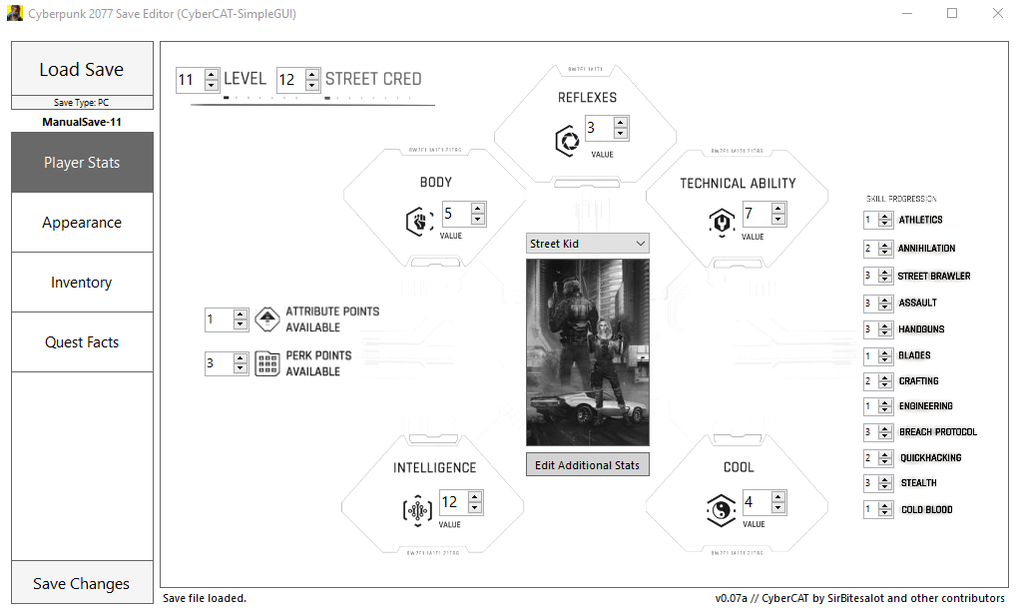
One of the most frequently utilized features is the adjustment of core player statistics. In Cyberpunk 2077, progression is intrinsically linked to attributes like Street Cred, player level, and various skills such as Health, Intellect, Reflexes, Technical Ability, and Cool. With CyberCAT-SimpleGUI, players can instantly elevate these statistics to their desired levels. Imagine starting a new playthrough and immediately having the Street Cred necessary to unlock high-tier gigs, or boosting your Intellect to bypass dialogue options and access advanced hacking protocols right from the get-go. This capability not only saves an immense amount of time but also allows players to jump directly into the aspects of the game they find most engaging, or to test out high-level builds that would typically take dozens of hours to achieve.
Beyond numerical attributes, the save editor excels in inventory management. Players can add, remove, or modify virtually any item within the game – from legendary weapons and iconic armor pieces to crafting components, consumables, and even quest items (though caution is advised with the latter). This means an end to tedious farming for specific weapon drops or struggling to find that one rare crafting spec. Want to wield Johnny Silverhand’s iconic pistol or craft the most powerful cyberware without searching every corner of Night City? Project CyberCAT-SimpleGUI makes it possible. Furthermore, the editor allows for granular control over item upgrades, enabling players to max out the stats on their favorite weaponry and armor, ensuring they are always equipped for the fiercest encounters Night City can throw at them. The utility extends to consumables, allowing players to stock up on health recharges and ammo, minimizing downtime and maximizing combat efficiency. This level of granular control over a character’s loadout fundamentally alters the pacing and challenge of the game, putting the player firmly in command of their V’s destiny.
The process of using the save editor is intentionally straightforward. Once the application is launched, users typically select the specific Cyberpunk 2077 save file they wish to modify. The interface then presents various categories corresponding to character stats, inventory, and other game parameters. Within these sections, players can input new values, select items from lists, or toggle specific flags. After making the desired changes, a simple “save” command applies these modifications directly to the chosen save file. It’s designed to be a “breeze,” as the source material aptly puts it, requiring minimal technical expertise beyond navigating a simple GUI. While created primarily for PC, there are Windows portable versions available, enhancing its accessibility across different system configurations. This ease of use is crucial for a tool of this nature, as it allows a broader audience of players to customize their game without needing to delve into complex scripting or hexadecimal editing.
The Double-Edged Sword: Benefits, Risks, and Ethical Considerations
The introduction of a save editor like Project CyberCAT-SimpleGUI inevitably opens a discussion about the benefits it offers versus the potential risks it introduces, as well as the broader ethical implications within the gaming community. While the immediate allure of instant power and customization is undeniable, a balanced perspective is essential.
Benefits of Using a Save Editor
The advantages of employing a save editor are manifold, particularly for single-player experiences like Cyberpunk 2077. Foremost among them is time-saving. For players with limited time – perhaps due to work, family, or other commitments – grinding for experience, currency, or specific gear can be a deterrent. A save editor bypasses this, allowing them to jump straight into the story, experiment with builds, or engage with high-level content without the prerequisite hours. This drastically improves the accessibility and enjoyment of the game for a significant demographic.
Secondly, save editors facilitate build experimentation and theorycrafting. Creating a diverse range of character builds in Cyberpunk 2077 often requires multiple playthroughs or extensive respeccing (which can be costly in-game). With CyberCAT-SimpleGUI, players can instantly reconfigure their V’s attributes, perks, and cyberware, allowing them to test out different combat styles, dialogue options, or hacking approaches without commitment. This fosters a deeper understanding of the game’s mechanics and encourages creative playstyles that might otherwise be overlooked.
Thirdly, save editors can act as a difficulty equalizer. Some players might find certain segments of the game overly challenging, or they might simply prefer a more relaxed, narrative-driven experience. By boosting stats, acquiring powerful weapons, or increasing health/armor, the editor allows players to tailor the difficulty to their comfort level, ensuring they can progress through the story without undue frustration. This can enhance immersion for players who are primarily interested in the lore and characters rather than intense combat.
Finally, there’s the aspect of personalization and role-playing. Players might have a very specific vision for their V – perhaps a legendary netrunner from the start, or an unstoppable solo who never struggles for resources. The save editor provides the tools to realize these visions, making the game world feel even more like a personalized sandbox designed for their unique narrative. It allows players to craft their ideal power fantasy, unconstrained by the game’s initial progression systems.
Risks and Ethical Considerations
Despite the clear advantages, the use of save editors is not without its risks. The most significant technical risk is game file corruption. As the source content wisely warns, “You need to have the proper game installed before using the save editor to modify any of the game files, otherwise you will get some funny results or corrupt textures and other things.” Incorrectly modifying save files, using an outdated editor version, or applying changes to a game installation that isn’t fully compatible can lead to crashes, graphical glitches, progression blockers, or even render the save file unusable. Therefore, always backing up save files before making any modifications is paramount.
Another critical consideration, particularly highlighted by the reference to Dark Souls, is the potential for online game bans. While Cyberpunk 2077 is predominantly a single-player experience, many games incorporate online multiplayer components. In such titles, using save editors to gain an unfair advantage (e.g., maxing out stats or acquiring unreleased items) is often strictly against the terms of service and can result in permanent bans from online play. The reference specifically mentions that using a save editor “may cause a ban from Dark Souls 2,” illustrating this very real consequence. Even for games without direct multiplayer, some titles might have anti-cheat mechanisms that detect modified save files, potentially affecting online leaderboards or achievement systems.
Ethically, the use of save editors often sparks debate within the gaming community. Some argue that modifying save files constitutes “cheating,” undermining the intended challenge and sense of accomplishment the developers designed. Others contend that in a single-player context, how a player chooses to enjoy their purchased game is entirely their prerogative. The conversation typically revolves around the “fun” factor versus “integrity.” For many, the joy of overcoming adversity and earning progression through legitimate gameplay is a core part of the experience. For others, particularly those revisiting a game or simply seeking a different kind of fun, a save editor enhances enjoyment. It’s a highly subjective matter, and ultimately, the player must weigh these perspectives against their own desires for their gaming experience.
Technical Underpinnings and Accessibility of Project CyberCAT-SimpleGUI
Understanding the technical aspects of Project CyberCAT-SimpleGUI, even at a high level, helps demystify how these tools function and why certain precautions are necessary. Game save files are essentially structured data. When a player performs an action in the game – gains experience, picks up an item, completes a quest – this information is recorded and stored within the save file in a specific format. A save editor acts as an interpreter and manipulator of this data.
Project CyberCAT-SimpleGUI works by reading the raw binary data of a Cyberpunk 2077 save file, parsing it into a human-readable and editable format, and then writing the modified data back into the save file. This process involves complex serialization and deserialization techniques, where game objects (like your character’s health stat or a specific weapon) are converted into a stream of bytes for storage and then reassembled when the game loads them. The “SimpleGUI” aspect refers to the graphical user interface that abstracts away these complex operations, presenting them as intuitive checkboxes, sliders, and text fields.
The current version of Project CyberCAT-SimpleGUI, v0.10a-r1, as detailed by PhanMemFree.org, is specifically designed for the Windows operating system. This is logical given that Cyberpunk 2077 was initially developed with PC in mind, even if console versions were subsequently released. The editor’s compatibility hinges on it being updated to match changes in the game’s own save file structure. Game developers frequently release patches and updates that might alter how save data is stored, which can render older versions of save editors incompatible, leading to the aforementioned corruption risks. This necessitates consistent updates from the editor’s developer, DeweySalt, to ensure ongoing functionality.
The relatively small size of the application (around 206.87 MB) indicates an efficient and focused design, primarily concerned with its core function of save file modification. The availability of “Windows portables” means that some versions of the editor might not require a full installation, allowing users to run the application directly from an executable file, which can be convenient for quick use or on systems where software installation is restricted. However, regardless of whether it’s an installed or portable version, the fundamental requirement remains: a properly installed and up-to-date copy of Cyberpunk 2077 to ensure the editor can correctly read and write the save files. Without the game’s context, the editor would be modifying meaningless data, leading to the “funny results” or “corrupt textures” described.
The robust community surrounding Cyberpunk 2077 and its modding scene plays a crucial role in the development and maintenance of tools like CyberCAT-SimpleGUI. Fan-made projects often thrive on user feedback, bug reports, and shared knowledge, contributing to the longevity and reliability of such utilities. This collaborative spirit is a hallmark of PC gaming, where players actively shape their experience beyond the developer’s initial design.
Beyond Night City: Save Editors in the Broader Gaming Landscape
While Project CyberCAT-SimpleGUI is tailored for Cyberpunk 2077, the concept of a save editor is by no means new or exclusive to this title. The reference content itself makes a direct connection to the Dark Souls series, explicitly mentioning save editors for Dark Souls 1, 2, and 3. This highlights a recurring theme in single-player RPGs: the desire for players to have greater control over their progression and inventory.
In games like Dark Souls, renowned for their brutal difficulty and opaque mechanics, save editors serve a similar purpose to CyberCAT-SimpleGUI. They can be used to alter character stats, acquire rare items or souls, or even customize character appearance more freely. For players who struggle with the game’s notorious challenges, a save editor can be a means to experience the rich lore and atmospheric world without the constant struggle. For speedrunners or content creators, they can facilitate quick testing of different routes or builds. However, the Dark Souls example also prominently features the risk of online bans, underscoring the critical distinction between modifying single-player experiences and affecting competitive or cooperative online environments.
Historically, save editors have existed for a vast array of single-player games, particularly those with complex character progression, inventory systems, or open-world designs. From classic RPGs to modern open-world adventures, these tools empower players to:
- Restore Lost Progress: In some unfortunate cases, a corrupted save file might be partially salvaged with an editor.
- Fix Glitches: Occasionally, a game bug might trap a player or prevent quest progression. An editor can sometimes bypass these issues.
- Speed Up Repetitive Tasks: For players replaying a game or looking to achieve specific challenges, bypassing early-game grind can be a huge time-saver.
- Explore Unused Content: Sometimes, developers leave in items or features that are inaccessible through normal gameplay. Editors can sometimes unlock these for curious players.
The popularity of save editors underscores a fundamental aspect of modern gaming: players value agency and customization. While developers create intricate worlds and carefully balanced progression systems, a segment of the audience will always seek to push the boundaries, whether for challenge, convenience, or pure experimentation. Tools like Project CyberCAT-SimpleGUI are a testament to this player-driven impulse, transforming rigid game rules into flexible guidelines that can be bent to suit individual preferences.
Moreover, the existence and popularity of save editors often feed into the broader modding community. Players who get a taste of customization through simple stat changes might then delve into more complex visual mods, gameplay overhauls, or new content additions. This ecosystem of player-created content not only extends the lifespan of games but also fosters a vibrant creative community around them. PhanMemFree.org, by hosting and showcasing such utilities, plays a role in connecting players with these tools and fostering this broader engagement with game modification.
In conclusion, Project CyberCAT-SimpleGUI stands as a powerful and user-friendly tool for Cyberpunk 2077 enthusiasts. It offers an unparalleled degree of control over one’s game experience, allowing for immediate character progression, extensive inventory management, and deep build customization. While it brings significant benefits in terms of time-saving, experimentation, and personalized enjoyment, users must proceed with caution, always prioritizing save file backups and being aware of the potential for game corruption or, in the context of other titles, online bans. As an offshoot of the acclaimed Cyber CAT Save Editor, it represents the best of community-driven innovation, empowering players to truly become masters of their destiny in the neon-drenched streets of Night City. Its existence, alongside similar tools for games like Dark Souls, reinforces the enduring appeal of player agency and customization in the ever-evolving landscape of video games.
File Information
- License: “Free”
- Version: “v0.10a-r1”
- Latest update: “September 8, 2021”
- Platform: “Windows”
- OS: “Windows 10”
- Language: “English”
- Downloads: “526”
- Size: “206.87 MB”


