
The gaming world is often dominated by titles that emphasize rapid reflexes, explosive action, or grand narratives. Yet, occasionally, a game emerges that defies conventional expectations, offering a refreshingly cerebral and intensely psychological experience. SpyParty, an indie multiplayer title developed by Chris Hecker, is precisely such a game. It’s not about who can shoot fastest or build biggest; it’s about who can think smarter, observe more keenly, and blend in more flawlessly. At its heart, SpyParty is a two-player duel of wits, an intricate dance of deception and detection set within the seemingly innocuous confines of an elegant cocktail party. It presents a simple premise with profoundly complex execution, forcing players to delve into the subtle intricacies of human behavior and strategic misdirection.
From the moment you load into SpyParty, you’re thrust into a unique asymmetric multiplayer experience. One player assumes the role of the Spy, tasked with infiltrating a sophisticated gathering, completing a series of covert objectives, and vanishing unnoticed. The other player becomes the Sniper, positioned high above the party, armed with a powerful rifle and a singular mission: to identify and eliminate the Spy before they can achieve their goals. This fundamental dynamic—one of stealth and subterfuge against keen observation and lethal precision—forms the bedrock of an unexpectedly deep and endlessly engaging game. While the game may at first seem simplistic, its true depth becomes apparent after just a few rounds. SpyParty is an unexpectedly difficult game, requiring significant concentration and patience from both roles, but a comprehensive tutorial mode expertly explains the key elements of gameplay, easing newcomers into its challenging yet rewarding mechanics.
The Art of Blending: Playing as the Spy
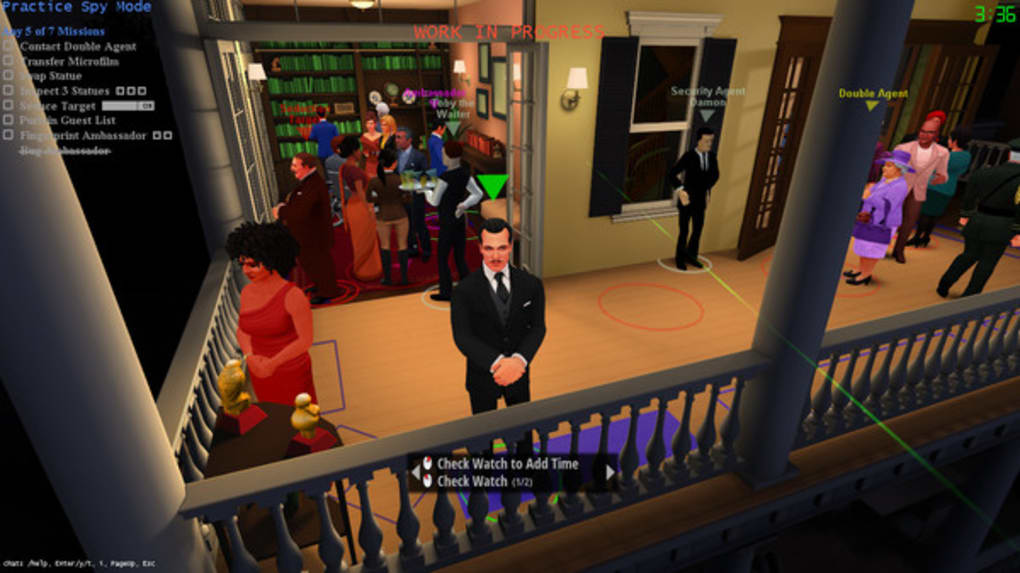
Stepping into the shoes of the Spy in SpyParty is a masterclass in psychological tension and subtle performance. Your mission is not to engage in direct combat or dramatic escapes, but to blend seamlessly into a crowd of AI-controlled party guests. This isn’t just about looking like an AI; it’s about behaving like one, performing actions that are both necessary for your objectives and utterly inconspicuous. The brilliance of SpyParty lies in its ability to transform mundane actions—sipping a drink, admiring a statue, talking to a diplomat—into high-stakes maneuvers fraught with peril.
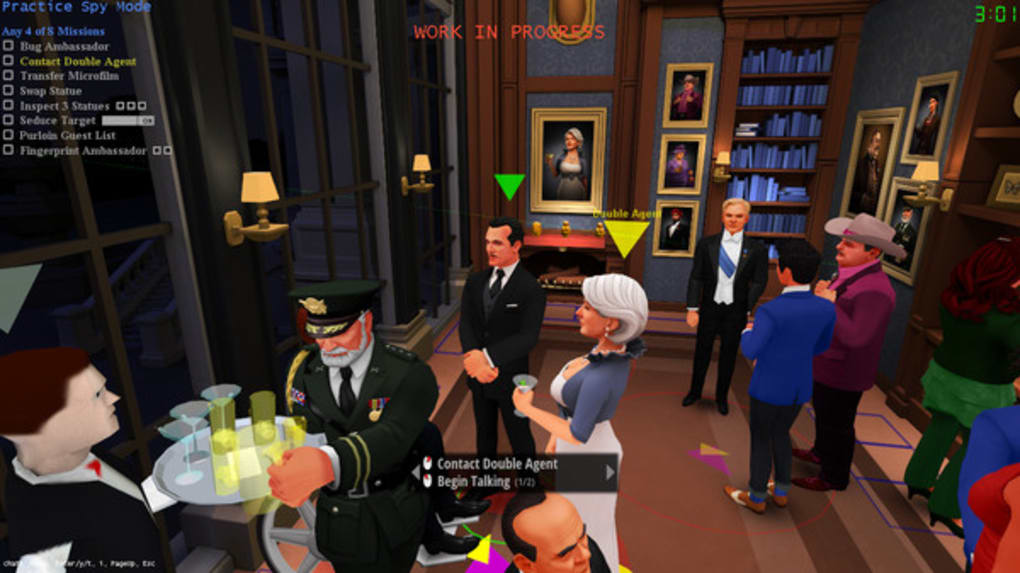
Upon entering a party, the Spy is presented with a list of objectives. These can range from “contact the ambassador,” “swap the books,” “bug the statue,” “seduce the guard,” or “transfer data.” Each objective requires specific interactions with elements or characters within the environment. For instance, “swapping the books” might involve approaching a bookshelf, interacting with it for a brief moment, and then moving away. The challenge is that AI guests also perform these actions, or similar ones, but without the underlying intent. The Spy’s job is to execute their tasks while mimicking the natural, somewhat repetitive, and often unthinking patterns of the AI. The subtle ways in which AI characters move, their predictable loops, their lack of genuine hesitation, and their sometimes robotic pathfinding become the blueprint for the Spy’s deception. Every subtle flicker of human decision-making, every slightly too-quick turn, every moment of genuine thought can be a fatal give-away.
The pressure on the Spy is immense. Every movement, every interaction, every pause is under the microscopic scrutiny of the Sniper. An overly quick movement, a slightly off-kilter path, a prolonged interaction with an objective, or even a moment of hesitation can give you away. The game forces you to internalize the AI’s “tells” – their predictable loops, their lack of genuine hesitation, their sometimes robotic pathfinding. A human player, even subconsciously, might exhibit micro-behaviors that an astute Sniper can pick up on. You might overcompensate, trying too hard to look natural, which ironically makes you stand out. The fear of being identified, the internal monologue of “Am I acting like an AI right now?” or “Did the Sniper just see me complete that objective?”, creates a palpable tension that elevates the simplest actions to thrilling strategic decisions. The exhilaration when you successfully complete all objectives and escape undetected is immense, a testament to your ability to outwit a human opponent.
Successfully completing objectives often involves a careful dance of timing and misdirection. You might linger near an objective, waiting for the Sniper’s gaze to shift, or you might perform a partial action, move away, and return later. Sometimes, a bold, quick action can be more effective than prolonged caution if it catches the Sniper off guard. The most advanced Spy players learn to use the AI guests as cover, positioning themselves behind a cluster of bots as they perform a sensitive action, or using the chaos of multiple AIs performing similar actions to mask their own. It’s a game of managing attention, creating plausible deniability, and exploiting the Sniper’s limited field of vision and processing capacity. It’s truly a test of how well you can inhabit a role and maintain the illusion of being just another background character.
The Unblinking Eye: The Sniper’s Vigil
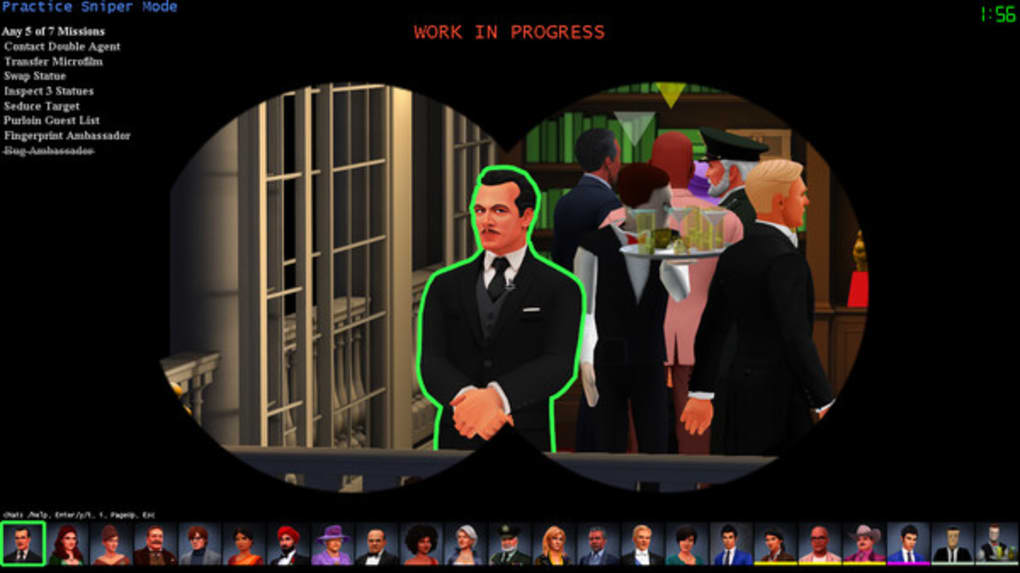
If the Spy’s role is a test of performance and blending, the Sniper’s role is an extreme examination of observation, patience, and deductive reasoning. Perched high above the party, armed with a high-powered scope, the Sniper’s mission seems deceptively simple: find the one human among many AI imposters and make the single bullet count. However, as many players quickly discover, this is far from easy. The sheer volume of activity within the party setting can be overwhelming. Dozens of characters are moving, interacting, and changing positions, making it incredibly difficult to track every individual, let alone discern a human from an AI. Trying to keep track of all the happenings within the party setting can feel overwhelming, and truly requires singular concentration and immense patience to make that crucial single bullet count.
The Sniper’s primary tool is their scope, which offers different levels of zoom. At wider zooms, they can see more of the party, observing general patterns and traffic flow. At closer zooms, they can scrutinize individual characters, looking for anomalies. The Sniper needs to build a mental model of “normal” AI behavior. This involves recognizing the typical routes, interaction durations, and overall mannerisms of the bots. Any deviation, however slight, from these established patterns becomes a potential red flag. The challenge isn’t just seeing suspicious activity, but interpreting it correctly and differentiating it from the random quirks of the AI.
The game provides the Sniper with limited tools to aid their observation. They can “laser” a character, drawing a temporary highlight around them, allowing for easier tracking amidst the crowd. This is crucial for keeping an eye on a suspect or for quickly re-acquiring a character who has moved out of view. However, overuse of the laser can be distracting or lead to tunnel vision, making the Sniper miss broader patterns or other potential suspects. The Sniper also has a limited number of “infers” – special abilities that can, for example, reveal characters who have recently performed an objective interaction, or highlight characters who exhibit certain unusual movement patterns. Using these infers wisely is a critical strategic decision, as they are not unlimited and can often be a “shot in the dark” if not used based on strong suspicion. A wasted infer can be as costly as a missed shot, revealing a lack of conviction or a misread of the situation.
The psychological warfare from the Sniper’s perspective is equally intense. Every second that passes without a shot being fired increases the Spy’s chances of completing objectives. The Sniper must resist the urge to shoot prematurely, as a miss means a lost opportunity and a significant penalty, potentially even signaling to the Spy that they’ve been identified, prompting them to adapt. The Sniper has only one bullet per round. This one-shot kill mechanic amplifies the tension to an unbearable degree, ensuring that every trigger pull is a decision of immense consequence. A good Sniper doesn’t just look for “suspicious” behavior; they actively build a case against a suspect, gathering multiple pieces of evidence before taking the shot. Did that character just talk to the Ambassador? Did they briefly flicker near the statue? Did they walk a path that an AI typically wouldn’t? The Sniper becomes a detective, a forensic analyst of digital human behavior, constantly weighing the certainty of their suspicions against the irreversible consequence of a misfire. The thrill of successfully identifying the Spy and landing that critical shot is unparalleled.
The Subtle Intricacies of Human Behavior and Strategic Depth
What makes SpyParty truly remarkable is its ability to force players to think deeply about human behavior. It’s not just about identifying a human; it’s about understanding the psychology of the opponent. The game, in its deceptive simplicity, taps into complex cognitive processes: pattern recognition, anomaly detection, predictive modeling, and even empathy (trying to imagine what your opponent is thinking).
For the Spy, success hinges on embodying the unthinking nature of an AI. This means suppressing natural human tendencies: the urge to be efficient, to make eye contact, to react quickly, or to follow a logical path. Instead, the Spy must embrace randomness, inefficiency, and the subtle imperfections that characterize automated routines. A Spy might deliberately walk into a wall for a second, or pause for an inexplicably long time before moving, just to mimic an AI glitch. They might perform “bluffs,” interacting with non-objective items in a way that looks suspicious, hoping to draw the Sniper’s attention away from their true goals. The art of deception becomes a delicate balance between executing objectives and creating diversions, all while maintaining an unreadable poker face in their digital persona.
For the Sniper, the challenge is to sift through a torrent of visual data and identify the minute deviations that betray a human presence. An AI will path perfectly; a human might correct a slightly off-course movement. An AI will interact with an object for a precise duration; a human might linger a fraction of a second too long, or too short. The Sniper isn’t just looking for blatant errors; they’re looking for the absence of perfect AI behavior, or the presence of subtly human decision-making. The best Snipers learn the “tells” not just of the AI, but of specific Spy players, recognizing their favored strategies and patterns of deception. This meta-game, where players learn each other’s habits and try to exploit or counter them, adds another layer of profound strategic depth.
The game’s maps, while initially seeming similar, offer a surprising variety of strategic possibilities. Different party layouts, objective placements, and environmental features (like balconies, stairs, or crowded areas) subtly alter the dynamic. A map with many identical statues might make a “bug the statue” objective harder to detect, while a map with clear sightlines might favor the Sniper. Mastering SpyParty isn’t just about understanding the core mechanics, but about deeply understanding each map’s nuances and how they can be exploited by both sides. This constant learning and adaptation contribute significantly to the game’s “infinite replay value,” as no two rounds ever play out exactly the same. The thrilling action never becomes tiresome because the human element introduces an unpredictability that AI opponents could never replicate.
A Cohesive Community and Enduring Appeal
Despite its indie roots and unconventional gameplay, SpyParty has cultivated a remarkably “cohesive and friendly online community.” This is partly due to the nature of the game itself. The high skill ceiling and emphasis on mental acuity over brute force tend to attract a patient and analytical player base. The game often encourages interaction and discussion, as players share strategies, analyze replays, and even mentor newcomers. While the game’s core premise might seem niche, those who are drawn to its unique blend of stealth, psychology, and deduction often become deeply invested.
The community plays a crucial role in the game’s longevity, particularly given the mention of “updates being released slowly.” As an indie title with a dedicated developer (Chris Hecker), development cycles can be longer than those of large studios. However, the strong community helps maintain interest, organizes tournaments, and provides feedback that shapes the game’s evolution. This mutual respect between the developer and the player base fosters an environment where the game can thrive even without a constant stream of new content, relying instead on the depth of its core gameplay and the emergent strategies that arise from player interaction. The slow pace of updates might be a minor drawback for some, but the depth of existing content ensures there’s always something new to learn and master within the current framework.
While “gameplay matchmaking can sometimes be problematic,” particularly in an indie title that might not always have a massive concurrent player count, the dedicated community often mitigates this. Players might arrange matches directly or use community platforms to find opponents, ensuring that keen players can almost always find a worthy adversary. The enjoyment derived from a well-fought round of SpyParty, where both sides meticulously executed their strategies, far outweighs any occasional inconveniences in finding a match. The sense of accomplishment after a perfectly executed blend as a Spy, or a meticulously reasoned shot as a Sniper, is incredibly rewarding and keeps players coming back for more. This shared passion for the game’s unique blend of cunning and intellect ensures a vibrant and welcoming environment for all.
SpyParty’s Unique Legacy
SpyParty stands as a testament to the power of original game design and the potential of independent development. It demonstrates that innovation doesn’t always require cutting-edge graphics or massive budgets, but rather a brilliant core idea executed with meticulous attention to detail. The game challenges players to engage with their opponents on a deeply psychological level, moving beyond mere button presses to truly anticipate and deceive. It’s an incredibly well put-together title, which forces us to think more deeply about human behavior and its subtle intricacies.
Its focus on subtle cues, behavioral analysis, and the tension of a single, decisive moment sets it apart from almost every other game on the market. It teaches patience, observational skills, and the art of misdirection – lessons that extend beyond the game itself. For those seeking an adrenaline rush born not from explosions, but from the quiet dread of discovery or the pinpoint accuracy of deduction, SpyParty offers an exhilarating and intellectually stimulating experience.
In an industry often criticized for its reliance on established formulas, SpyParty carved out its own unique niche, proving that deep, thoughtful gameplay can be found in the most unexpected places. It’s a game that demands your full attention, rewards your cleverness, and endlessly fascinates with its exploration of the intricate dance between hunter and hunted. It’s a title that celebrates the mind games inherent in human interaction, offering an unparalleled platform for strategic improvisation and genuine psychological warfare. As PhanMemFree notes, it’s an “incredibly well put-together title, which forces us to think more deeply about human behaviour and its subtle intricacies,” ensuring its place as a cult classic for discerning gamers.
File Information
- License: “Full”
- Version: “1.0”
- Latest update: “January 31, 2023”
- Platform: “Windows”
- OS: “Windows 7”
- Language: “English”
- Downloads: “16.2K”


