
StarCalc is a powerful, free astronomy software application exclusively available for Windows. Categorized under Science & Education software, with a specific focus on astronomy, it has enjoyed significant popularity since its addition to software directories in 2002, accumulating over 44,000 downloads. While its last official update was in 2008, its functionality remains relevant and appreciated by many astronomy enthusiasts. This comprehensive guide delves into StarCalc’s features, capabilities, and user experiences, providing a detailed overview of this enduring piece of astronomy software.
Exploring the Celestial Sphere with StarCalc
StarCalc’s core functionality lies in its ability to illustrate the precise positions of stars at any given time and location on Earth. This capability extends beyond simple star plotting; the software allows users to visualize the entire hemispherical sky or specific user-defined areas, providing a customizable view of the celestial sphere. These views can be manipulated interactively. Users can zoom in and out at various scales, rotate the view to explore different perspectives, capture screenshots for record-keeping or sharing, and print high-quality images of their customized celestial displays.
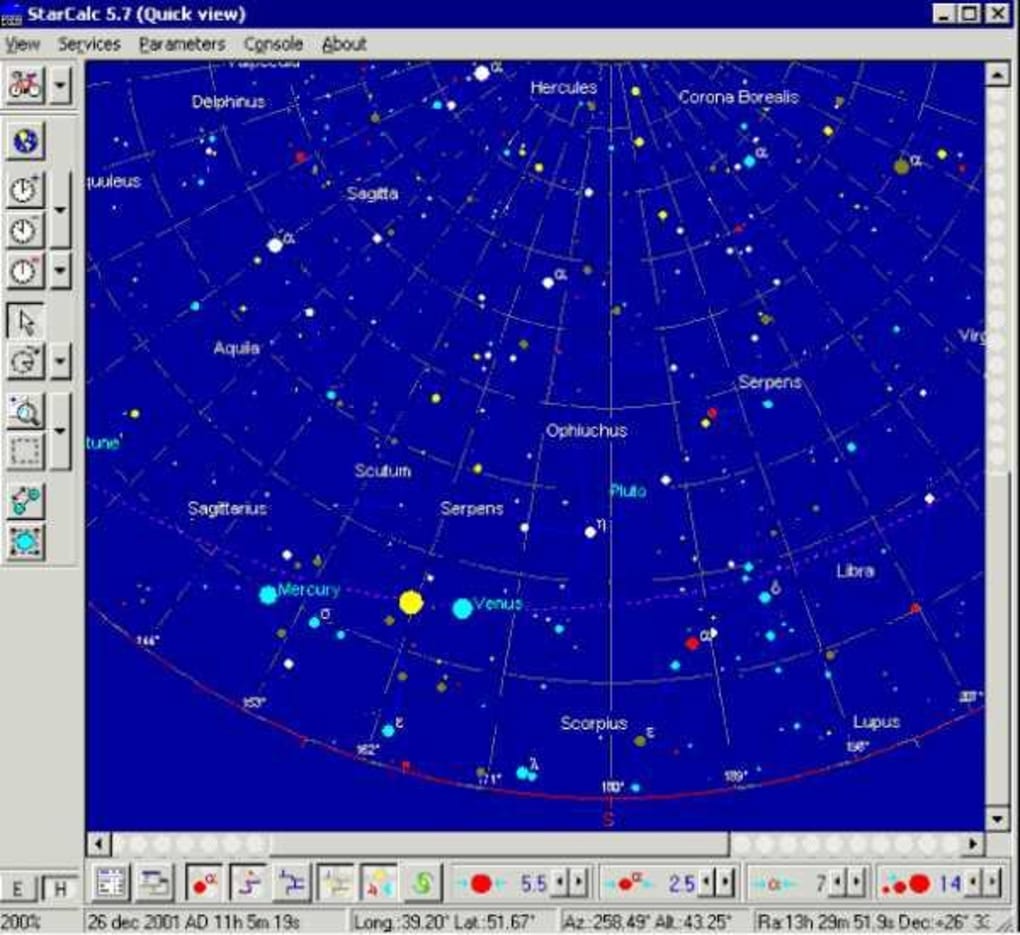
The detail rendered by StarCalc extends to the finest astronomical details, thanks to its implementation of WYSIWYG (What You See Is What You Get) technology. This ensures that what is displayed on screen accurately represents the final printed output, guaranteeing high-fidelity astronomical charts and visualizations. The ability to create highly customized and detailed visualizations sets StarCalc apart from simpler stargazing applications. The ability to focus on specific regions of the sky, zoom in to explore individual stars and constellations, and output high-resolution images makes it a valuable tool for both casual observers and serious astronomy enthusiasts.
Beyond visualization, StarCalc offers a wide array of computational functions related to celestial objects. While the specifics aren’t explicitly detailed in the provided information, the implication is that it can calculate various astronomical data points, perhaps including distances, magnitudes, or other relevant parameters. The presence of these functions underscores StarCalc’s utility as a versatile tool for both observation and calculation. This combination of visual representation and numerical data provides a comprehensive astronomical experience for the user.
The Plugin Architecture: Extensibility and Future Proofing
One of StarCalc’s key architectural features is its reliance on a “Plugin StarCalc interface to catalogs and object groups.” This plugin architecture is crucial to the software’s extensibility and its potential for future updates. New modules can be added as plugins, expanding the software’s functionality without requiring core code modifications.
This design has several advantages:
- Enhanced Functionality: Plugins allow users and third-party developers to add support for new astronomical catalogs, observational tools, and other features. This significantly increases StarCalc’s capabilities over time.
- Modular Updates: Instead of requiring large, comprehensive updates, new features can be added incrementally through plugins, making updates easier to manage and deploy.
- Community Involvement: The plugin architecture fosters community involvement, allowing users to contribute their own modules and share them with others. This collaborative aspect can lead to the development of specialized tools and resources tailored to specific astronomical interests.
- Adaptability to New Data Sources: As new astronomical data becomes available, plugins can be developed to incorporate this information, ensuring that StarCalc remains current and relevant.
The flexibility of this plugin system underscores StarCalc’s long-term viability and its capacity to adapt to evolving astronomical data and research. This design choice suggests a forward-thinking approach to software development, placing emphasis on extensibility and community contribution.
User Interface and Ease of Use
StarCalc boasts a user-friendly interface designed for intuitive operation. The majority of functions are controlled using the mouse, minimizing the need for complex keyboard shortcuts or command-line inputs. This straightforward design makes the software accessible to users with varying levels of technical expertise, from casual stargazers to experienced astronomers. The emphasis on ease of use ensures that the software’s powerful capabilities are accessible to a broad audience.
The simplicity of the interface doesn’t compromise functionality. The software remains powerful and capable, while maintaining accessibility for those unfamiliar with complex astronomy software. This combination of power and accessibility is a crucial element in StarCalc’s appeal.
User Reviews and Community Feedback
User reviews highlight StarCalc’s intuitive design and its effectiveness as a tool for planning observation sessions. One user described it as “an intuitive tool that leaves the fun IN exploring our sky,” emphasizing the enjoyment derived from using the software to explore the night sky. Another long-term user praised its features for planning observing sessions, noting the convenience of setting date and time, visualizing moon phases and planetary positions, and identifying constellations and Messier objects.
However, some limitations are mentioned. These include limitations in the display of faint stars (remediable by downloading larger star catalogs) and an installation requirement to place the StarCalc folder on the C: drive to prevent program lockups. These issues highlight the importance of proper installation and the need for potential users to be aware of these limitations. Despite these minor drawbacks, the overall sentiment expressed in user reviews is one of positivity and appreciation for StarCalc’s capabilities and user-friendliness.
The availability of user reviews provides valuable insights into the practical experiences of other users, offering potential new users a realistic picture of the software’s strengths and weaknesses. The overwhelmingly positive feedback underscores StarCalc’s success in providing an accessible and enjoyable astronomical experience.
Conclusion: A Lasting Legacy in Astronomy Software
StarCalc, despite its age and lack of recent updates, remains a relevant and valuable tool for astronomy enthusiasts. Its blend of powerful visualization tools, computational capabilities, and a user-friendly interface makes it an accessible and enjoyable program for both beginners and experienced users. The plugin architecture ensures its potential for future expansion and adaptation, suggesting a lasting legacy in the world of free astronomy software. While more modern alternatives may exist, StarCalc’s enduring popularity and positive user feedback testify to its enduring appeal and utility in the world of amateur astronomy. Its straightforward design, coupled with its powerful features, continues to make it a valuable resource for those exploring the wonders of the night sky.
File Information
- License: “Free”
- Version: “5.73”
- Latest update: “February 12, 2019”
- Platform: “Windows”
- OS: “Windows 98”
- Language: “English”
- Downloads: “14.2K”
- Size: “781.73 KB”


