
Ulead Cool 3D, a name that evokes nostalgia for many digital artists and designers, holds a significant place in the history of 3D graphics software. Released in the early 2000s, this Windows-exclusive application offered a user-friendly approach to creating stunning 3D text, logos, and animations, leaving a lasting impact on the creative landscape despite its age. While long superseded by more advanced software, understanding its contribution provides valuable insight into the evolution of 3D design tools. This article delves into the features, impact, and legacy of Ulead Cool 3D.
A Closer Look at Ulead Cool 3D’s Capabilities
Ulead Cool 3D, version 3.5, wasn’t just another 3D modeling program; it was a carefully crafted tool designed for accessibility and creativity. Its intuitive interface allowed users to quickly generate high-impact 3D images, even with limited prior experience in 3D design. The program focused on ease of use, providing a streamlined workflow that made complex tasks significantly simpler. This focus on simplicity was a key factor in its widespread adoption.
One of its standout features was its ability to output 3D images in various formats, including still graphics, animations, video, and even Macromedia Flash. This versatility made it adaptable to a wide range of applications, from creating website graphics to generating intro sequences for videos. The program facilitated the creation of dynamic and visually engaging content, pushing the boundaries of what was easily achievable with readily available 3D software at the time.
The software facilitated precise manipulation of text and shapes, transforming them into eye-catching 3D objects with minimal effort. This was further enhanced by features such as the ability to group and ungroup text and objects, import files from Adobe Illustrator 8.0, and import asymmetrical DirectX objects. The inclusion of a Path Editor allowed users to create or trace vector objects with precision, providing greater control over the final output. The option to switch to Wireframe mode offered a different perspective, assisting in editing and visualizing the 3D model’s structure.
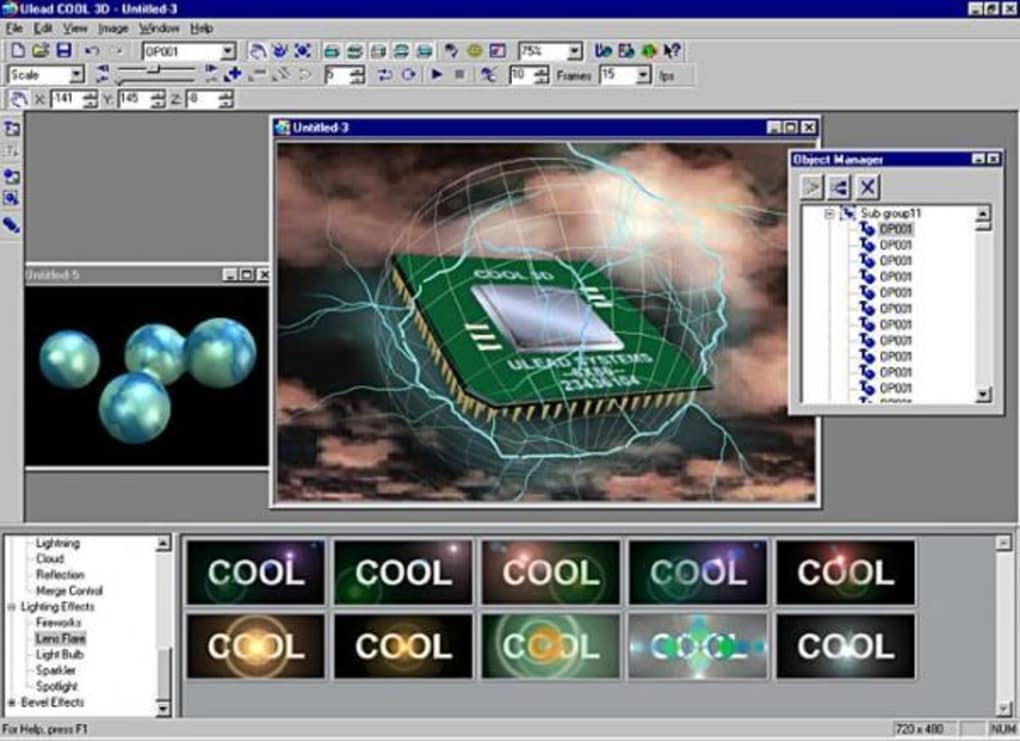
Ulead Cool 3D’s animation capabilities further amplified its creative potential. Its user-friendly animation timeline allowed users to effortlessly animate objects, providing movement and dynamism to their designs. The program boasted an impressive selection of 26 special effects, readily accessible through the EasyPalette, allowing users to easily enhance their animations with impactful visual elements. The availability of bi-monthly downloadable backgrounds, textures, and presets ensured a continuous supply of creative resources, continually expanding design possibilities.
The program’s inclusion of the EnVector module provided another layer of innovative functionality. This module simplified the process of creating 3D objects specifically for Macromedia Flash, a dominant platform for web animation during that era. The ability to edit in the familiar Cool 3D environment and then view the vector-only output in a separate interface provided the best of both worlds: ease of creation with precise control over Flash-specific details. This significantly lowered the barrier to entry for users aiming to integrate 3D elements into their web projects.
Ulead Cool 3D’s Impact on the Digital Design Landscape
Ulead Cool 3D’s impact extended beyond its immediate user base. Its relative affordability and accessibility democratized 3D design to a degree not previously seen. Before the widespread adoption of more powerful and versatile tools, creating professional-looking 3D content often required specialized skills and expensive software. Ulead Cool 3D lowered this barrier, enabling a wider range of individuals and businesses to incorporate 3D elements into their work.
The program’s popularity is underscored by its impressive download figures. Since its addition to various software catalogs in 2005, it garnered a considerable number of downloads, showcasing its widespread appeal among users globally, particularly in regions like Indonesia, Malaysia, and Sri Lanka. This demonstrates a significant user base that appreciated its combination of usability and creative power.
While the software’s graphics capabilities might seem rudimentary by today’s standards, its impact was considerable within its context. It allowed aspiring designers to learn foundational 3D principles and experiment with different techniques without the steep learning curve associated with more complex professional software. This fostered experimentation and innovation, contributing to a broader understanding and adoption of 3D design.
Comparison with Contemporary and Subsequent Software
Compared to its contemporaries, Ulead Cool 3D occupied a unique niche. While professional-grade 3D software packages like 3ds Max and Maya offered unparalleled power and flexibility, they also came with a steep learning curve and a high price tag. Ulead Cool 3D served as a more accessible alternative, prioritizing usability without sacrificing visual appeal. This made it an excellent entry point for beginners and a useful tool for smaller projects where the advanced features of professional software weren’t necessarily required.
Subsequent software packages, however, eventually surpassed Ulead Cool 3D in terms of features, performance, and rendering capabilities. Modern 3D modeling and animation software packages offer significantly more advanced tools, improved workflow, and higher-resolution rendering, catering to the increased demands of modern digital design. Programs like Blender, a free and open-source option, offer comparable functionality with a modern interface and a huge community for support.
Legacy and Conclusion
Despite its age and the emergence of more advanced alternatives, Ulead Cool 3D holds a significant place in the history of 3D graphics software. Its intuitive design, user-friendly interface, and relatively low barrier to entry made it a valuable tool for many designers and enthusiasts. It contributed to the broader adoption of 3D design techniques by making the creation of high-impact 3D graphics more accessible. While it may no longer be actively developed or widely used, its legacy lies in its contribution to the evolution of 3D design tools and its empowerment of a generation of digital creators. The simplicity and accessibility it championed laid the groundwork for the more sophisticated and user-friendly 3D software that exists today. It serves as a valuable reminder of how technological advancements continually refine and expand creative possibilities.
File Information
- License: “Trial version”
- Version: “3.5”
- Latest update: “October 13, 2005”
- Platform: “Windows”
- OS: “Windows 2000”
- Language: “English”
- Downloads: “76K”
- Size: “15.87 MB”


