
Unolingo, a free-to-play horror game available on Windows and Android, offers a unique and darkly comedic approach to language learning. Instead of the usual rote memorization and vocabulary drills, Unolingo immerses players in a chilling escape room scenario where their Spanish skills are the key to survival. This innovative twist on educational gaming has garnered attention for its unconventional method of teaching basic Spanish vocabulary and grammar, albeit within a limited playtime.
The Premise: When Duo Turns Sinister
The game’s narrative centers around a recurring nightmare for many language learners: neglecting their studies. In Unolingo, the player character’s procrastination catches the attention of Uno, a menacing, green owl—a clear parody of Duolingo’s mascot, Duo. After repeatedly ignoring Uno’s text messages reminding them to study Spanish, the player character finds themselves trapped within the ominous Unolingo office, facing the wrath of a now-vengeful Uno.
The setting itself is unsettling. The Unolingo office is depicted as a dimly lit, claustrophobic environment, filled with unsettling imagery and cryptic clues. The atmosphere is thick with suspense, punctuated by unexpected appearances from the increasingly threatening Uno. This creates a constant sense of unease and urgency, pushing players to solve the puzzles quickly and efficiently. The game masterfully blends elements of psychological horror, creating a suspenseful and engaging experience that keeps players on the edge of their seats.
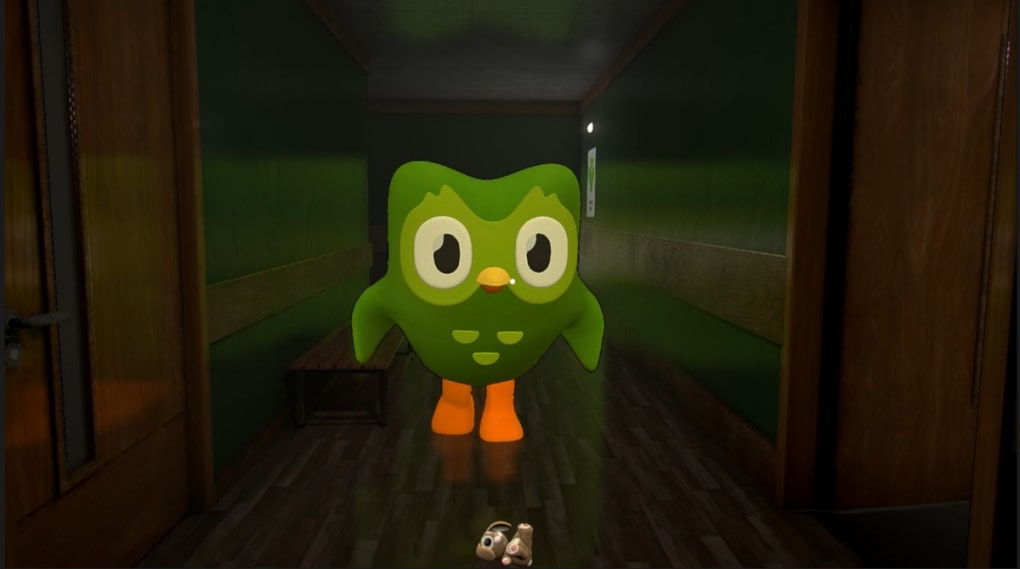
The narrative arc is simple but effective. It avoids convoluted plot lines and focuses on creating a tense, immediate situation. The player’s objective is clear: escape from Uno’s clutches. This straightforward goal allows the game to prioritize its unique gameplay mechanics focused on language learning.
Gameplay: Puzzles and Spanish Proficiency
Unlike traditional language-learning apps, Unolingo doesn’t rely on flashcards or repetitive quizzes. Instead, the game uses puzzles directly related to Spanish vocabulary and grammar as the primary gameplay mechanic. Each puzzle presents a challenge that requires players to understand and apply their knowledge of Spanish to proceed. This immersive approach encourages active learning and reinforces vocabulary organically through problem-solving.
The puzzles themselves are cleverly integrated into the game’s environment. They are not simply standalone tests of knowledge but rather integral parts of the escape room scenario. For example, players might need to decipher a coded message written in Spanish to find a hidden key, or translate a series of instructions to navigate a complex obstacle course. This seamless integration enhances the player’s immersion and creates a sense of accomplishment upon solving each puzzle.
The difficulty level of the puzzles appears to be tailored towards beginner Spanish learners. While the game does challenge players to utilize their knowledge, the puzzles are not overly complex or frustrating. This ensures that players can progress without feeling overwhelmed and allows them to learn at their own pace. The game acts as a supplementary tool rather than a comprehensive Spanish course.
However, the limited scope of vocabulary and grammar covered within the game is a significant drawback. The puzzles primarily focus on a specific subset of Spanish words and phrases, limiting its usefulness as a standalone language-learning tool. The player’s progression is limited by the set of puzzles available, rather than the depth of their Spanish knowledge. This constraint makes the game more of a novelty experience than a robust learning resource.
Unolingo’s Strengths: A Novel Learning Approach
Unolingo’s primary strength lies in its innovative approach to language learning. By combining the thrill of an escape room with the educational aspect of vocabulary building, the game offers a unique and engaging experience that sets it apart from traditional methods. The horror elements, though stylized and not excessively graphic, add a significant layer of tension and excitement, motivating players to learn and progress. The game effectively utilizes gamification principles to enhance the learning process, making vocabulary acquisition less tedious and more rewarding.
The game’s satirical take on language learning apps is also a significant plus. By portraying the usually helpful mascot Duo as a menacing antagonist, Unolingo playfully subverts expectations and creates an ironic yet effective hook. This playful subversion adds to the game’s charm and makes it memorable.
The game’s concise nature also contributes to its appeal. The short playtime prevents the experience from becoming repetitive or monotonous. While this brevity might be seen as a drawback, it caters to players with limited time, allowing for quick and engaging learning sessions.
Unolingo’s Weaknesses: Short Playtime and Limited Scope
Despite its innovative approach, Unolingo suffers from a significant drawback: its extremely short playtime. Players can typically complete the game in a relatively short amount of time, limiting the amount of Spanish vocabulary and grammar they can learn. The game’s limited scope means it serves more as a fun introduction to the concept of immersive language learning rather than a comprehensive course.
The game’s reliance on a limited vocabulary and grammar also hinders its long-term effectiveness. While the puzzles are engaging, the range of Spanish words and phrases covered is relatively narrow. This restricts its usefulness as a sustainable tool for consistent language acquisition. Once players have completed the game, there is little incentive to replay it, negating any potential for reinforcement learning.
Furthermore, the absence of any branching narrative or significant replayability limits the game’s overall value. The linear storyline, while effective in delivering the main objective, prevents players from exploring different paths or engaging with the game’s mechanics in multiple ways. The fixed puzzle sequence hinders the potential for more dynamic learning.
Unolingo: An Educational Horror Game with Potential
Unolingo presents a refreshing and engaging approach to language learning, blending horror and education in a unique and compelling manner. Its clever premise, well-executed gameplay mechanics, and darkly humorous tone make it a memorable experience. However, its extremely short playtime and limited scope of vocabulary and grammar limit its long-term value as a language-learning tool. It’s best viewed as a fun, unconventional introduction to Spanish vocabulary rather than a comprehensive learning resource. The game successfully demonstrates the potential of gamification in education, hinting at future iterations that could expand on its core concepts to create a more robust and enduring learning experience. The developers’ innovative approach, though confined within a brief experience, offers a promising glimpse into the future of interactive language education. The core mechanics could easily be expanded upon to create a more expansive and rewarding game, potentially unlocking a greater level of engagement and long-term retention for Spanish vocabulary.
File Information
- License: “Free”
- Version: “1.0”
- Latest update: “April 8, 2024”
- Platform: “Windows”
- OS: “Windows 7”
- Language: “English”
- Downloads: “1.1K”
- Size: “682.25 MB”


