
In an era saturated with innovative indie titles pushing the boundaries of traditional genres, “Windowkill” emerges as a truly groundbreaking experience, redefining what a twin-stick shooter can be. Developed by torcado, this unique action game doesn’t just run on your computer; it interacts with your classic Windows desktop in a way never before seen. Instead of being confined to a full-screen application or a static window, “Windowkill” transforms your very operating system’s interface into its dynamic battlefield. Players are tasked with navigating and manipulating the game window itself, shooting its edges to move it around the desktop, evade a relentless onslaught of enemies, and gain a tactical advantage. It’s a concept so audacious, so distinctly different, that it immediately captures attention and promises an experience that is as challenging as it is novel.
At its core, “Windowkill” is a twin-stick shooter, a genre celebrated for its fast-paced action and demanding precision. However, it takes this familiar framework and overlays it with an entirely new dimension of interaction. The game’s ingenious design leverages the fundamental properties of a desktop window—its movable, resizable borders—and turns them into core gameplay mechanics. This isn’t just a gimmick; it’s an integral part of the strategy, forcing players to think outside the box, or rather, within the box of their game window, as they literally push and pull their play area to survive. The blend of classic shooter sensibilities with this meta-desktop interaction creates a frantic, engaging, and often humorous dance between virtual combat and real-world interface, setting “Windowkill” apart as a truly singular creation in the gaming landscape.
Unveiling the Unique Gameplay Mechanics
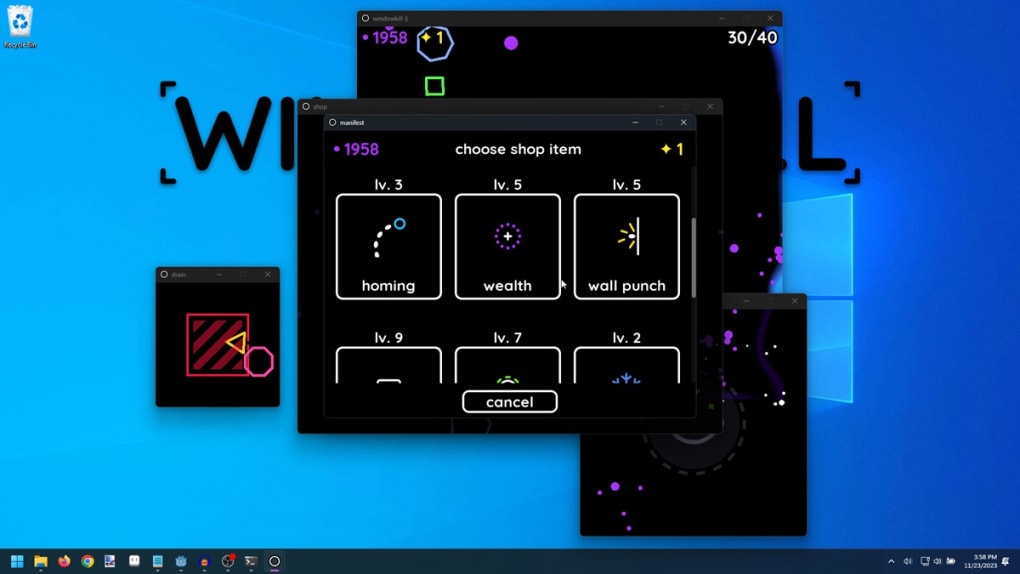
The most striking and undeniably innovative aspect of “Windowkill” lies in its revolutionary gameplay mechanics, which eschew traditional fixed arenas in favor of a dynamic, player-manipulated environment. This isn’t merely a game that runs in a window; the window is the game, a living, breathing entity that responds directly to the player’s actions, fundamentally altering the entire approach to a twin-stick shooter.
The Desktop as Your Battlefield
Imagine a twin-stick shooter where the boundaries of your playing field are not static, but fluid, constantly shifting in response to your strategic decisions. This is the reality “Windowkill” presents. The game unfolds directly on your Windows desktop, with enemies and projectiles appearing both within and beyond the confines of your game window. Your desktop itself becomes the sprawling, expansive arena, and your game window is a movable viewport through which you perceive and interact with this larger, unseen battleground. This constant tension between the known (what’s inside your window) and the unknown (what lurks just outside its borders) is a core driver of the game’s unique appeal.
The implication of this design is profound. Players are not just controlling a character within a fixed space; they are actively controlling their perspective, their field of view, and their escape routes. An enemy might appear from the ’north’ of your window, but if you push your window ‘south,’ that enemy might now be above your current visible area, or perhaps you’ve revealed a safe zone previously hidden. This constant mental mapping of your position relative to the larger desktop, and anticipating where threats or opportunities might emerge, adds an unparalleled layer of strategic depth that is absent in conventional shooters. It transforms the often-passive act of viewing a game into an active, strategic engagement with the interface itself.
Mastering Window Manipulation
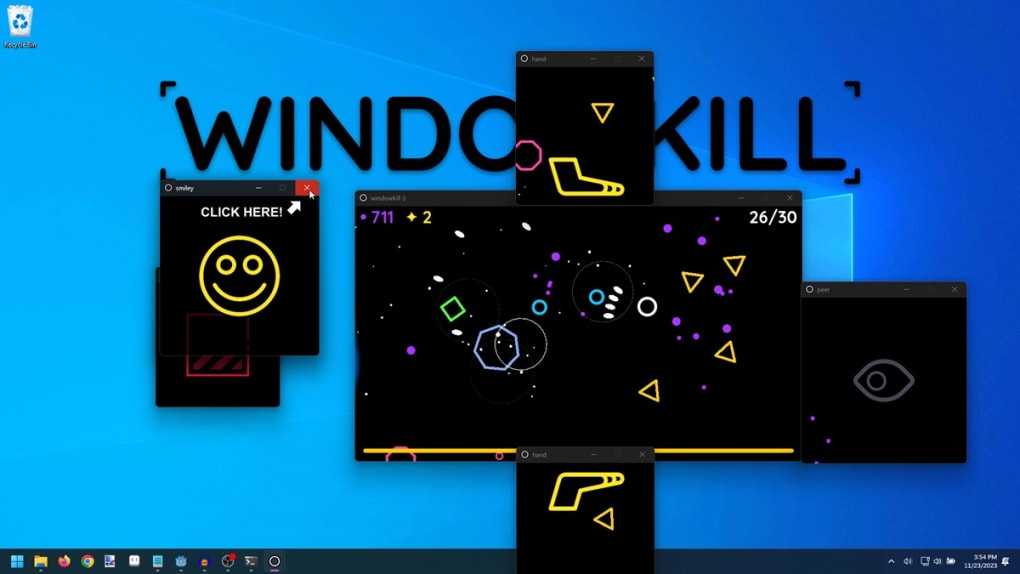
At the heart of “Windowkill”’s ingenious design is the mechanic of “shooting the edges of the window.” This isn’t a mere aesthetic choice; it’s the primary mode of locomotion and evasion. Unlike traditional twin-stick shooters where one stick controls movement and the other aims, here, your actions are multi-faceted. When you shoot at an enemy within your window, you’re engaging in direct combat. But when you direct your firepower towards the very borders of your game window, you’re performing a different kind of action: you’re pushing it.
For instance, aiming and firing your weapon at the left edge of your window will cause the entire window to move to the right, effectively shifting your playable area and revealing new parts of the desktop arena. Shooting the top edge pushes the window downwards, and so on. This mechanic is intuitive yet demands immense spatial awareness and quick thinking. Players must constantly evaluate not only enemy positions and incoming projectiles but also the optimal direction to push their window to evade damage, expose new targets, or reposition for a better attack angle.
This dual functionality of aiming—for offense against enemies and for strategic movement of the window—creates a constant push-and-pull in the player’s decision-making process. Do you focus fire on a menacing foe, or do you prioritize pushing your window to safety? What if the best attack angle requires you to expose yourself to a previously unseen threat lurking just beyond the window’s edge? This dynamic interplay between offensive and defensive window manipulation is what gives “Windowkill” its intense, moment-to-moment engagement. It’s a mechanic that feels alien at first but quickly becomes second nature, transforming the mundane act of moving a window into an exhilarating dance of survival and strategy. The precision required to control both your character’s aim and the window’s movement simultaneously elevates “Windowkill” from a simple shooter to a sophisticated tactical experience.
Dive Deep into Roguelike Challenges
“Windowkill” proudly embraces its roguelike nature, which translates into a formidable challenge for players, ensuring that each run feels distinct and demands adaptability. This genre choice is not just for difficulty; it’s an inherent part of the replayability and learning curve, emphasizing skill progression through repeated attempts and strategic decision-making.
Diverse Enemies and Bosses
A crucial element that keeps “Windowkill” fresh and engaging across countless runs is the sheer diversity of its enemy types and the epic scale of its boss encounters. The adversaries in “Windowkill” are not merely palette swaps or minor variations; they are distinct entities, each possessing unique movement patterns, attack styles, and vulnerabilities. Some might relentlessly home in on your window, requiring swift movement to avoid collisions. Others might fire barrages of projectiles that necessitate precise dodging and window repositioning. There could be foes that move erratically, or those that create zones of denial, forcing the player to constantly shift their window’s perspective to find a safe haven or an opportune moment to strike.
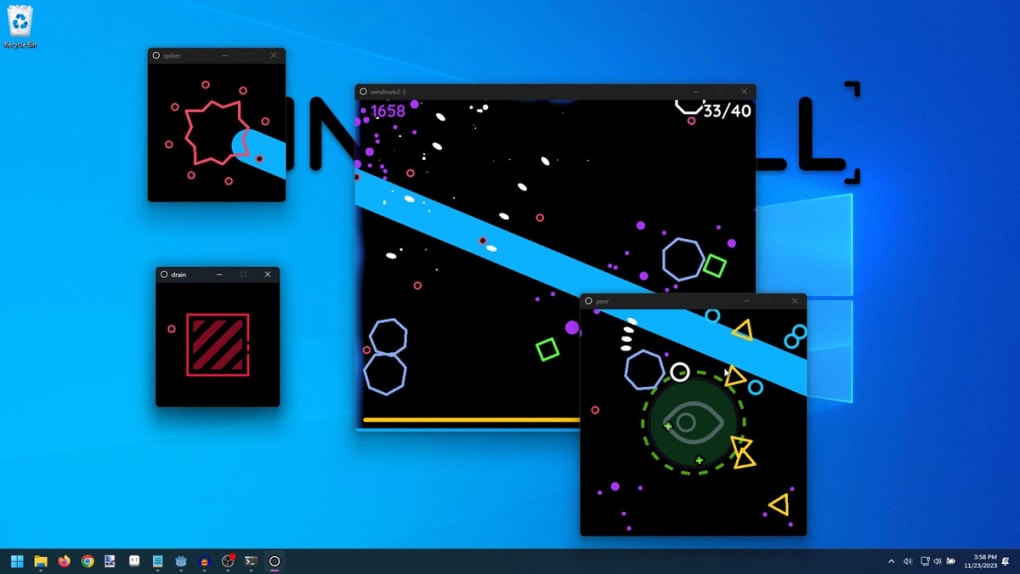
This variety forces players to develop a dynamic understanding of their threat landscape. It’s not enough to master one strategy; you must be prepared to adapt on the fly, recognizing enemy behaviors and reacting accordingly, often while simultaneously manipulating your game window. The environmental hazards presented by different enemy types directly influence the player’s window-pushing decisions. For example, a sprawling enemy that takes up a large portion of the visible screen might require rapidly pushing the window to expose its weak point while avoiding its wide-arc attacks.
The boss battles in “Windowkill” are where this enemy diversity truly shines, escalating the challenge to epic proportions. These aren’t just larger versions of standard enemies; they are intricate multi-stage encounters that often leverage the game’s unique window-manipulation mechanics in creative and punishing ways. A boss might occupy such a massive area that only a fraction of it is visible within your window at any given time, forcing you to frantically push and pull the window to identify and target weak points. Another boss might unleash attacks that travel across the entire desktop, requiring you to preemptively move your window out of harm’s way before the attack even enters your current visible area. Each boss encounter is a puzzle of spatial awareness, reaction time, and precise window control, providing a satisfying sense of accomplishment upon victory and a clear motivation to refine your skills after defeat. The constantly evolving threat landscape ensures that no two runs are ever truly identical, fueling the roguelike loop of “just one more try.”
Character Variety and Strategic Depth
Beyond the dynamic enemy roster, “Windowkill” further enriches its roguelike depth through a selection of multiple unique characters, each offering a distinct playstyle and strategic approach. This character variety is not just cosmetic; it fundamentally alters how players engage with the core mechanics of window manipulation and combat, injecting significant replay value and fostering diverse tactical choices.
Each character comes equipped with their own set of abilities, weapon characteristics, or passive traits that subtly (or dramatically) shift the gameplay experience. For instance, one character might have a higher rate of fire but less overall damage per shot, encouraging an aggressive, suppressive playstyle. Another might possess a slow but powerful weapon, demanding careful aim and opportunistic strikes. There could be characters with unique movement modifiers, making window pushes more efficient or allowing for temporary bursts of speed, which in turn opens up new evasion and positioning strategies. Perhaps a character has a defensive ability that briefly protects the window from damage, providing a valuable respite in chaotic encounters.
The choice of character directly influences how a player will approach a run, especially considering the diverse enemy types and challenging boss encounters. A character focused on high mobility might excel at dodging projectiles and repositioning the window rapidly, making them ideal for navigating dense bullet-hell scenarios. Conversely, a character with potent area-of-effect abilities might be better suited for clearing swarms of smaller enemies that flood the screen, using fewer, more impactful window movements.
This strategic depth encourages experimentation and mastery. Players are not just learning the game; they are learning how to play each character effectively within the “Windowkill” framework. Discovering synergies between a character’s abilities and certain upgrades found during a run, or developing specific tactics for bosses with different characters, forms a significant part of the game’s enduring appeal. The roguelike loop is amplified by this character selection, as players can continually find new ways to tackle the same challenging content, ensuring that “Windowkill” remains fresh and offers a wealth of strategic avenues for even the most dedicated players to explore.
Beyond the Single-Player Experience: Co-op and Secrets
While “Windowkill”’s innovative core mechanics and challenging roguelike structure provide a compelling single-player experience, the game extends its appeal significantly through the inclusion of local co-op and a wealth of hidden secrets. These features broaden the game’s horizons, transforming it into a versatile title that can be enjoyed both alone and with friends, fostering shared discovery and collaborative struggle.
The addition of local co-op is a standout feature, particularly in a genre often dominated by solitary experiences. This mode presents an exciting opportunity for shared experiences, allowing two players to team up and tackle the desktop chaos together. The implications of co-op on “Windowkill”’s unique mechanics are fascinating. Do both players control the same window, coordinating their pushes and shots? Or does each player control their own separate game window, leading to a frantic, multi-window juggling act across the desktop? The latter, if implemented, would introduce an entirely new layer of cooperative strategy, requiring impeccable communication and synchronized window manipulation to survive the onslaught. Imagine one player focusing on pushing the shared or their individual window to safety while the other concentrates on clearing immediate threats, or perhaps both working in tandem to expose boss weak points by moving their windows in unison or in complementary directions. This shared challenge not only amplifies the fun but also potentially alleviates some of the difficulty, as two minds and four hands can often navigate complex situations more effectively than one. It transforms the intense pressure of “Windowkill” into a memorable bonding experience, full of triumphant successes and hilarious, chaotic failures.
Furthermore, “Windowkill” encourages extensive exploration and rewards curiosity through a variety of secrets scattered throughout the game. This aspect adds an extra dimension to the gameplay, moving beyond pure combat and survival to incorporate elements of discovery. These secrets could range from hidden characters, unlockable weapons, or powerful upgrades that significantly alter subsequent runs. They might involve obscure objectives, specific conditions to meet during a run, or even require players to interact with the desktop environment in unconventional ways outside the direct combat loop.
The presence of secrets injects a strong incentive for replayability. Players aren’t just aiming to beat their high score or reach a new stage; they are actively seeking out these hidden gems, adding a meta-game of discovery to the core roguelike progression. Finding a secret might unlock a new pathway or provide a significant advantage, dramatically changing the strategic landscape for future attempts. This encourages a deeper engagement with the game world, pushing players to experiment, observe, and piece together clues, fostering a sense of mystery and wonder. Ultimately, the combination of local co-op and a robust system of secrets ensures that “Windowkill” is not only a novel and challenging action game but also a rich, multilayered experience designed for prolonged engagement, whether you’re battling solo or with a companion.
The Balance of Innovation and Difficulty
“Windowkill” is an experimental title, a testament to indie development pushing boundaries. What makes it particularly compelling is its ability to strike a delicate balance between its inherent challenge and the undeniable enjoyment it delivers. This equilibrium is crucial for a game that dares to be so different, ensuring that its novel concept doesn’t alienate players but rather draws them into its unique world.
The Roguelike Learning Curve
One of the most frequently highlighted aspects of “Windowkill” is its high difficulty level. For players new to the roguelike genre, or those accustomed to more forgiving action games, this can indeed be quite frustrating. The game’s roguelike nature means that death is permanent for a given run, and progress often feels hard-won, only to be reset. This inherent brutalism is a cornerstone of the genre, designed to encourage mastery through repetition and learning from mistakes. In “Windowkill,” this difficulty is amplified by its unique mechanics. Not only do players need to master traditional twin-stick shooting skills, but they also have to learn the complex art of window manipulation, effectively fighting two battles at once: one against the enemies, and one against the constraints and possibilities of their own game window.
However, beneath this challenging exterior lies a paradox: “Windowkill” boasts easy mechanics yet is difficult to master. The actions themselves—shooting and pushing the window—are straightforward. There aren’t complex button combinations or intricate skill trees to navigate initially. The simplicity of the core controls makes the game immediately accessible. Anyone can pick up the controller (or keyboard and mouse) and understand what they need to do. The true challenge, and the path to mastery, emerges from the nuanced application of these simple mechanics in increasingly complex and chaotic scenarios.
Learning to anticipate enemy movements while simultaneously positioning your window for optimal evasion or attack, knowing when to commit to a firefight versus when to prioritize a defensive window push, and adapting to the diverse enemy types and bosses—these are the elements that comprise the steep, yet rewarding, learning curve. Each death in “Windowkill” is not a failure but a lesson. Players learn enemy patterns, discover optimal window strategies for different situations, and gradually refine their spatial awareness. The “frustration” often cited by new players is precisely what roguelike enthusiasts cherish: the drive to overcome, the satisfaction of making it further than before, and the incremental improvement of skill that comes with each attempt. The game’s design inherently pushes players to experiment with different characters and strategies, ensuring that the journey towards mastery is as engaging as it is demanding.
Why Windowkill Stands Out in the Shooter Genre
“Windowkill” is more than just another action game; it’s a statement, a bold reinterpretation of the twin-stick shooter genre that leverages its experimental nature to carve out a distinct identity. Its unique concept, placing the game directly on the desktop and making the window itself a dynamic play area, fundamentally sets it apart from its contemporaries. In a landscape often filled with iterative designs, “Windowkill” offers a breath of fresh air, proving that there’s still ample room for genuine innovation in established genres.
The fresh and engaging perspective it brings to the twin-stick shooter genre cannot be overstated. By introducing the mechanic of window manipulation, “Windowkill” forces players to rethink fundamental assumptions about game spaces. The arena is no longer a static backdrop but an active participant in the gameplay, requiring a level of environmental awareness and control previously unseen. This elevates the strategic depth, transforming simple evasion and shooting into a complex dance of positioning, perception, and preemptive action. The joy comes not just from skillful aiming, but from the cunning use of the window to outsmart and outmaneuver foes that exist within and beyond your immediate view.
Moreover, the blend of its innovative core with classic roguelike elements ensures deep replayability. The diverse enemy types, multi-faceted boss battles, and a roster of unique characters, combined with scattered secrets, mean that each playthrough offers a new challenge and new opportunities for discovery. The high difficulty, while initially daunting, reinforces the roguelike ethos of learning and mastery, turning every defeat into a step toward becoming a more skilled player. The availability of local co-op further enhances its appeal, offering a chaotic yet rewarding shared experience that brings a social dimension to its unique gameplay.
In conclusion, “Windowkill” is a triumph of creative design. It takes an everyday interface element—the desktop window—and transforms it into the centerpiece of an exhilarating action game. Its courage to experiment and its successful execution of a truly novel concept make it a standout title. For anyone seeking a twin-stick shooter that breaks free from conventional molds and offers an experience that is as intellectually stimulating as it is action-packed, “Windowkill” is an absolute must-play. It’s a game that not only entertains but also leaves a lasting impression, demonstrating the boundless potential of indie game development.
File Information
- License: “Full”
- Version: “varies-with-devices”
- Latest update: “January 2, 2024”
- Platform: “Windows”
- OS: “Windows 8.1”
- Language: “English”
- Downloads: “4.5K”


