
Hex editors, powerful tools for directly manipulating binary data, often intimidate newcomers with their seemingly cryptic interface of numbers, letters, and symbols. However, their capabilities in debugging, file editing, and data analysis are invaluable for programmers, data recovery specialists, and anyone working with low-level file formats. While numerous hex editors exist, XVI32, developed by Christian Maas, stands out as a remarkably versatile and free option. This review explores XVI32’s strengths, weaknesses, and overall suitability for various users.
Portability and Ease of Use
One of XVI32’s most compelling features is its exceptional portability. Unlike many applications requiring extensive installation processes, XVI32 is distributed as a compact ZIP archive. This eliminates the need for installation; users simply extract the archive and run the executable directly from the extracted folder. This makes XVI32 incredibly convenient for use on various systems, including those without administrator privileges, and allows users to easily carry the program on portable storage devices like USB drives. This portability is a significant advantage for those who require quick access to a hex editor across different machines.
Key Features and Functionality
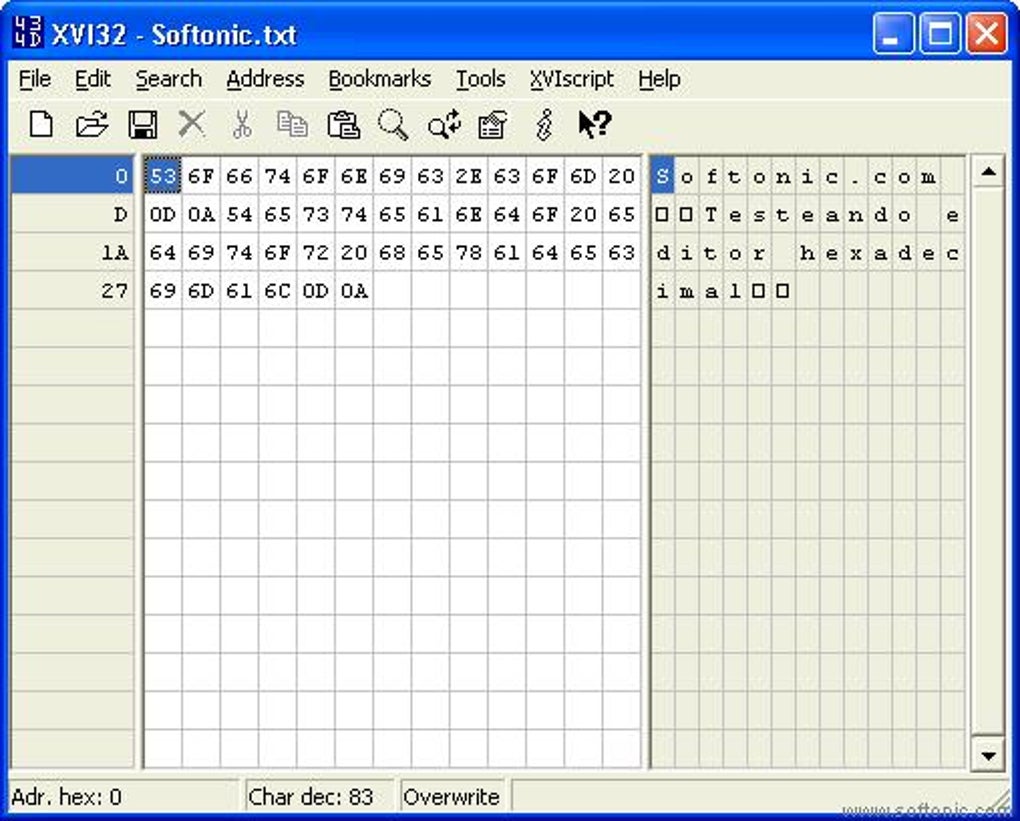
Beyond its portability, XVI32 offers a robust set of features commonly sought in hex editors. The core functionality revolves around seamless hexadecimal editing. Users can directly modify hexadecimal values within the interface, a process facilitated by intuitive navigation and editing tools. The editor supports common operations such as copying, replacing, and searching for specific hexadecimal sequences or ASCII strings. This enables users to efficiently locate and manipulate targeted data within files.
The inclusion of a bookmark feature significantly enhances the usability of XVI32, particularly when working with large files. While the limitation to only nine bookmarks might seem restrictive, it still offers a valuable way to navigate and revisit specific points of interest within the data. Furthermore, the ability to open files in read-only mode is a crucial safeguard against accidental data corruption or unintended modifications. This feature is particularly helpful when examining sensitive or critical files where preserving the original data is paramount.
The search functionality in XVI32 extends beyond simple hexadecimal or ASCII string searches. It allows for more sophisticated searches, such as finding specific byte patterns or ranges, which is essential for various data analysis tasks. This powerful search capability complements the editing tools, allowing users to pinpoint and modify precisely the data they need, even in complex file structures. The program also supports various file formats, enabling users to work with a broad range of data types.
Limitations and Areas for Improvement
Despite its many strengths, XVI32 isn’t without its shortcomings. A significant drawback is the inability to select multiple bytes or blocks of data using the mouse. While this functionality can be achieved through keyboard shortcuts and navigation keys, it represents a considerable usability impediment for users accustomed to mouse-based selection in other applications. This limitation can significantly slow down the editing workflow, especially when manipulating larger datasets or performing bulk modifications.
Another notable limitation is the less-than-ideal scrolling performance when handling extensive files. Navigating large datasets can become cumbersome due to the program’s apparent limitations in efficient scrolling and rendering, causing delays and affecting overall productivity. This issue becomes particularly frustrating when dealing with files exceeding typical memory capacities, where smooth navigation is crucial for efficient work.
Finally, XVI32 presents a relatively steep learning curve for novice users. While its interface is relatively straightforward, a strong understanding of hexadecimal notation and data structures is essential for effective utilization. The lack of extensive documentation or built-in tutorials can further hinder the learning process for beginners. Although its core functionality is intuitive for experienced users, the absence of comprehensive guidance might dissuade newcomers from exploring its capabilities fully.
Comparison with Alternative Hex Editors
While XVI32 offers a compelling combination of portability and functionality, it’s crucial to consider its limitations in the context of competing hex editors. Many commercial and open-source alternatives provide more advanced features, such as integrated scripting capabilities, support for a wider range of file formats, and more sophisticated data visualization tools. For instance, some competitors offer graphical representations of data structures, making analysis more intuitive. Others provide integrated debugging features, connecting directly with debuggers to enhance the overall development workflow.
However, XVI32’s unique selling proposition remains its portability and ease of use for basic hexadecimal manipulation. If the primary requirement is a lightweight, easily transportable hex editor with core editing capabilities, XVI32 might still be preferred over more resource-intensive alternatives. The choice ultimately hinges on the user’s specific needs and technical expertise. Users with advanced requirements or who prioritize enhanced features might find more feature-rich options more suitable, while those prioritizing simplicity and portability might find XVI32 to be a better choice.
Conclusion: A Powerful Tool for Experienced Users
XVI32 remains a valuable tool despite its limitations. Its portability, combined with its efficient core editing capabilities, makes it a strong contender for users who prioritize convenience and speed in basic hexadecimal manipulation. The lack of mouse-based block selection and challenges in navigating large files, however, present significant usability hurdles. While these drawbacks might deter casual users or beginners, experienced users already comfortable with keyboard-based navigation and hexadecimal editing might find XVI32’s strengths outweigh its weaknesses.
The absence of a steeper learning curve and comprehensive documentation might limit its appeal to those new to hex editing. A more user-friendly interface and improved documentation would greatly enhance its accessibility and appeal to a broader user base. Nonetheless, for its intended purpose – providing a portable and functional hex editor – XVI32 remains a respectable and powerful option. It’s a tool best suited for those who appreciate its portability and are willing to work within its limitations. The program’s speed and efficiency in core functions often make up for its shortcomings in areas like user interface and complex data handling, cementing its position as a robust and reliable option for the right users. The overall experience with XVI32 hinges heavily on the user’s technical proficiency and expectations.
File Information
- License: “Free”
- Latest update: “August 15, 2023”
- Platform: “Windows”
- OS: “Windows 2000”
- Language: “English”
- Downloads: “86.3K”
- Size: “571.07 KB”


