
Desert Moto Racing, a title that immediately conjures images of powerful bikes tearing through vast, unforgiving landscapes, offers a singular vision of extreme motocross. Developed by GameHitZone.com, this single-player game aims to immerse players in the thrill of off-road motorcycle racing, specifically within a desert environment. Available for Windows and boasting a remarkably low file size, it positions itself as an accessible, free-to-play option for casual gamers and motocross enthusiasts alike. However, as with many free games, the experience often comes with its own set of compromises, raising the question: does Desert Moto Racing deliver on its promise of high-octane desert adventure, or is it a journey best left untaken?
This review delves deep into the core mechanics, visual presentation, and overall entertainment value of Desert Moto Racing, evaluating it not just as a standalone title but also within the broader context of the motocross gaming genre. We’ll explore its two distinct racing modes, scrutinize its claims of high-definition graphics and action-packed gameplay, and ultimately determine whether its “easy to play” nature translates into genuine enjoyment or simply a lack of depth. For those seeking an adrenaline rush on two wheels without the commitment of a premium title, understanding the nuances of Desert Moto Racing is crucial before hitting the virtual dunes.
The World of Motocross: Beyond the Pavement
Before diving into the specifics of Desert Moto Racing, it’s essential to understand the vibrant and diverse sport it attempts to emulate: motocross. Motocross racing is a captivating form of off-road motorcycle competition, traditionally held on enclosed, unpaved circuits designed to test both rider skill and machine endurance. Its roots trace back to motorcycle trial competitions held in the United Kingdom, where riders navigated challenging natural obstacles. Over the decades, motocross evolved, giving birth to a spectrum of specialized bike racing disciplines, each with its unique demands and spectacles.
One of the most visually stunning branches is Freestyle Motocross (FMX), where the emphasis shifts from pure speed to aerial acrobatics. Riders perform breathtaking stunts and tricks while soaring through the air from massive jumps, often scoring points based on complexity, style, and execution rather than lap times. This sub-genre has cultivated a dedicated following for its daring displays and gravity-defying maneuvers.
Then there’s Supermoto, a hybrid discipline that uniquely blends the aggressive nature of motocross bikes with varied track surfaces. Supermoto tracks typically consist of three distinct sections: flat dirt, intricate dirt obstacles (like jumps and whoops), and paved road. This format demands riders possess exceptional versatility, transitioning seamlessly between dirt racing techniques and road racing skills, often involving dramatic slides and precision braking on asphalt sections.
For those who prefer a more direct, raw form of off-road competition, Flat Dirt Racing focuses on speed and control on relatively flat, unpaved tracks, often with wide, sweeping turns that encourage powerful slides. Closely related, but with a different vehicle, is ATV or Quad Motocross, which substitutes traditional two-wheeled motocross bikes for all-terrain vehicles (ATVs or quads). This brings a different dynamic, requiring unique handling skills and offering a wider, more stable platform for racing on dirt.
Supercross represents a highly condensed and intense version of motocross, typically held within stadiums or arenas. Supercross tracks are characterized by much shorter straights, tighter turns, and an abundance of man-made obstacles, including rhythm sections, triple jumps, and technical whoop sections. The confined space and demanding layout lead to incredibly fast-paced, high-flying action, making it a favorite for spectators and requiring pinpoint precision from riders.
Sidecarcross adds a unique team element to the sport. Here, bikes are equipped with sidecars, and races involve a driver and a passenger working in tandem. The passenger’s role is crucial, shifting their weight dynamically to help balance the sidecar through corners and over jumps, making it a highly coordinated and physically demanding discipline.
Finally, Mini-motocross caters to younger riders or those who prefer smaller machines. This discipline utilizes “pit bikes” or miniature motocross bikes, often on scaled-down tracks, serving as an excellent entry point into the sport for budding racers and offering a fun, competitive environment.
Regardless of the specific type, a common thread weaves through all these disciplines: the challenge of racing on unpaved terrain. Dirt, mud, sand, and various obstacles introduce a level of unpredictability and skill requirement far beyond what’s found on smooth asphalt circuits. In the realm of motocross video games, replicating this dynamic is a formidable task. Accurately configuring virtual dirt roads to mimic the varied traction, bumps, and ruts of real-life off-road conditions is notoriously difficult. This inherent challenge explains why motocross racing games often vary widely in terms of their gameplay realism and how effectively their physics engines capture the authentic feel of dirt bike handling. A good motocross game must find a delicate balance between accessibility and a convincing simulation of off-road dynamics, a benchmark against which Desert Moto Racing will be critically examined.
Desert Moto Racing: An Overview
Desert Moto Racing is presented as a straightforward, single-player extreme motocross racing game, explicitly set within the harsh, sandy confines of a desert landscape. Its appeal, for many, lies in its accessibility: it’s a free download for Windows, boasts a compact file size (around 25MB), and promises an easy-to-play experience. Such characteristics often target casual gamers, school pupils, and teenagers, both male and female, who are drawn to smaller, engaging diversions without the commitment or complexity of larger, paid titles.
The game features two distinct racing modes designed to test a player’s virtual motorbike skills. The “Racing Contest” mode pits the player against AI opponents, with the objective of winning medals to progressively unlock new tracks and more powerful motorbikes. This classic progression system aims to provide a sense of achievement and a reason for continued engagement. The second mode, “Ghost Race,” offers a more personal challenge, allowing players to race against their own best times, encouraging continuous improvement and self-competition.

Visually, Desert Moto Racing claims to offer “high-definition graphics” and a “3-dimensional graphics” environment, intending to deliver an “action-packed gameplay” experience. The developer, GameHitZone.com, highlights its “high performance” and “variety of gameplay features” as distinguishing factors from similar software on the market. These claims, however, are often met with a discerning eye, especially for a free title, as the reality of in-game execution frequently diverges from marketing descriptions. As we will explore, while the game does render in 3D, the “high-definition” and “action-packed” aspects often fall short of modern expectations, leading to an experience that, despite its apparent simplicity, struggles to maintain player interest.
Gameplay Mechanics and User Experience
At the heart of any racing game lies its gameplay, and for Desert Moto Racing, this is where many players will find themselves wanting. The game positions itself as a basic, no-frills racing experience, similar to many free and simple titles available on platforms like PhanMemFree.org. However, it unfortunately extends beyond the typical limitations, offering a remarkably constrained and often uninspired level of interaction.
The most glaring limitation lies in the control scheme. Players essentially have only one primary control over their bike: the accelerator. There’s no manual steering, no braking, and no fine-tuned control over bike balance or body lean, which are fundamental to genuine motocross simulation or even arcade fun. The bike auto-steers, leaving the player solely responsible for timing their acceleration. This singular input drastically simplifies the gameplay, reducing what should be a dynamic test of skill into little more than a reflex-based exercise in throttle management. While “easy to play” is touted as a feature, in this context, it translates to a severe lack of player agency and strategic depth.
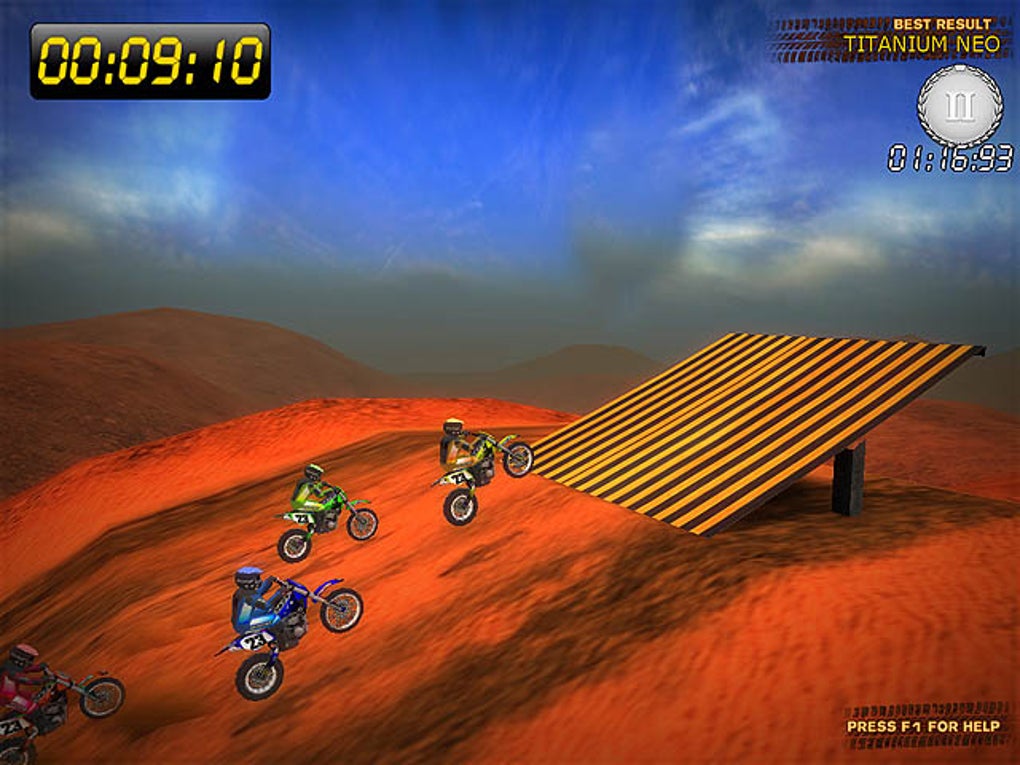
The camera angle further contributes to the game’s static feel. The view is almost isometric, fixed behind and slightly to the left of the player’s character. There is no option to change the camera perspective, meaning players are stuck with a perpetual over-the-shoulder view that limits immersion and situational awareness. While the camera does move up and down in sync with the bike navigating hills, preventing motion sickness, its fixed lateral position restricts the visual experience. In modern racing games, flexible camera options are standard, allowing players to choose between first-person, third-person chase cam, or even cockpit views. Desert Moto Racing’s rigid camera setup contributes to a detached feeling, making it harder to connect with the on-screen action or appreciate the supposed “high-definition graphics.”
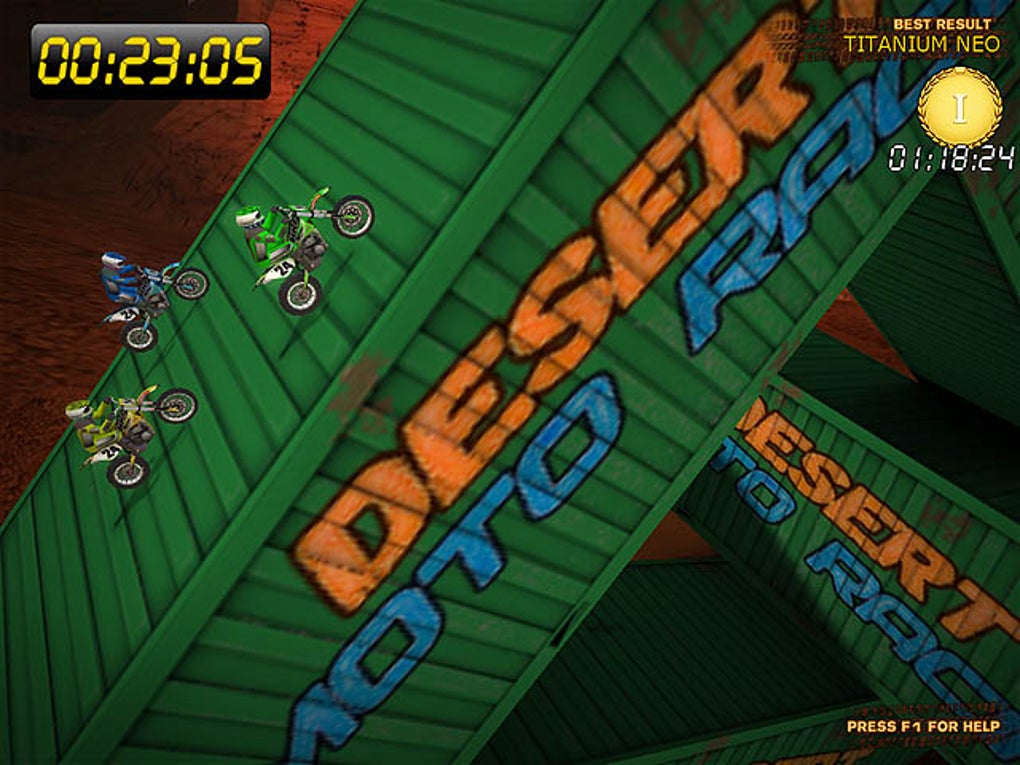
Track design in Desert Moto Racing follows a highly linear, almost rudimentary pattern. The tracks are invariably straight, devoid of complex turns or branching paths that might require skillful navigation. The primary challenge, if it can be called that, comes from timing your acceleration as you ascend and descend hills and makeshift ramps. These ramps are often depicted as stacks of empty shipping containers, a somewhat creative but ultimately repetitive visual element. The absence of diverse obstacles, varying terrains, or challenging cornering reduces the racing to a repetitive rhythm game rather than a test of racing prowess. Players simply hold the accelerator, release it momentarily before a jump, and then re-engage it upon landing, a cycle that quickly becomes monotonous.
The overall graphics and environment also leave much to be desired. While the game claims 3D graphics, the execution is basic. The background is bland and repetitive, offering little in the way of visual interest or dynamic elements. The desert environment, which could be a source of varied textures and distant vistas, appears static and sparsely detailed. The “road can be too brightly colored” is another critique, suggesting a lack of visual polish and perhaps even a garish aesthetic that detracts from immersion. Given its small file size and free nature, some graphical compromises are expected, but the degree to which Desert Moto Racing falls short in delivering an engaging visual experience is notable. The environment feels lifeless, with no ambient details or environmental interactions to make the race feel truly alive.
Modes of Play: Limited Horizons
Desert Moto Racing offers two primary game modes, both straightforward but ultimately limited in their ability to provide sustained entertainment. These modes are “Racing Contest” and “Ghost Race.”
The Racing Contest mode is the more traditional of the two. Here, players compete against AI opponents, vying for medals. The primary incentive for winning is the ability to unlock new tracks and additional motorbikes. This structured progression is a standard feature in many racing games, designed to provide a sense of accomplishment and encourage players to keep playing. However, the effectiveness of this system in Desert Moto Racing is hampered by the core gameplay issues. If the act of racing itself isn’t engaging due to simplified controls and linear tracks, the promise of new tracks and bikes loses much of its luster. Unlocking a new desert track that looks and plays almost identically to the previous one, with the same limited control scheme, doesn’t offer a significant refresh to the experience. The AI opponents also contribute to the blandness, often following predictable paths without demonstrating intelligent racing strategies, making victories feel less earned and more like a foregone conclusion based on perfect throttle timing.
The Ghost Race mode provides a different kind of challenge, focusing on self-improvement. In this mode, players race against a “ghost” of their best previous performance on a given track. The objective is to beat one’s own fastest time, pushing for incremental improvements. While this mode can be highly engaging in games with deep mechanics and intricate track designs, allowing for continuous refinement of racing lines and techniques, it falls flat in Desert Moto Racing. With only accelerator control and straight tracks, there’s little room for genuine skill development or nuanced strategy. The “best result” often boils down to executing perfect jump timings repeatedly, rather than mastering complex corners or tricky overtakes. Without the satisfaction of intricate gameplay, chasing a ghost simply highlights the repetitive nature of the game, rather than offering a rewarding, skill-based pursuit.
Beyond these two modes, there is “nothing much else after that,” as the original review succinctly puts it. The absence of multiplayer options (local or online), time trial leaderboards beyond personal bests, customizable bikes or riders (beyond unlocking new models), or alternative challenges (like stunt modes or specific objective races) severely limits the game’s replayability. Once a player has experienced the few tracks and unlocked the available bikes, the incentive to continue playing rapidly diminishes. This lack of variety means the game quickly exhausts its novelty, leaving players with a sense of superficiality rather than a desire for long-term engagement. For a game that aims for “action-packed gameplay” and “variety of gameplay features,” the reality of its limited modes paints a starkly different picture.
The Verdict: A Barren Landscape of Entertainment
Comparing Desert Moto Racing to other, more established and popular titles in the racing genre reveals a significant gap in quality and entertainment value. While the game does offer basic 3D graphics and a functional racing concept, its execution is profoundly underwhelming. The game doesn’t suffer from technical issues like frequent crashes or freezes, which is a commendable stability point for a free title. However, the core gameplay is so profoundly unengaging that players might almost wish for glitches just to introduce some unexpected variation to the monotonous experience.
The primary gameplay loop, stripped down to its bare essentials, transforms racing into a contest of throttle control rather than a comprehensive test of motocross skills. The absence of steering, braking, or advanced physics reduces the player’s role to a timing mechanism for acceleration over jumps. This oversimplification deprives the game of any strategic depth, real-time decision-making, or the adrenaline rush typically associated with off-road racing. The linear tracks, static environments, and limited game modes further compound this issue, creating an experience that quickly becomes repetitive and devoid of lasting appeal.
Pros:
- Linear tracks: For players seeking an extremely simple, straightforward experience without complex turns or navigation, the linear design might be appealing. It removes any need for steering, making it very accessible.
- Cool setup of ramps: The use of makeshift ramps, often depicted as stacks of shipping containers, offers a visually distinct, albeit repetitive, element to the jumps.
- Camera angle isn’t dizzying: While fixed, the camera maintains a stable, consistent view that prevents motion sickness, which can be a problem in some fast-paced, unoptimized racing games.
- Camera goes up and down with you: The camera’s basic vertical movement in response to hills and jumps provides a rudimentary sense of terrain interaction, aligning with the bike’s motion.
- Low file size: At around 25MB, it’s incredibly lightweight, making it quick to download and install, and suitable for systems with limited storage.
- Easy to play: Its minimal control scheme ensures virtually anyone can pick up and “play” almost instantly, though the depth of engagement is another matter.
- Security Status: Clean: As certified by PhanMemFree, the software is scanned across over 50 leading antivirus services and is deemed free from threats, which is a crucial aspect for any free download.
Cons:
- Bland gameplay: The biggest drawback is the fundamental lack of engagement. With only accelerator control and auto-steering, the gameplay feels more like an interactive screensaver than a true racing challenge.
- Road can be too brightly colored: A minor but noticeable graphical flaw, where the road textures can appear overly vibrant or garish, detracting from visual realism and immersion.
- Environment is too static: The desert background lacks dynamism, detail, and interactive elements, making the world feel lifeless and repetitive. There’s no sense of speed or scale from the surroundings.
- Game offers to change your homepage during setup: This is a significant negative. The inclusion of potentially unwanted bundled software or browser modifications during installation is an intrusive practice often associated with lower-quality free applications, eroding user trust.
- Limited game modes: With only Racing Contest and Ghost Race, the game quickly exhausts its content, offering very little in the way of replayability or varied challenges.
- Lack of advanced controls/physics: The absence of steering, braking, or realistic bike physics removes any sense of skill development or nuanced control typically found in the genre.
For those who actively dislike the complexity of manual bike control and prefer an extremely simplified, almost hands-off racing experience, Desert Moto Racing might briefly appeal as a mindless diversion. However, for the vast majority of players seeking even a modicum of excitement, challenge, or immersion in a racing game, this title falls far short.
PhanMemFree’s Recommendation:
Rather than wrestling with the simplistic throttle management of Desert Moto Racing, players are strongly advised to explore the plethora of superior alternatives available, even within the free-to-play segment. Titles such as Motoracing (rated 3.6/5, described as “Entertaining game about bikes and … kicks”), Super Moto Racers (rated 4/5, promising to “Become an Ace Motorcycle Racer”), and X-Moto (rated 4/5, a “2D motorcycle platform game”) offer more engaging gameplay, diverse challenges, and a more fulfilling experience. Other recommended alternatives like Super Motocross Deluxe (rated 4.1/5), City Moto Racer (rated 3.5/5), or even older but more refined games like MotoGP series or MTX MotoTrax (trial version) provide a significantly richer and more rewarding dive into the world of motorcycle racing. These alternatives, many also available for free or as trials on PhanMemFree.org, represent better investments of a player’s time and download bandwidth.
In conclusion, while Desert Moto Racing attempts to deliver a desert motocross experience, its execution is ultimately too shallow and repetitive to truly entertain. Its “easy to play” nature comes at the cost of genuine gameplay depth, making it a title that most racing enthusiasts will likely want to skip in favor of more robust and engaging options.
File Information
- License: “Free”
- Latest update: “February 4, 2025”
- Platform: “Windows”
- OS: “Windows XP”
- Language: “English”
- Downloads: “108.1K”
- Size: “25.19 MB”


